

Madison Township, one of the earliest four townships established in the county, covered nearly a quarter of the county’s area in its southwestern region. It was officially organized on May 4, 1835, and was named in honor of President James Madison.
The township saw its first settlers arriving from the east, venturing into the new and untamed lands, mostly from areas near the Missouri River to the north. Prior to 1830, few settlers ventured south of the Blackwater River. Among the earliest settlers were the Ferguson family, who were among the first to cross the Blackwater and settle in what is now Madison Township. Most of these early settlers established their homes north of the present-day Holden site, with a few settling west of that area, near the branches of Pin Oak Creek.
Notable early settlers included Samuel and Aaron Ferguson, James Bradley, William Davidson, Squire A. B. Hamilton, P. H. Ray, Archy Ray, High Ray, Moses Tapscott, August Demasters, Squire J. G. Doyle, Matthew Cummings, William Cummings, Sanford Cummings, Joseph Mason, John Windsor, Reuben Fox, John Utt, Thomas Tapscott, G. Hays, Joseph Christian, Jacob Sams, Jacob Beck, Charles S. Ferguson, Martin Ferguson, Pleasant R. Ferguson, Joseph Matthews, William Burden Sr. and Jr., Eldridge Burden, George Conley, John Miller, William Miller, James Thompson, George Medlock, G. Cunningham, Barrett Duff, Squire Thompson, G. K. Roberts, Doctor Roberts, and many others.
Until 1868, Madison Township retained its original boundaries, encompassing much of the present-day Kingsville and Rose Hill townships, as well as parts of Chilhowee. Early elections were held in the oldest settlement in the southwest part of the county in 1858, with numerous recognizable names appearing on the poll books from that year. Despite misspellings, many of these names are still familiar today, with descendants still residing in the area.
Only a handful of the original pioneers of Madison Township remain to recount the arduous journey of settling and developing this part of the county. Among them is Squire John A. Doak, now residing in Holden, who, at eighty-three years old, still retains remarkable vigor of both mind and body, vividly recalling the conditions of seventy-five years ago. He arrived in the area with his parents from Lafayette County in 1842, settling six miles south of present-day Holden, near Bear Creek. At that time, the city of Holden was merely a distant dream, and the nearest trading point was Lexington, forty-five miles away. Travelers traversed trails cutting across the land, ignoring section lines, and a journey to Lexington, undertaken about twice a year, demanded four days of travel.
Settlements clustered around the streams, where the timber provided essential resources for fuel, construction, and natural shelter. Though lacking in luxuries, the communities embraced a sense of comfort, with high standards of democracy and hospitality prevailing.
The earliest church in the township, Rock Spring Cumberland Presbyterian Church, stands as a testament to the enduring spirit of the settlers. Organized on May 21, 1835, by Rev. R. D. Morrow, it was initially known as the New Hope congregation before adopting the name Rock Spring in 1843. Serving as the communal place of worship for the neighborhood, it bore witness to the trials and triumphs of the community long before the Civil War.
Major Nathaniel B. Holden
Maj. N. B. Holden played a significant role in the early affairs of Johnson County. He served in the Legislature and was instrumental in bringing the Pacific Railroad through the county, contributing to the growth and development of Holden. In 1857, anticipating the railroad’s path, Warrensburg resident Col. Benjamin Grover laid out a plat to the east of Holden Street. Grover wisely secured an agreement with the Pacific Railroad, donating 40 acres for a depot, water tower, and freight building.
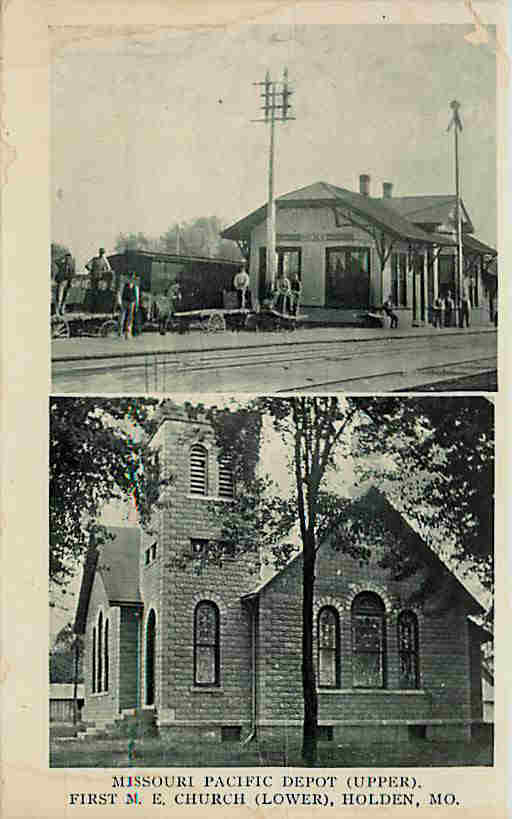
However, due to a mistake or other circumstances, the depot was constructed in 1865 on land owned by N.B. Holden, west of Grover’s property. Only one image of the original station remains, depicting a simple one-story structure with a gabled roof and vertical wood siding. The south elevation featured a raised loading dock for efficient movement of cargo between boxcars and the freight room. Sadly, the station met its end in February 1889 when it succumbed to flames, leading to its replacement by the present station.
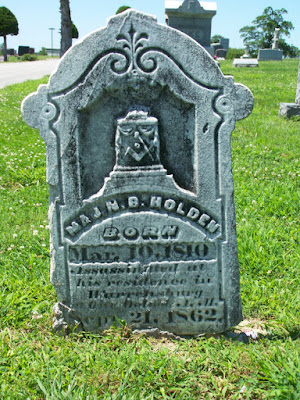
Assassinated at his home just outside Warrensburg by four unidentified horsemen on September 21, 1862, the victim’s final resting place is at Sunset Hills Cemetery. Holden Street in Warrensburg is named in honor of Holden, Missouri’s namesake. This information is sourced from an old Johnson County Missouri Historical Society newsletter.
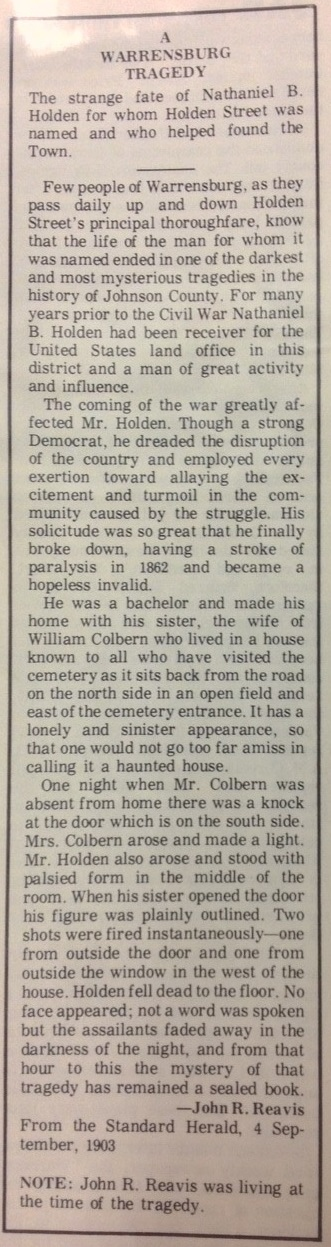
A WARRENSBURG TRAGEDY
The strange fate of Nathaniel B. Holden for whom Holden Street was named and who helped found the Town.
Few people of Warrensburg, as they pass daily up and down Holden Street’s principal thoroughfare know that the life of the man for whom it was named ended in one of the darkest and most mysterious tragedies in the history of Johnson County. For many years prior to the Civil War Nathaniel B. Holden had been receiver for the United States land office in this district and a man of great activity and influence. The coming of the war greatly affected Mr. Holden. Though a strong Democrat, he dreaded the disruption of the country and employed every exertion toward allaying the excitement and turmoil in the community caused by the struggle. His solicitude was so great that he finally broke down, having a stroke of paralysis in 1862 and became a hopeless invalid. He was a bachelor and made his home with his sister, the wife of William Colbern who lived in a house known to all who have visited the cemetery as it sits back from the road on the north side in an open field and east of the cemetery entrance. It has a lonely and sinister appearance, so that one would not go too far amiss in calling it a haunted house. One night when Mr. Colbern was absent from home there was a knock at the door which is on the south side. Mrs. Colbern arose and made a light. Mr. Holden also arose and stood with palsied form in the middle of the room. When his sister opened the door his figure was plainly outlined. Two shots were fired instantaneously—one from outside the door and one from outside the window in the west of the house. Holden fell dead to the floor. No face appeared, not a word was spoken but the assailants faded away in the darkness of the night, and from that hour to this the mystery of that tragedy has remained a sealed book.
—John R. Reads, From the Standard Herald. 4 September, 1903
NOTE: John R. Reavis was living at the time of the tragedy.
M.L. Golladay
The notable accomplishments of M. L. Golladay, a prominent figure in Holden, Missouri, position him among the foremost leaders in Johnson County’s industrial and business sectors. His successful endeavors as an organizer have greatly contributed to the development of his hometown and county.
Despite his relatively young age, Mr. Golladay has made significant strides in the commercial realm, showcasing his exceptional capabilities. Born on September 9, 1870, in Holden, Missouri, he is the son of David and Maria Golladay. David, a native of Preble County, Ohio, was a druggist who relocated to Johnson County in 1868, where he established Holden’s first drug store.
M. L. Golladay’s achievements as a druggist and entrepreneur highlight his dedication to enhancing the prosperity of Holden and Johnson County. His success serves as a testament to his talents and vision for the community’s growth.
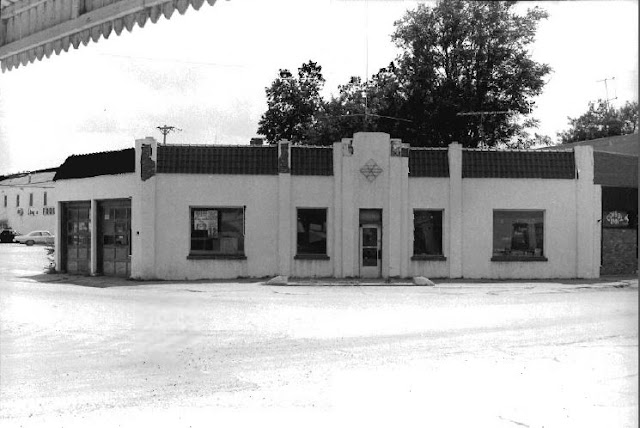
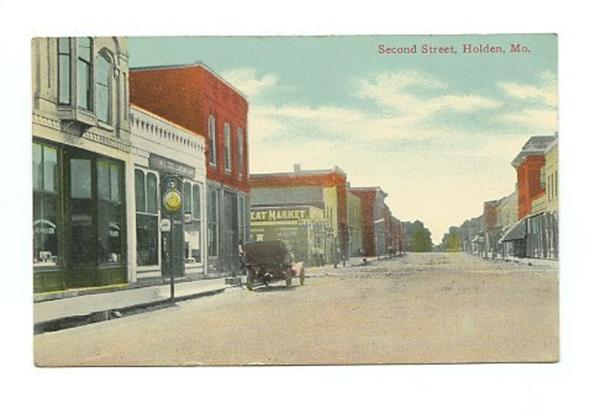
The front of this uniquely shaped building is cut off at an angle. This corner spot has a long history tied to transportation-related activities. From around 1880 to 1910, it housed a livery stable, a sale barn, and a carriage house. Later, around 1914, Rankin’s Garage occupied this corner.
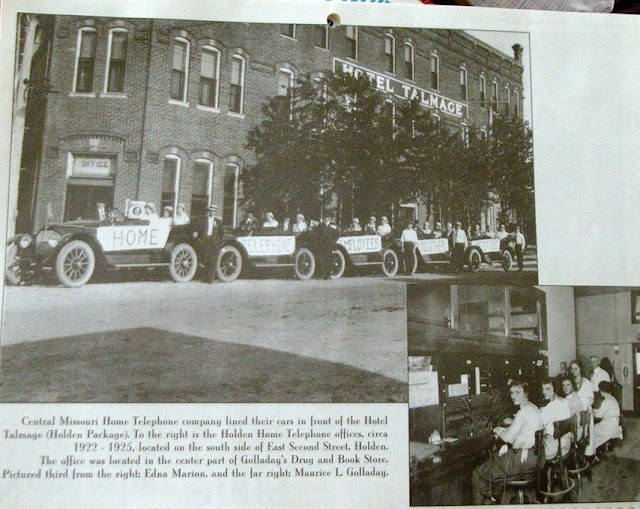
The current building served as an automobile dealership for many years under the ownership of M. L. Golladay, who was not only a druggist in Holden but also engaged in various other ventures. Golladay owned and operated Golladay’s Drug and Book Store at 103 E. 2nd St., organized the Holden Home Telephone Co., and established the Holden Steam Laundry. The building also accommodated a gasoline pump island and a drive-through accessible from 2nd Street.
Mr. Golladay was among the earliest entrepreneurs to establish roots in Holden, playing a pivotal role in the town’s development during his extensive residency. His father, a respected figure in local affairs, served as city treasurer and built a thriving business, laying the groundwork for the family’s prosperity. His passing in 1899 was deeply mourned by the community.

Mrs. Maria Golladay, a woman of remarkable abilities and strong character, left a lasting impact on Holden and beyond until her passing in 1916. A dedicated educator and advocate for temperance, she held prominent roles in various organizations and spearheaded moral uplift initiatives.
M. L. Golladay received his education in Holden’s public schools and Wentworth Military Academy. Immersed in the drug business from a young age, he eventually took over his father’s enterprise, Golladay’s Drug & Book Store, which remains Johnson County’s oldest business of its kind. Despite his diverse interests, including ownership of Hillcroft Farms known for its livestock, Mr. Golladay continued to prioritize community service, notably organizing the Holden Home (Central Missouri) Telephone Company in 1901.
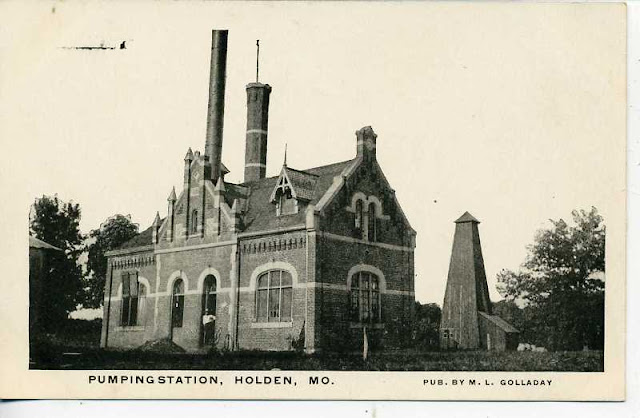
Johnson County Historical Society and State of Missouri Digital Newspaper Archives
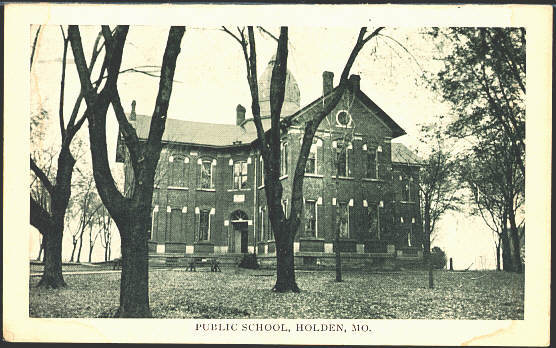
1894
One of the earliest educational institutions in the area was Round Grove School, which dates back to before the Civil War. Across three generations of a single family, students have graced its halls, with one of them now serving as its teacher. Catherine Hayes, daughter of Mr. and Mrs. Hayes, received her education there under the tutelage of Thomas Murray. Following in her footsteps, her daughter Ada, who later married John F. Baker, a prominent stockman from Holden, attended the school, initially taught by John Morrin. Continuing the family tradition, Ada’s daughter, Catherine Baker, received her education at Round Grove School under the guidance of Charles Gauss and now stands as its dedicated teacher. Originally constructed from logs, the school was situated a mile west of its current location before being relocated after the Civil War.
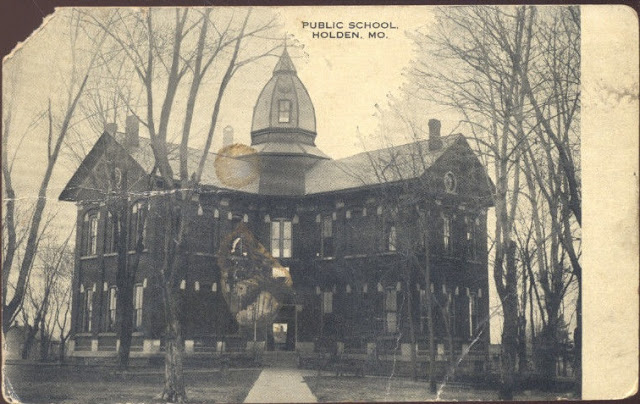


1896
🚂 Holden, Missouri: Born of Rails and Resilience
In the wide-open prairie of Missouri, where the grass waved in the breeze and the horizon stretched forever, a bold man named Isaac Jacobs saw opportunity. In 1857, he bought 160 acres of raw land for just 12½ cents an acre — a bargain struck with the United States Government, and a bet on the future. That future? Railroads.
Jacobs had his eye on the ambitious Union Pacific Railroad project that aimed to unite the East and West Coasts. By 1858, he was already petitioning the State of Missouri to build a rail depot in a humble settlement that would soon become known as Holden.
With iron rails on the horizon, excitement buzzed. Thirty city lots sold for $25 each, stoking dreams of trains, travelers, and a booming new hub. Holden was officially founded in 1858, just as the first stages of the St. Louis to Kansas City corridor were being laid.
But just as momentum picked up—BOOM!—the Civil War crashed into the scene.
⚔️ War on the Rails
In 1864, the infamous General Sterling Price of the Confederate Army swept through Missouri, tearing up tracks and torching bridges. His raiders left destruction in their wake. The fledgling town of Holden, full of promise, was stripped bare. Rail work halted. The population plummeted to around 100 souls, and most of the town’s structures were either burned or abandoned.
🛠️ Rebuilding the Dream
When the war ended, Holden dusted itself off and got back to work. The railroad dream was not dead — it was just delayed. And once the tracks started rolling through town again, so did prosperity.
Holden became a powerhouse of rail operations. A small army of over 100 railroad Section Hands kept the rails and bridges humming across 500 miles of Missouri, from St. Louis to Kansas City. Machine shops buzzed, water towers rose, and piles of coal and lumber fed the relentless steel beast of the railroad.
Thanks to coal mining, local timber, and pure grit, Holden transformed into a critical hub of the expanding Midwest railway.
🚉 All Tracks Lead to Holden
In the 1870s, a generous $70,000 gift — likely raised by enterprising local merchants and farmers — helped extend a new rail line from Paola, Kansas to Holden. This turned the town into a vital turnaround point with a full Roundhouse, sending trains back west with fresh crews and cargo.
By the 1880s, the MK&T Railroad expanded again, linking Holden southwest to Windsor, Missouri, creating a seamless East-West connection. Holden wasn’t just on the map — it was shaping the map.
🍽️ Holden: Pit Stop to the Nation
Back before dining cars and refrigerated freight, Holden rose to the occasion. Every train — eastbound or westbound — stopped in Holden. Hungry passengers disembarked to enjoy a warm meal at one of the local eateries.
The Talmage House Hotel, perfectly nestled between the Missouri Pacific and MK&T tracks, served up hearty meals in its spacious dining room. Another restaurant — now the site of the Holden Image newspaper — fed scores of travelers daily. The town’s icehouse kept perishables chilled, playing a crucial role in the railroad’s early freight system.
🏭 From Prairie to Powerhouse
Holden thrived. The town grew with each passing train. Switch tracks, grain elevators, mills, meat packers, and stockyards popped up, supporting a community of workers, families, and dreamers. With the clang of iron and the hiss of steam, Holden became a bustling industrial and commercial center in the heart of Missouri.
So next time you hear the distant whistle of a train, think of Holden — the little prairie town that refused to quit, forged in fire, and powered by steam.
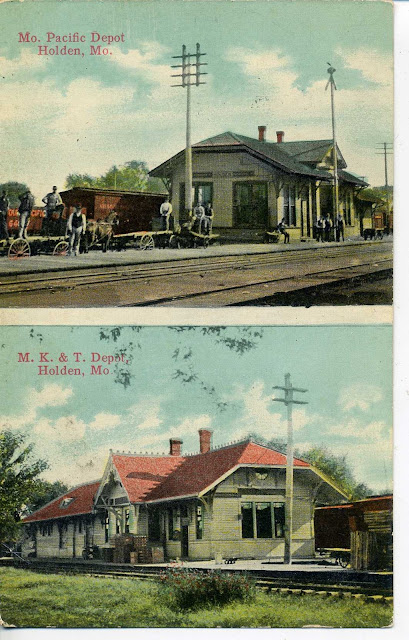
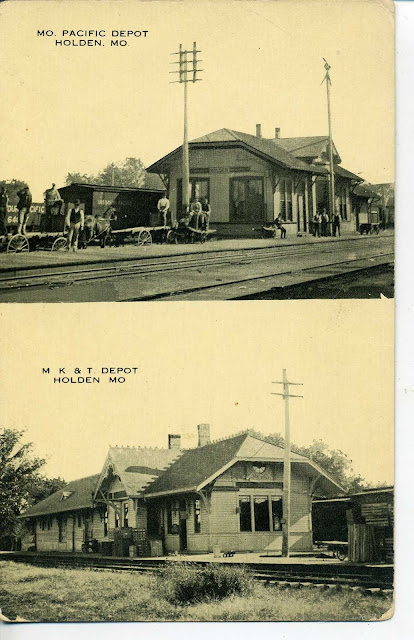
The St. Louis & Santa Fe Railroad was the second railway to be established in Johnson County. Its route stretched from Holden in the southwest, traversing portions of Madison, Kingsville, and Rose Hill townships, and extending through Harrisonville to Paola, Kansas. Established in 1870, the railway initially operated under the Missouri Pacific before eventually becoming integrated into the M. K. & T. network.
Civil War reaches Holden
August 2-8, 1864: Civil War engagements occurred near Holden, Missouri, including a skirmish on August 8th at Norris Creek. Captain Melville U. Foster of the Seventh Missouri State Militia Cavalry reported that on August 6th, Corporal Skidmore and twenty men from Company G journeyed to Lost Creek and back, covering a distance of twenty miles. On August 8th, Lieutenant Combs, accompanied by a forage train, encountered a group of bushwhackers at Norris Creek, resulting in a skirmish during which one horse sustained minor injuries.
August 11-19, 1864: Further Civil War activities took place in Johnson County, Missouri, including a skirmish near Holden on August 12th. Captain Foster reported that on August 16th, he led Lieutenant Marr and thirty men to Norris Creek, where they found no one, before proceeding to Honey Creek and dispersing three bushwhackers from their huts. They returned on the 19th, covering a total of seventy miles. Meanwhile, Captain Baker and Lieutenant Combs, with thirty men, patrolled Panther and Walnut Creeks, traveling thirty miles. On August 17th, Lieutenant Pharis led twenty-five men in pursuit of the gang responsible for burning the stagecoach but could not locate them, covering a distance of forty miles.
August 22-30, 1864: Operations extended into La Fayette County, Missouri. Captain Foster reported that on August 22nd, he arrested the families of Durrett, Stoner, Cowarden, and Scott for providing assistance to bushwhackers, covering thirty miles in the process. On August 24th, Lieutenants Pharis and Marr escorted prisoners to Warrensburg and returned, traveling thirty miles. The same day, Lieutenant Combs escorted Paymaster Mears to Chapel Hill, Missouri, covering thirty miles. On August 26th, thirty-five men under Captain Foster’s command, responding to a telegram from district headquarters, cooperated with Captain Queen from Warrensburg, driving Walnut Creek and engaging three bushwhackers, although no one was captured.
 Johnson County (MO) Historical Society
You must be logged in to post a comment.