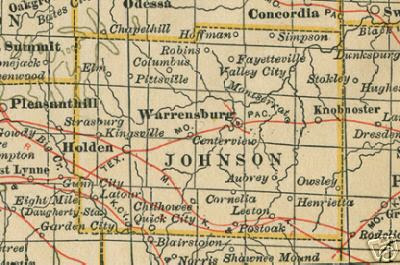
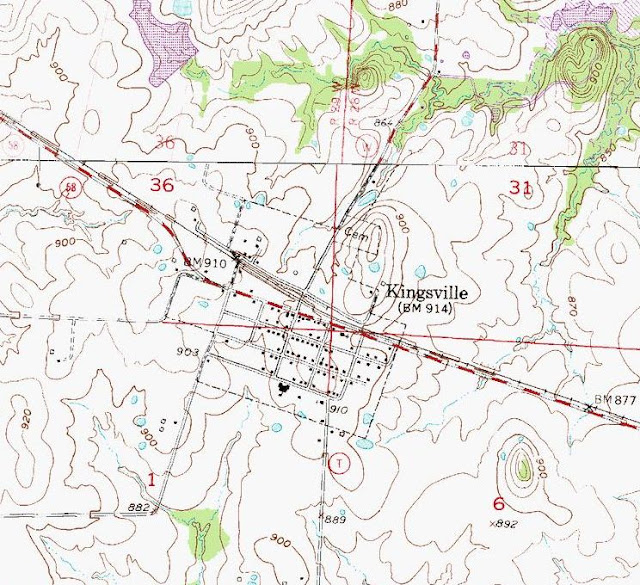
A town and post office on the Missouri Pacific Railroad in the eastern part of Kingsville Township.
| Kingsville Township | |
| Description: | In the western part of the county, organized out of Madison Township in 1870, and named for the town. (HIST. JOHNSON 1881 |
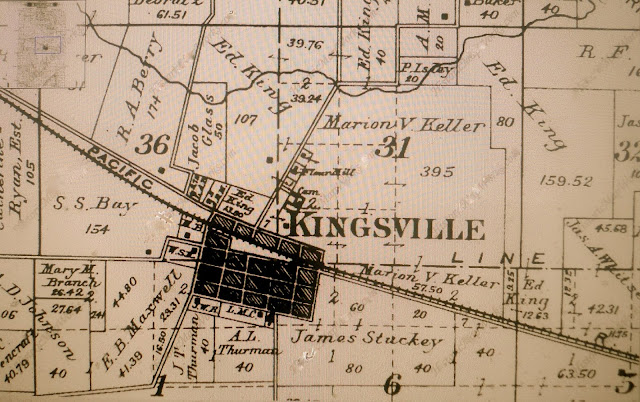
It was laid out in 1856 by General William King (1824-1859) and named after him. Mr. King had come from Alabama in 1852. In 1865, on account of the strict southern principles of the King family, bitter feeling was aroused leading to the burning in effigy of General King and the attempted change of name of Ramey. The new name, however, was never officially adopted, and just as soon as the Democrats had influence in Congress the name of Kingsville was resumed.
University of Colombia and Mo. State Historical Society
KINGSVILLE TOWNSHIP.
Kingsville township was organized May 12, 1870, after the railroad had been built. It took its name from Kingsville village, which was named for Gen. William King, who laid out the town in 1856.
Early Settlements.-It is said that Judge Anderson Smith, son of William Smith, the second sheriff of this county, was the first settler in Kingsville township. He located at Bluff Spring and built the first house there. This was probably about 1835 or 1836. In 1836, he sold to Benjamin Longacre, who soon put up a tanyard and tanned skins for the settlers for a radius of fifty miles. Henry Colbern, the first saddler of Warrensburg, grandfather of John R. Colbern, the stock man, came here for his supplies. He also built the first mill in the township, which was probably in 1837. Prior to that time the pioneers beat their corn in a mortar. A son of Benjamin Longacre, Joseph D., from Tennessee, was also an early settler in this township, coming about 1839. He was a soldier in the Mexican War and also served in the Confederate army during the Civil War. He and Joe Howard were noted wolf hunters and frequently hunted together. The first settlement on Pleasant Run, or Duncan’s branch, was also in 1839. P. W. Paul settled here prior to 1840. Samuel Boljack was an early settler and in 1844 bought the Longacre mill. At first this grist-mill was a two-horse mill of the old fashioned sweep lever type. Later it was converted into a two-horse tread mill and operated by Joe Howard. This was considered a model modern mill.
Benjamin F. Lewis settled here in 1853. Dr. William G. King came here in 1851. He was born in Independence, Missouri, December 28, 1831. Prominent among other early settlers of the township were Hon. W. F. Ralston, Hon. R. T. Fryer, Josiah Smith and John R. French.
First Postoffice.-The first postoffice was Bluff Spring and Benjamin Longacre was the first postmaster. He was succeeded by Samuel Boljack. In 1856, the postoffice was changed to Kingsville.
In 1860, Dr. W. H. Carpenter built a distillery and carding machine, which he operated about a year. It was later destroyed by fire.
Early Churches.-The first religious denomination to hold services in this township was the Methodists. Reverend Lee preached the first sermon at the residence of Benjamin Longacre. Soon after this a regular Methodist organization was effected here, which continued until the Civil War broke out. Rev. Daniel K. Pell was in charge of the circuit in 1844, and it was at that time that the vote was taken for the division of the North and South branches of the Methodist church. The congregation at first voted against the division, but they were all Southern people and upon reconsideration voted in favor of the division, and the church was named Bluff Spring Methodist Episcopal Church, South. Some of the early ministers in charge of this circuit prior to the time of the division in 1844, were Reverends Lee, Martin Paul, W. Ferrell, McKinney, Thomas Wallace, B. F. Love, George W. Love, Maj. Jonathan Fine, Samuel Colbern, Pratt, George W. Bewley, Daniel Leaper, Ashby and Daniel K. Pell. Rev. Jesse Greene was the first presiding elder of this district. The ministers after the division were, Revs. Robert Foster and Warren M. Pitts. There was no church building; ever erected here. The other early churches were in the town of Kingsville, and are given in the history of the town.
Early Cemeteries.-The oldest cemetery in the township is perhaps what is known as Hopper cemetery, located on section 3 in the western part of the township. It was the private cemetery of the families of William Hopper, Houston Helms and Thomas Savage, early settlers here. A blind man, who was accidentally killed, was the first to be buried here.
Major’s cemetery is an old burial ground supposed to have been laid out in 1837 and was used as early as 1840 as a public cemetery. One of the Major family was one of the first to be interred here. It is located on East fork of Lost creek in section 13.
Bluff Spring cemetery is also an old burial ground and was laid out by Benjamin Longacre in 1837. It is in section 25, on the ridge dividing the Osage and Missouri water sheds.
Duncan cemetery is located in section 14. The first burial here was that of Gideon Cunningham. In 1841 a man named Savage was buried here.
Hornsby cemetery, in section 15, is a family burial ground and the first to be interred here was Mrs. Esther Hornsby, the aunt of J. N. Ferguson, old county surveyor, in 1845.
There are numerous other private burial grounds and many lone graves in various parts of the township, the exact location of many of which is unknown.
Early Schools.-The first schools of Kingsville township were located at what was known as Lost creek and Bluff Spring. Hackney school house, an old log cabin which stood near Bluff Spring, was said to be the oldest school house in the township. The second school house to be built in the township was also a log structure known as Hornsby school house and stood in the southwestern part of*the township.
Early Teachers.-Some of the teachers who taught in these log school houses were Alfred Hawker, James Allen, William W. Sparks, Joseph Y. Alexander, J. N. Ferguson, A. J. Longacre, Hugh Wallace, Ben Howell and R. G. Stokley. Later teachers were, William T. Johnson, Thomas McKee, Maggie Duncan, J. K. P. Howe, R. T. Fryer, P. L. Hyer, Stanley T. Rogers. James A. Wright, T. A. Reavis, Maggie A. Totten, Dora Douthit, C. H. Hartzell, T. N. Haynes, F. E. Meigs, William L. Nelson.
Justices.-The justices of the peace of Kingsville township as far back as the county records show are: 1870, George Monroe, James Morrow; 1878, C. W. Moss, T. A. Conrad; 1880, John S. Jones; 1882, G. G. Valentine, J. R. White; 1886, G. G. Valentine, J. B. Lampkin; 1890, J. B. Lampkin, Joseph Hobbs; 1894, J. B. Lampkin, P. J. Burnett; 1898, W. B. Wallace, W. H. Zion; 1902, W. H. Ragsdale, W. H. Zion; 1904, Jacob Hobbs; 1906, Jacob Hobbs, A. L. Garvin; 1910, Jacob Hobbs, Charles H. Horsley; 1912, D. M. Connell; 1914, E. B. Maxwell, R. A. Berry.
County Officers.-The county officers of Kingsville township, as shown in the county records, since 1882, are as follow:
1882-84-86-R. T. Fryer (Democrat), presiding judge.
1890-W. P. Gibson (Democrat), presiding judge.
1894-George G. Valentine (Democrat), county clerk.
1896-98-John B. Lampkin (Democrat), treasurer.
County Road Improvements.-County road improvements made by Kingsville township since this system was established in 1911 were, up to January 1, 1918, twelve in number, and aggregated $633.75 furnished by citizens of the township, and $625 furnished by the county.
Organizations.-The following is a complete list of all organizations of every kind in Kingsville township. Full details of each organization are in separate chapters on the different organizations.
Churches-Baptist, Kingsville; Christian, Kingsville; Methodist, Wesley Chapel; Seventh Day Adventists.
Fraternal Organizations-Masons, Blue Lodge; Odd Fellows, Modern Woodmen, Eastern Star.
1917 War Organizations-Red Cross, Kingsville Branch.
Business-Bank of Kingsville.
Miscellaneous-Valley View Grange. Women’s Christian Temperance Union, Kingsville; Women’s Christian Temperance Union, Duncan; Homemakers Club, Duncan.
Total number of organizations in township is fourteen.
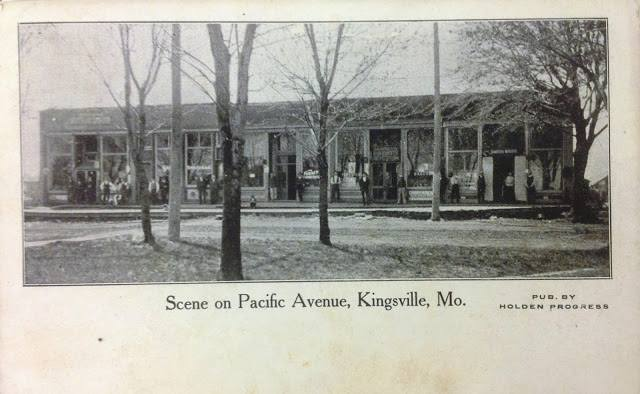
KINGSVILLE.
Kingsville was laid out in 1856 by General William King, from whom it takes its name. General King built the first house here in 1853 and Samuel Bolejack built a residence here shortly afterward.
A postoffice was established here in 1856 and Samuel Bolejack was the first postmaster, continuing to serve in that capacity until the Civil War broke out in 1861. The postoffice was discontinued for a time during the Civil War but was reestablished in July, 1865 about the time the Missouri Pacific railroad was built to this point.
Some of the early physicians who practiced in Kingsville and vicinity were Dr. James S. Fulkerson, Dr. H. W. King, Dr. W. G. King, Dr. B. King, Dr. W. H. Carpenter, Dr. T. A. Reed, Dr. J. A Houston, Dr. H. D. Douthit and Dr. W. D. Pinkston.
J. N. Ferguson taught a subscription school here in the winter of 1859-60 and a Mr. Belmont conducted a subscription school some time prior to that. Martha Givens and W. H. Duncan also taught school here prior to the Civil War. School was suspended most of the time during the war as Kingsville and vicinity suffered much from devastation during that period. Among some of the early day teachers of Kingsville who were identified with the schools after the war were W. P. Baker, Henry Harmon, J. Kline, J. Johnson, Rev. Isaac N. Newman, Maggie M. McCarty, Abagail Whitson, Rev. R. G. Thompson, William P. Hunt, George G. Valentine, Dora Douthit, A. C. Jones, Mollie Johnson, Maggie Duncan, Lizzie Hamshaw, Carrie Maynard, Mrs. Mattie George, Addie Johnson, Laura A. Glasse, George B. Longan, Mrs. Emma Longan, F. E. Meigs, John Moran, Sally King, J. D. King, Mrs. Adelia S. Boswell, and A. J. Sparks. At the organization of the Kingsville school district in 1868 the first board of directors consisted of the following: A. G. French, Jacob Glasse, James Robinson, A. J. Buchanan, John Hickman, and J. S. Jones.
Kingsville cemetery is located on Chair Knob, near the village and was laid out in 1856 by General William King. He was buried here July 26, 1870. There is also another cemetery in the vicinity of Kingsville which was formerly known as the People’s Public cemetery. The , Catholic church also has a cemetery here which is located on the western slope of. Chair Knob. This property was purchased and first used for a cemetery in 1881.
Kingsville to-day has a bank, high school and stores representing the chief lines of business.
Its population in 1910 was 238.
It was incorporated May 27, 1885.
“History of Johnson County, Missouri” by Ewing Cockrell, 1918
Transcribed by Karen Hammer -2009
Johnson County, Missouri Genealogy Trails
© 2006 – 2008 by Genealogy Trails – All Rights Reserved – With full rights reserved for original submitters.
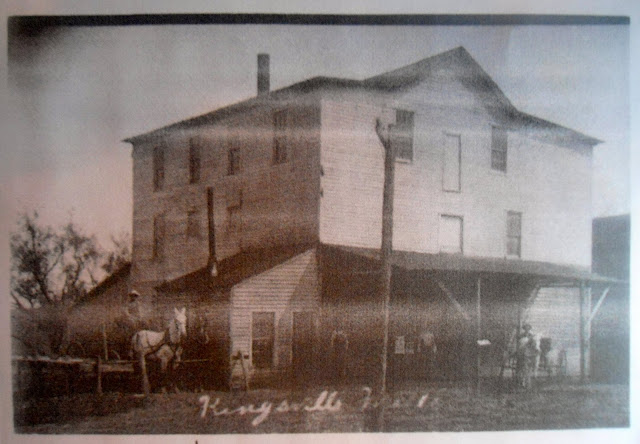
Kingsville Mill around 1888
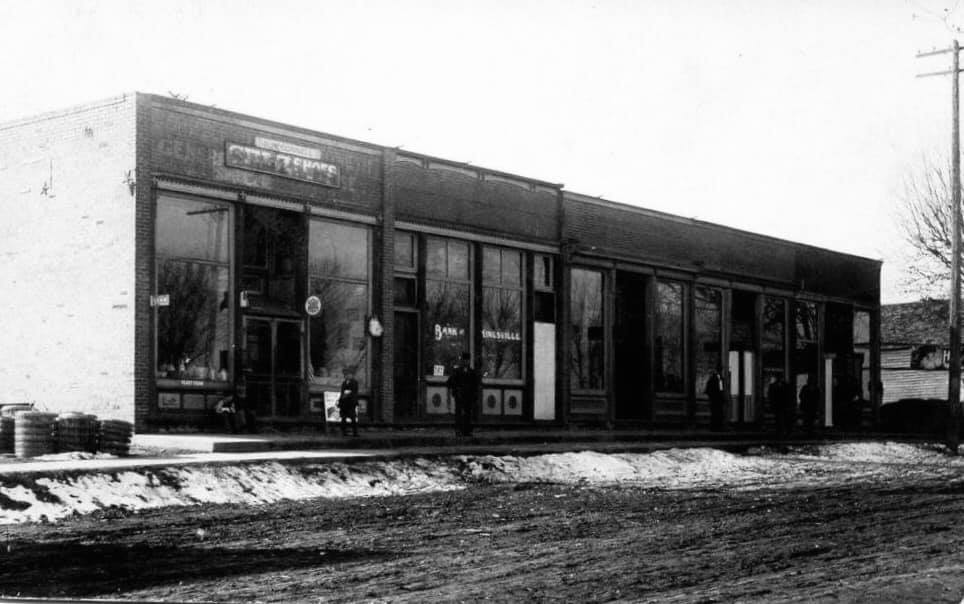
Kingsville
Williams General Store
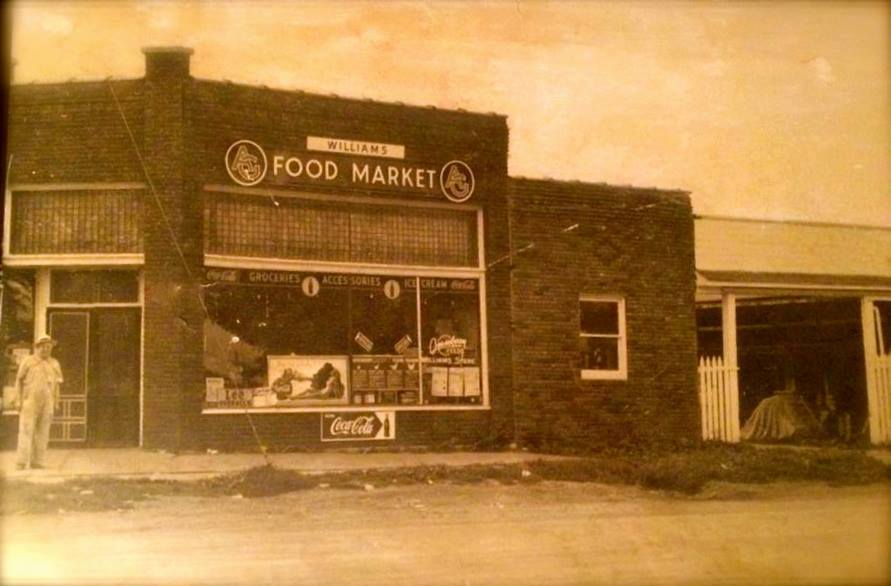
 Johnson County (MO) Historical Society
You must be logged in to post a comment.