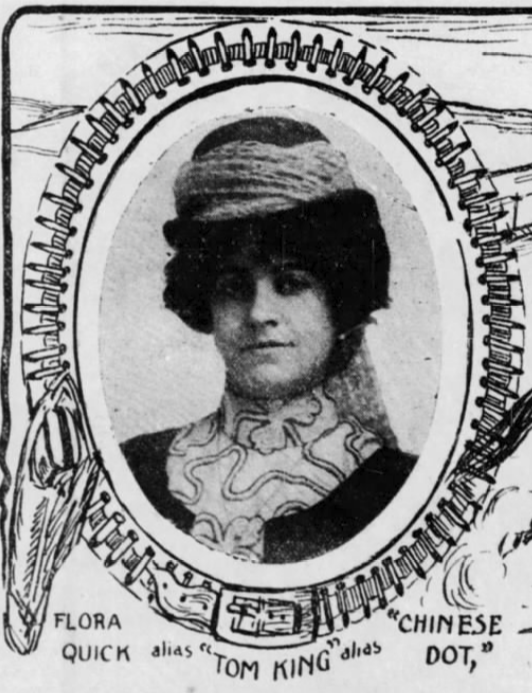
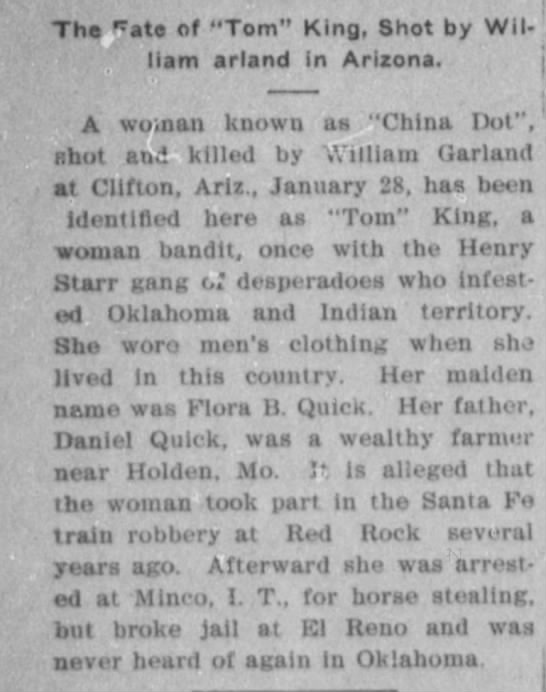
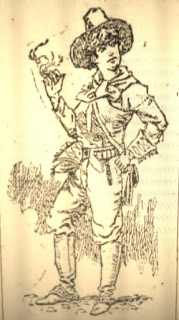
Flora was the daughter of a wealthy Johnson County landowner, the namesake of Quick City. A widower, her father enrolled her in etiquette school for girls in Holden Missouri in wich she dropped out against her father’s wishes. Her father later passed away when she was fifteen, leaving her orphaned with an estate of 2,300 acres and $13,000 in cash. Shortly after, she married a man named Ora Mundis, notorious for hell raising and whose primary interest was her inheritance. However, when the money was gone, so was he. Left to survive on her own, Flo turned to prostitution, adopted men’s clothing, began stealing horses, and took on the alias “Tom King.” She soon formed a partnership with Jessie Whitewings, also known as Ed Bullock, a woman with similar inclinations. Together, they opened a brothel in Guthrie, where they exchanged their services for both money and horses.
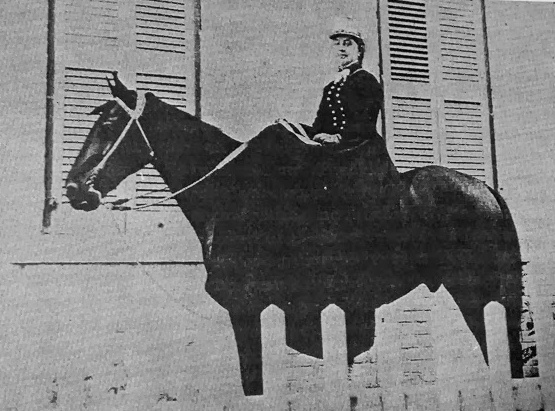
Despite the exaggerated stories of murder and train robbery, Flo’s criminal activities appear to have been limited to horse theft—though she had a keen eye for quality, stealing only the finest horses.
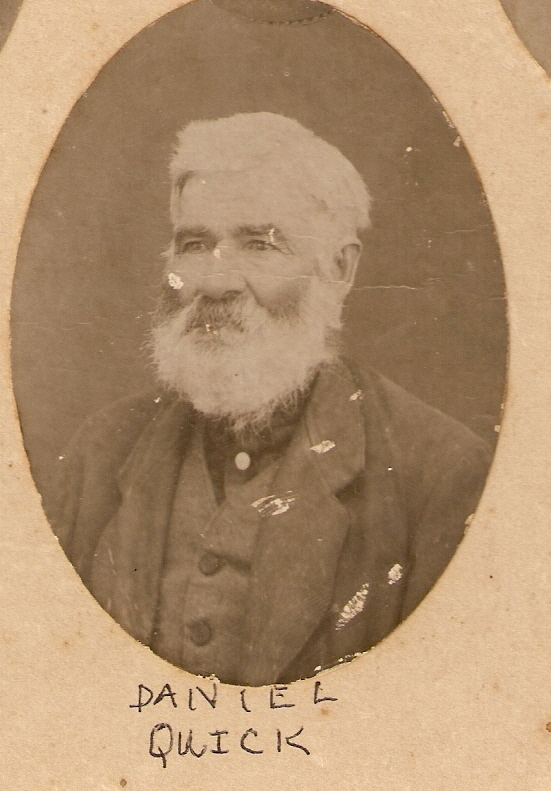
Daniel Quick, father to his favorite daughter Flora Quick. Now buried in Quick City Cemetery in Johnson County, Missouri
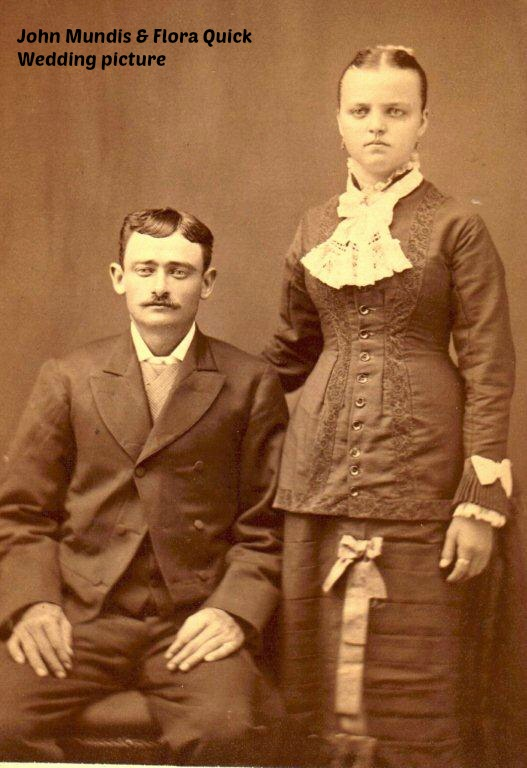
Her first documented encounter with the law was reported in a Guthrie newspaper, which described her sitting in an Oklahoma City jail, dressed in men’s clothing, on a charge of horse theft. While incarcerated, she befriended train robber Ernie Lewis and convicted rapist Billy Roach. Using her charm, she seduced the jail guard, locked him in a cell, and freed her new accomplices. At the time, the eighteen-year-old was described as standing just 4’8” and weighing approximately 130 pounds.
Though Flo was quickly recaptured and returned to jail, she soon escaped, only to be caught and imprisoned again—then broke out the very next day. One newspaper account claimed she eloped with a deputy sheriff, while another suggested she was pregnant and released due to her “delicate condition.”
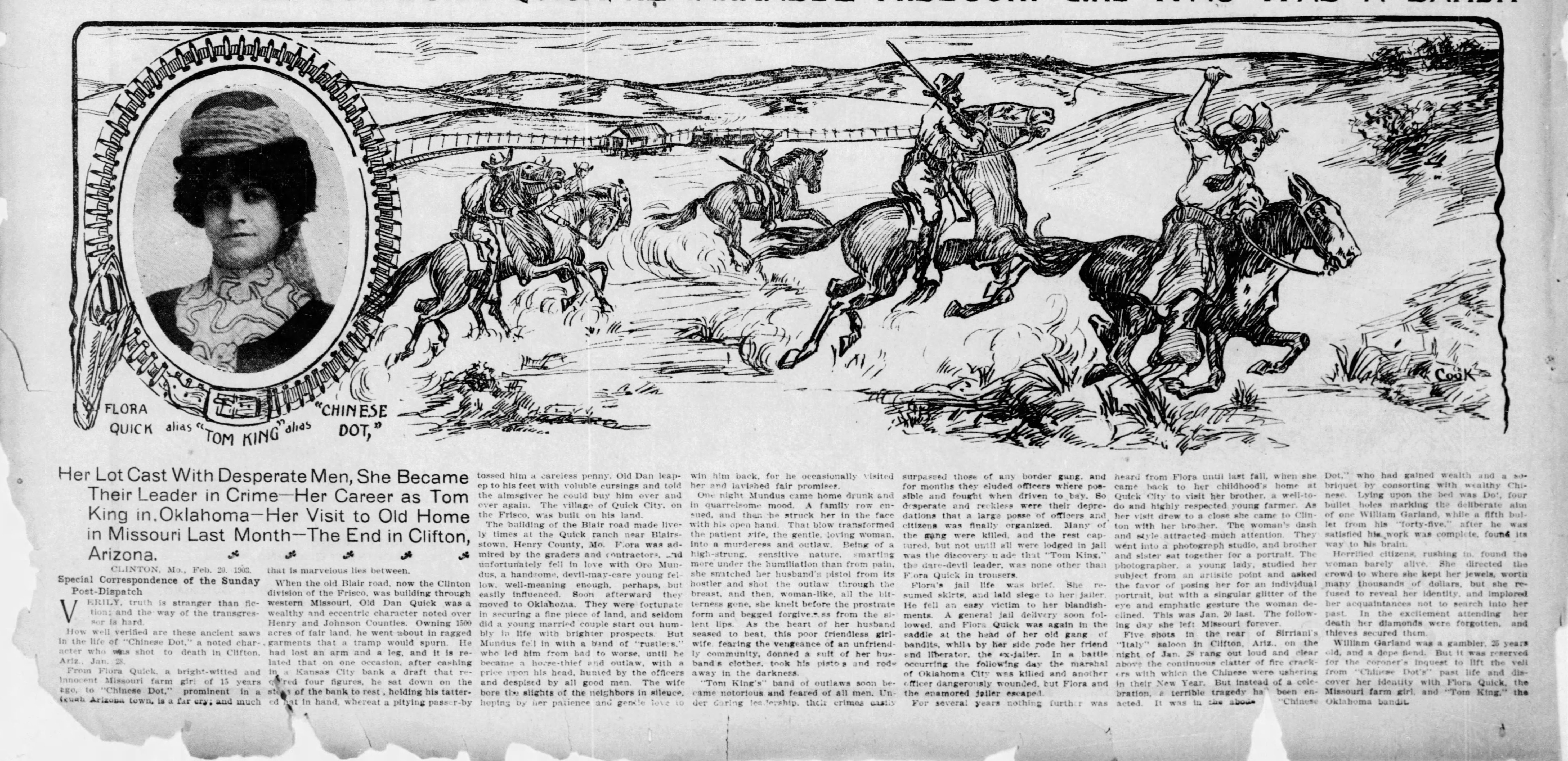
Eventually, Flo made her way west to Arizona, settling in the rough mining town of Clifton. There, she became involved with a Chinese man and adopted the name “China Dot.” After growing tired of the relationship, she left him for a man named Bill Garland. In late January 1903, the two were under the influence of opium when an argument turned deadly—Garland shot her four times before taking his own life.
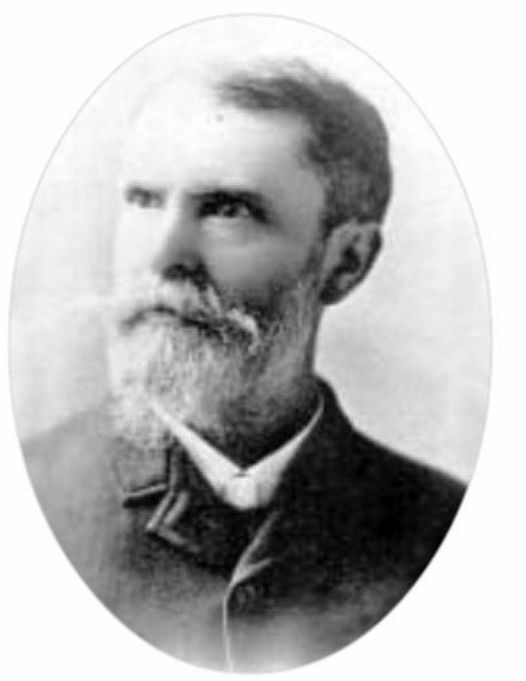
https://www.findagrave.com/memorial/132509902/flora_may-mundis
Mathematical Marvel
from Kentucky to
Missouri
Reuben “Rube” Field
researched and written by Joyce Dorrell.
Credit to Johnson County Missouri Archives, The State of Missouri Historical Society Digital Archives, Star Journal, Daily Democrat, St. Louis Republican and The Kansas City Star
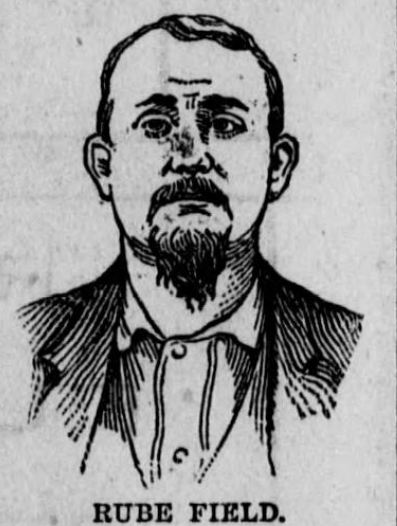
Bath County, KY – In the mid-19th century, a remote corner of Kentucky gave rise to one of the most astonishing and unconventional minds in American history. Reuben Field, born April 17, 1851 (or possibly 1852), in the now-vanished town of Pittsburgh along White Oak Creek, defied every expectation society had of intelligence and achievement. Despite being illiterate and widely considered uncouth, Field emerged as a mathematical prodigy whose uncanny mental abilities left experts and laypeople alike astounded.
The son of blacksmith Skidmore Field and his wife, Harriet Elizabeth Templeman Field, Reuben grew up alongside three sisters—Louisa, Elizabeth, and Mary Franklin. Early in life, Reuben showed signs that he was anything but ordinary. With a voracious appetite that bordered on legendary, neighbors recalled him devouring beans from barrels meant for livestock and draining an entire acre of sugar cane of its juice in a single sitting. His fondness for alcohol reportedly began in boyhood, long before he reached legal drinking age.
Unruly and unteachable, Field spurned formal education. He rarely attended school, and when he did, he terrorized classmates with frogs, snakes, and dangerous stunts involving frightened horses. He would later boast that schooling would have made him “as big a fool as other people.”
Physically, Reuben Field cut an eccentric figure. Barely over five feet tall and weighing around 200 pounds, he had a large head, small crossed eyes, and a scraggly beard. He was known for smearing grease on his face from a jar he carried with him. One obituary described him bluntly as “an overgrown country lout with boorish manners and silly mind.”
But beneath the crude exterior was a mind capable of extraordinary feats of calculation. Around the age of eight, Field began astonishing neighbors with his ability to solve arithmetic problems mentally. What began as simple math soon evolved into more complex computations, and his mental speed earned him the title of “lightning calculator.” A schoolteacher who knew him as a boy said he once needed days to work out problems but eventually could solve 12-digit equations in minutes—entirely in his head.
The Field family eventually relocated to Fayetteville, Missouri, though Reuben often traveled back and forth to Kentucky. By his late teens, his mathematical prowess had gained national attention. A 1870 article from the Waukesha Freeman in Wisconsin noted: “Reuben Field is a mathematical prodigy who lives in Missouri. He is a mere boy, has never been to school, and is possessed of no capacity for education. However, he gets drunk, young as he is. But he can give the square of 12 figures, mentally, in three minutes’ time.”
Reuben’s way with numbers is the stuff of legend, and stories abound concerning his freakish mental calculations. If read a lengthy column of numbers, he could instantly calculate the sum and he could remember the order in which the numbers were called. The Kansas City Star recounted a time when someone tested Reuben’s ability: “After having called several columns of figures for addition he went back to the first column, saying it was wrong and repeating it, purposely miscalling the next to the last figure. At once Field threw up his hand, exclaiming: ‘You didn’t call it that way before.’”
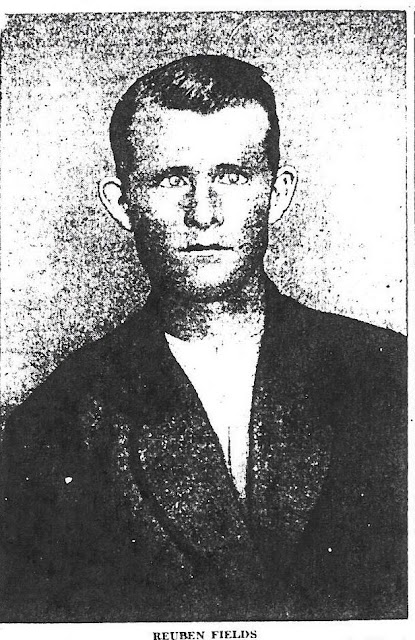
If provided with the date, month and year of a person’s birth, Reuben could instantly tell which day of the week the birth fell upon. Family Bibles and perpetual calendars proved him correct. He was able to calculate immediately how many grains of corn of a certain length it would take to reach from the earth to the moon. “It is immaterial whether there are 10 or 700 figures in [the problem],” declared the Courier-Journal in a November 1891 article. “Whether multiplication or subtraction, addition or division or a combination of all these, he will give you the answer, without the aid of paper or pencil, before the echoes of your voice in propounding the question have fully died away.” If given the circumference or diameter of a locomotive’s wheel and the distance between any two points, Field could immediately determine the number of revolutions the wheel would turn within that distance. Or the reverse: if told the distance and number of revolutions, he could calculate the circumference or diameter of the wheel. If given the dimensions of a brick and then the dimensions of a hypothetical wall, Field could instantly declare how many bricks of that size it would require to make up the wall. The Courier-Journal declared that if asked to multiply 59,746,989,223,615 by 94, subtract 73,275, and divide the result by 57 ½, “Reub” could give the correct answer nearly instantaneously.
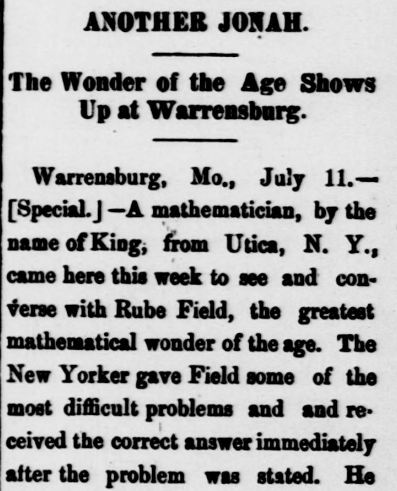
Once Field was asked: “The circumference of the earth is, in round numbers, 25,000 miles. How many flax seed, allowing twelve to the inch, will it require to reach around it?” He had the answer in less than a minute. (19,008,000,000, in case you were wondering.)
Naturally, Field was in great demand among businessmen. Surveyors beseeched him to help with their calculations. Merchants would hire him to do their invoices. In the fall of 1873 the Fayetteville tax collector had Reuben look over his records; several months later, in summer 1874, he could still remember every number in the taxman’s ledger. A wholesale firm in Kansas City hired him for a single day as an experiment after he told them he could do the work of ten clerks. By the end of the day he had proved that he certainly could, and the firm gave him $45—pay sufficient for ten men. It was a rare occurrence, however, when Field accepted money for his computing skills. The childlike prodigy usually asked only for some piece of merchandise such as a pair of boots. On one occasion he accepted a bar of perfumed soap as payment. Rumor held that he ate the soap.
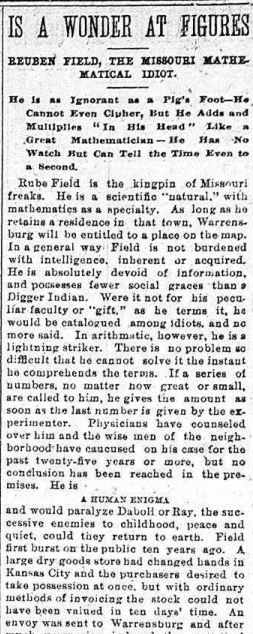
Then there was the time the government of Bath County called on Reuben to provide aid with his highly specialized skill. As told by historian Richards,
Bath County was indebted to the Big Sandy Railroad in a large amount, the bonds for which were held by a New York firm. The debt had been running and accumulating interest a great many years and a member of this firm was sent to negotiate a compromise with the county. The compromise was effected, the calculations were made and all the papers drawn and approved by the parties to the contract. The County Judge sent for [Field] and stated to him the whole business in a way he could understand it and though not being able to read or write he made the entire calculation by mental process and it tallied to the cent with the calculations made by the parties.
In addition to these feats, Field had some sort of internal clock that allowed him to tell the exact time of day or night without consulting a watch. He never owned a watch and would have been unable to tell time with one if he had it; because he was illiterate, he was unable to distinguish numerals as well as letters. (To put it another way, Field knew the numerical value of, say, the number 220, but if shown the numbers written on a piece of paper he did not recognize them.) People would experiment by waking him up in the middle of the night and asking the time. He was never wrong.
The press enjoyed informing readers about the wonder known as Reuben Field, often comparing him to Tom Bethune, a blind and probably autistic former slave who became a celebrity due to his phenomenal talent at playing piano. The St. Louis Republican sent a reporter out to visit him at his home in Fayetteville in July 1874. The following edifying dialogue took place.
Journalist: “Reub, I hear that you can tell what day of the week any given date was or will be. Is that so?”
“Yes, sir.”
“What was July 1, 1868?”
“Wednesday.”
“Correct. What was the 22nd of January, 1848?”
“Sunday.”
“What day will the Fourth of July come on this year?”
“Saturday.”
“New Year’s?”
“Friday.”
“All right. I have also heard, Reub, that you can tell the hour at any time of day or night. Is that so?”
“Yes, sir.”
“What time is it now?”
“It is 17 minutes past 2 o’clock, railroad time—sun time is 13 minutes slower.”
The reporter repeatedly tested Field’s ability to tell time without a watch and was satisfied. Perhaps in the mood to show off a little, Field asked a passing citizen to write down and read aloud a column of numbers. There were thirteen two-digit numbers in all. Reuben immediately added them, and proved that he could repeat the numbers in the order they were written. He could also do it backwards.
” In 1874 Field enigmatically attempted to explain his mathematical instincts to the St. Louis Republican reporter: “You commence at the bottom and work up—I commence at the top and work down; it is easier falling out of a tree than climbing out. If I could read and write, I shouldn’t know any more than you do.”
Field refused to work, although the 1880 Johnson County, Missouri, Census lists his occupation as “natural mathematician.” He lived with various family members and acquaintances, leaving for another host whenever he sensed that he was wearing out his welcome. Sometimes his benefactors had to resort to subterfuge in order to get him to leave, as related by local historian Richards: “When the good woman of the house felt that he had overstayed his time, he was told about some neighbor who had just slaughtered a hog, or had procured a new supply of hominy, both of which he loved, whereupon he would take off for a visit there until the hog and hominy were gone.” Field never married, claiming he would do so only if the Lord commanded it. “Even then,” said the Kansas City Star, “it is doubtful if any sane woman would have had him for a husband.”
In 1887 Field displayed his skills before Governor Crittenden of Missouri and other celebrities of that state, all of whom “unhesitatingly pronounce[d] him one of the greatest wonders of the century.”
Scientists and mathematicians who tested Field invariably found that his near-instantaneous calculations were correct. “The most learned mathematicians have tried to trap him, but without success,” said the Courier-Journal in 1891. “He always instantly gave a correct answer to their most difficult and complicated problems…. While expert accountants who have witnessed his feats have sometimes questioned the correctness of his answers, they have always found, upon investigation, that they were in error and Field was right…” The paper further noted that the savant had a perpetual idiotic grin and glassy eyes that lit up only when doing his mental calculating.

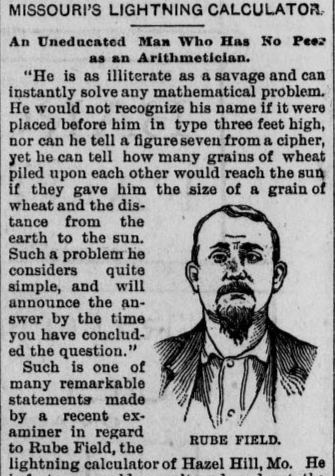
In April 1892 the Scientific American printed a letter describing his feats, sent by reader N. T. Allison of Columbus, Kansas:
[…H]is reasoning powers have never developed beyond those of a child of the most ordinary intellect. In the face of these facts, however, he has the keenest perception of the relation of numbers and quantities, and is able, as if by instinct, to solve the most intricate mathematical problems. He does not know figures on a blackboard, but he understands them perfectly in his mind…. Once in my office I asked him the time. He replied at once: “Sixteen minutes after three.” In order to test him, I drew him off upon some other question, not letting him know my object, and when seventeen minutes had passed, I looked at my watch and asked him the time. He said: “Twenty-seven minutes to four.”
After a lifetime of amazing people, sometime in the early twentieth century Reuben Field vanished from the record. John A. Richards writes in his history of Bath County that the place and date of Field’s death were unknown. However, due to the magic of backbreaking research, I can relate the story of the prodigy’s final days. He had moved to Jackson County, Missouri, and in 1907 was committed to the county poor farm by court order. With the onset of poor health came the loss of his mathematical skill. He died of apoplexy at the county hospital at Little Blue on November 27, 1913. “Death now holds the secret of Rube Field’s wonder,” remarked the Kansas City Star.
Field’s relatives were unable to care for his remains, so he was buried in the cemetery at the county poor farm. It is a matter for metaphysicians to ponder whether his ghost can instantly compute the number of grains of dirt that fill his grave.
VERA McGINNIS

Vera McGinnis
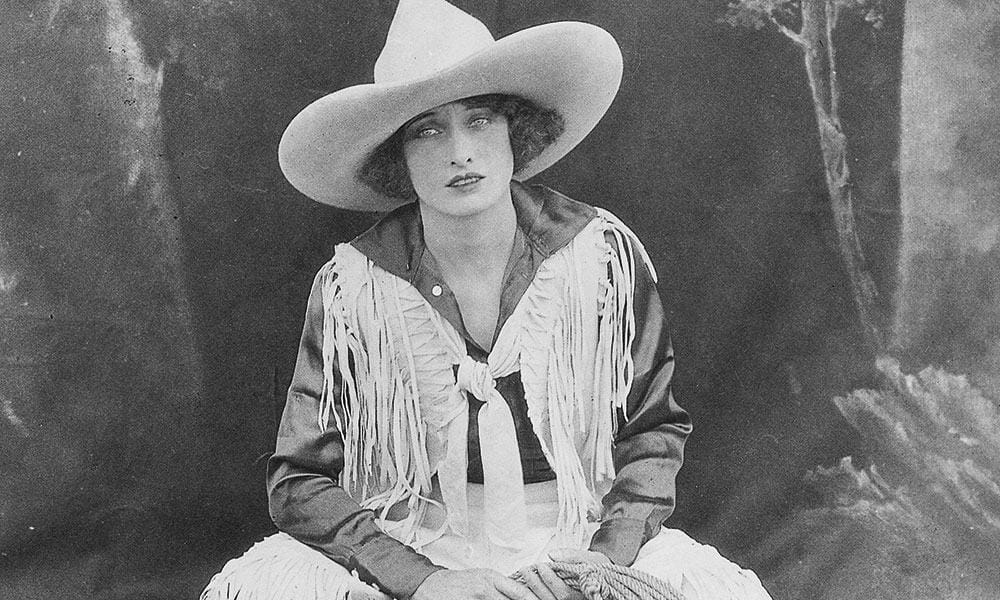
Vera McGinnis, 1892-1990
Johnson County Missouri’s own famous rodeo star.
It is common today to see a woman wearing pants, and we can thank Vera McGinnis for that.
As a rodeo champion and Hollywood trick rider, Vera gave up her split skirts and started wearing slacks while performing. This fashion took off and more women started wearing them.
Vera had an amazing career despite learning the ropes later in life. She excelled and won rodeos, played as stunt doubles in westerns and traveled the world with many famous show troupes. Despite all the broken bones throughout her career and even a collapsed lung from a horse tumble, she lived to the ripe old age of 98.
Article by Joyce Simmons- Dorrell
Photos courtesy of Wikipedia and Historical Archives.
****************************************************************************************************
MYSTERY SOLVED
Have you ever wondered who the unnamed Confederate soldier was who entered the blacksmith shop where Major Emory Foster lay wounded and proposed to do him harm?
A 161 year old Warrensburg related mystery was finally solved by our own Library and Museum Artifact Trustee, Andrea Whitehead!
Read this article she wrote for the Lone Jack Historical Society to find out the answer
Visit the website to find out!! www.historiclonejack.org
****************************************************************************************************
Vernaz Drug Store Legacy
by Joyce Simmons- Dorrell
Pierre Veraz and his wife Colette arrived in New York in 1857 from Bulle Switzerland. They moved quickly to St Louis Missouri where they ran a millinery business for about 13 years. After the Civil War Pierre Joined a company that would travel to Fort Laramie to trade with Indians. On route, Pierre was shot through the hand, beaten and left for dead by Indians. He survived and eventually moved back to St. Louis until moving his family to Warrensburg Mo. in 1867. He settled in Old Town and then in 1875, purchased 5 acres of land at Holden and Cleveland St. There he grew an orchard with a variety of fruits and a two-acre Vinyard with eight types of grapes in which he made wine from. Pierre died in 1906 and his wife in 1907.
In 1896 Julius, son of Pierre and Colette, bought into the Miller Drug Store on W. Pine St.

jocohs
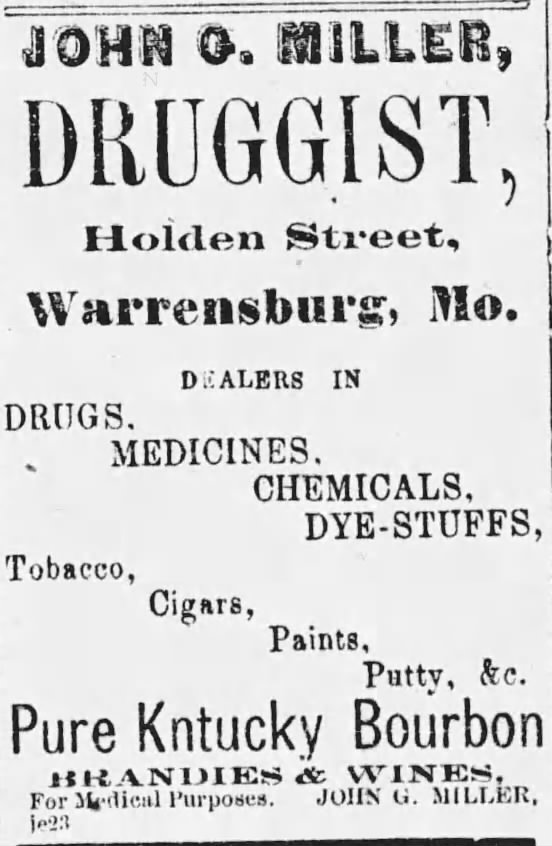
1876 Advertisement for Miller Drug on Holden Street from The Warrensburg Journal. Photo courtesy of SHSMO
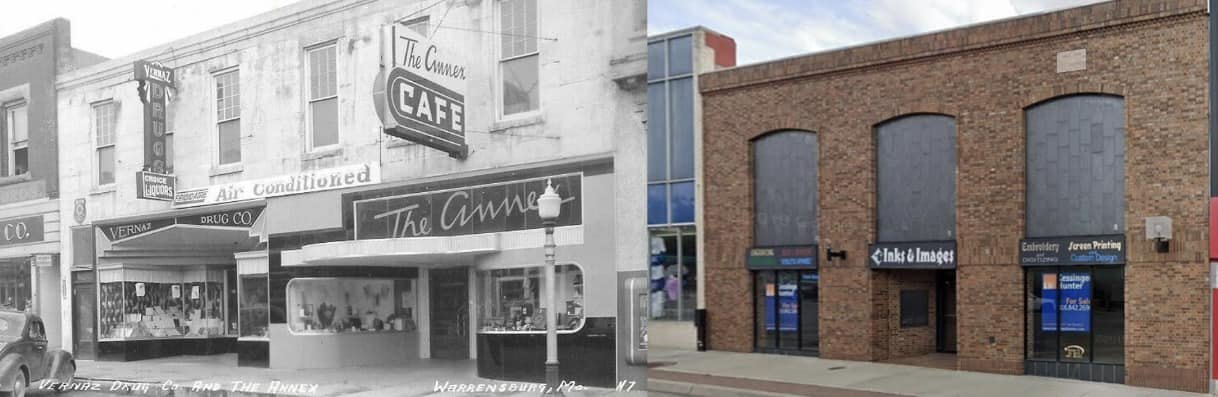
He knew town was booming and would be the ideal place to run a business. Located next to the Standard Herald Newpaper, it became known as Miller Vernaz Drug In 1902 Julius bought out Millers interest in the store, moved to 116 W Pine St. and it became J.C. Vernaz..The Druggist
Miller & Vernaz advertisement from JOURNAL DEMOCRAT 1900 SHSMO Digital Archive

Julius fell ill in 1904 and asked his brother Adam to join the business and keep the Veraz business name alive. Adam became a full partner and the name was changed to The Vernaz Drug Company.
Julius passed away in 1906 at the age of 33, Adam continued to run the business until his death in 1924.
Murray Q Williams, a young man who had worked for Vernaz for several years, purchased one half the interest of the business from Mrs. Adam Vernaz. Soon after, Reynolds Achauer, another former employee also bought into the business. Achauer became a trained druggist and eventually bought out all the remaining shares from Mrs. Vernaz. She later stated her husband had told her to sell to the right person when they came along. She felt Achauer was indeed that person.
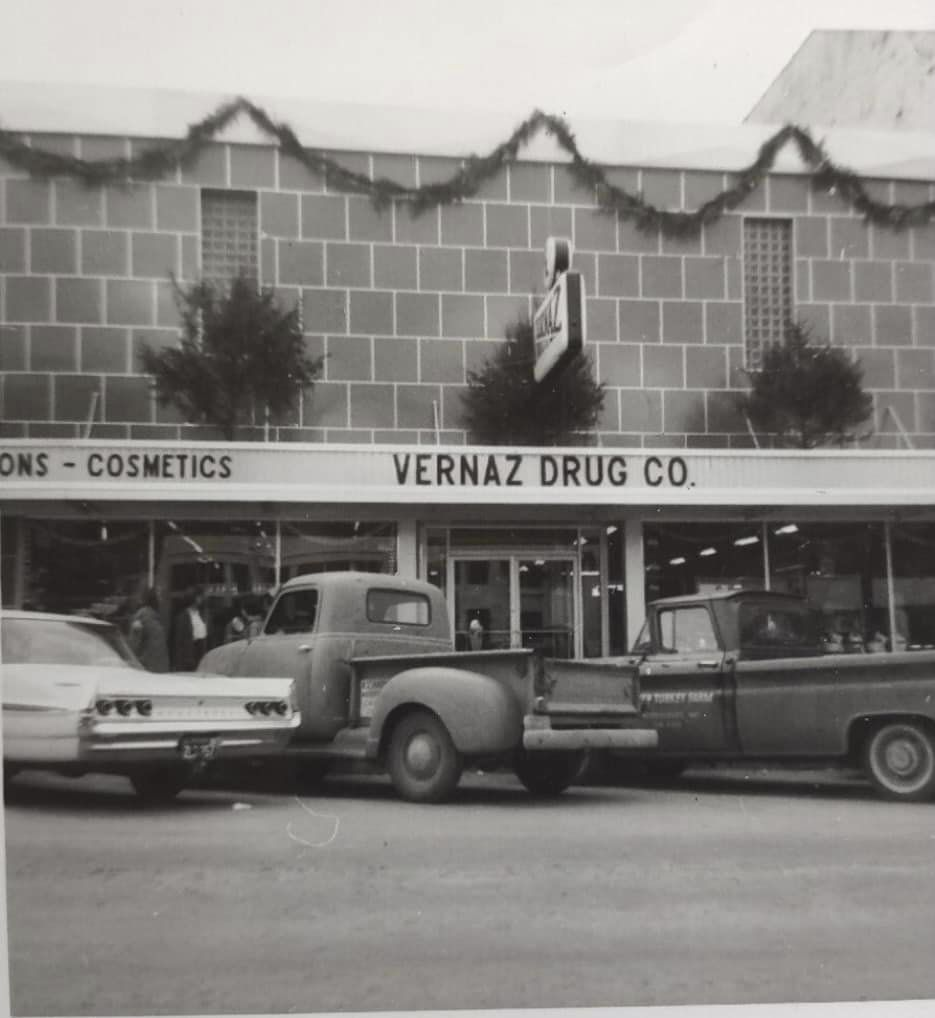
In 1929 Vernaz Drug was moved to 108 W. Pine and in 1939 they bought the building next door at 110 W Pine and expanded the store.
Veranz Drug remained a staple of Pine St. well into the 1980’s and was a popular after school stop for young kids to get their candy and soda pop.

The Mrs. Adam Vernaz home is still standing located at 109 W Russell Ave.
Article by Joyce Simmons Dorrell and sourced from the Vernaz family file and collection.
To learn more about the Vernaz Family, visit us at the Mary Smiser Heritage Library

Leonard Goodall The Man Who Invented
The Modern Lawnmower
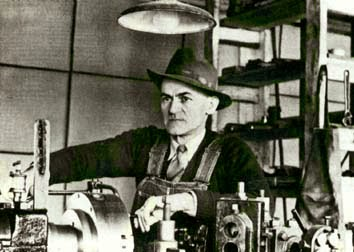
Leonard B. Goodall, who lived in Warrensburg, Missouri, invented the rotary power lawn mower in his basement. He saw the need for a better mower and worked hard to create one.
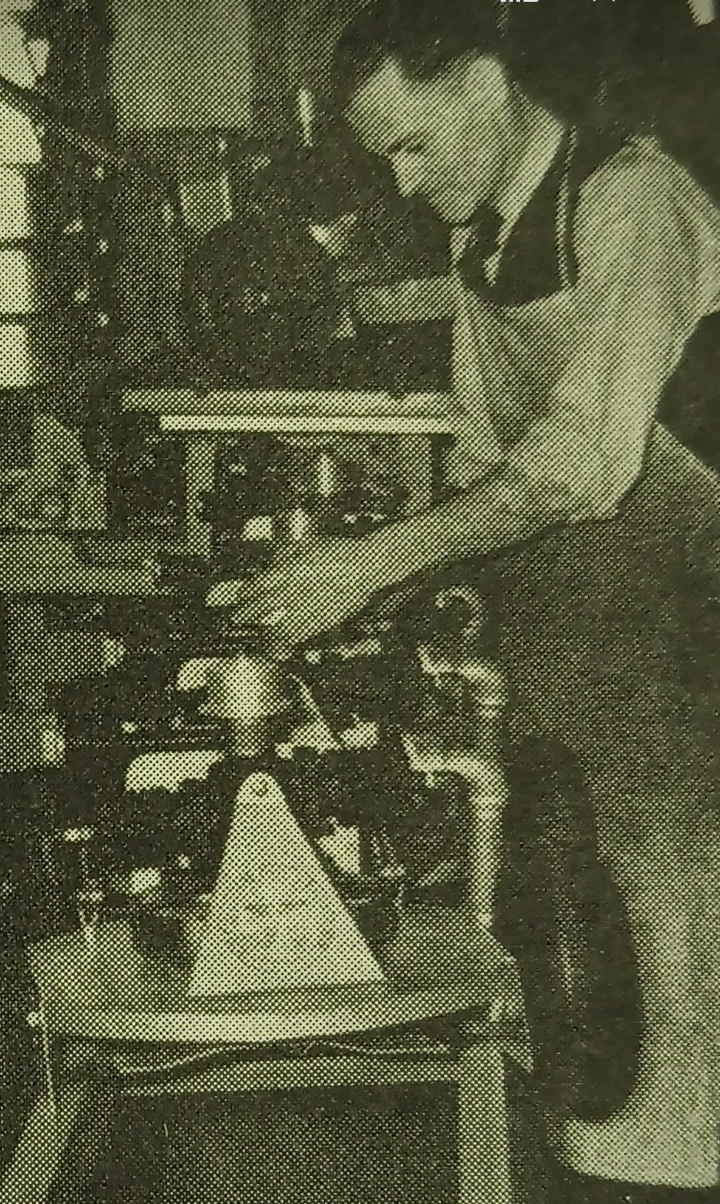
Eight years of experimenting at his home at 444 East Market Street in Warrensburg, Missouri resulted in the marketing of a new type of power-driven mower.
After World War II, many Americans dreamed of owning homes with yards. Goodall’s mower made it easier to maintain these yards neatly.
Before Goodall’s invention, mowers were reel-type and couldn’t handle tall grass. This was fine for city dwellers or farmers, but suburbanization created a need for a mower that could handle large lawns.


Leonard B. Goodall was born on November 17, 1895, in Delphos, Kansas, to farming parents. Growing up in the rural setting of central Kansas, he only completed eight grades of schooling. However, his fascination with mechanical matters began early and persisted throughout his life, shaping his professional endeavors and work habits.
During his teenage years, Goodall encountered a life-altering event when he attempted to repair a tractor while its engine was running. Unfortunately, the tractor unexpectedly engaged, causing severe vibrations that resulted in his left leg becoming entangled in the machinery, leading to its amputation. This tragic incident profoundly influenced his life trajectory.
In the 1920s, Goodall moved to Kansas City, where he became fascinated with radios and cars. He later moved to Warrensburg and worked as a mechanic, then started experimenting with lawn mower designs.
He married Eula Johnson in 1929 and they built a home together, where Goodall set up his workshop. Despite working at the Ford dealership, he spent evenings working on his inventions.
Subsequently, Goodall’s physical limitation, coupled with his inability to operate a reel-type mower, compelled him to explore alternative methods of lawn maintenance.
Goodall tried different designs before settling on the rotary mower, which he patented in 1940. He partnered with local businessmen to start manufacturing the mowers.
His invention revolutionized lawn care and earned him several patents. The Goodall trademark became well-known for its rotary movement, symbolizing the company’s success.
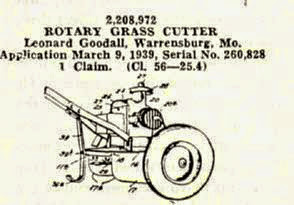
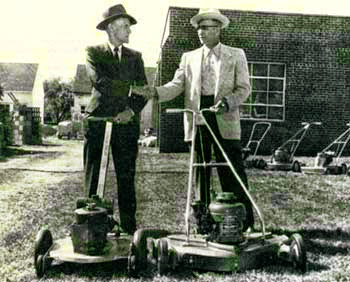
In the image, Leonard Goodall is seen on the left, standing next to a 1941 model, while his partner, Charles S. (Sam) Baston, stands with a 1956 model. The backdrop consists of the company buildings situated behind the Goodall residence on East Market Street.
Goodall faced tough competition from other manufacturers who could produce mowers of slightly lower quality but at lower prices. While Goodall’s mowers were of high quality, they were not cheap, with prices ranging from $110 to $174 in the 1940s, placing them at the top end of the market. Retail giants like Sears, Roebuck & Co. and Montgomery Ward posed significant competition with their extensive retailing, advertising, and distribution capabilities, which were challenging for a small independent business to match.
As time went on, protecting his product through patents became increasingly difficult. Legal advisors cautioned Goodall that enforcing patents would be costly and time-consuming, leading him to doubt its worth.
Health issues also weighed on Goodall, tempting him to sell the business. His perfectionist nature made him a chronic worrier, often losing sleep over business matters. He constantly brainstormed product improvements, even in his sleep.

Financial pressures added to his worries. The seasonal nature of the lawn mower business meant that sales had to be made between February and May for a successful year. Each year, Goodall had to secure a personal loan of $50,000 from the bank to cover expenses. Despite the business’s success, the bank demanded his personal guarantee on the loan. Goodall knew that one bad season could impact both the business and his family’s financial stability. His worrying led to health issues such as ulcers, which plagued him for the rest of his life.
Goodall’s financial priorities were different from many. As his income grew, he maintained a modest lifestyle. He and his wife, Eula, stayed in the same house they built in 1929, only expanding it slightly. He wasn’t interested in status symbols like joining country clubs or playing golf. His attire was casual, with suits and ties reserved for church. However, he did enjoy owning a nice car and invested in a country home near Stover in 1953.
Despite the potential for greater wealth, Goodall wasn’t driven by a desire for more money. He had no heirs interested in taking over the business, and he wasn’t motivated by financial gain. These factors led him to consider selling the company.
Goodall, along with Baston and Garrett Crouch, the company’s attorney, explored the possibility of selling to larger manufacturers and enlisted the help of a real estate firm. Foley Manufacturing Company, known for chain saws, expressed interest and eventually bought the corporation for $317,520 in 1952.
Even though the company continued under the Goodall name in Warrensburg, Goodall retired and remained on the board of directors. However, Foley faced financial challenges, struggling to match previous sales figures. Increased competition, changes in engine suppliers, and rising costs contributed to the difficulties.
Eventually, in 1962, Foley decided to relocate Goodall Manufacturing Corporation to Winona, Minnesota, closer to their main office. This decision caused concern in Warrensburg, as the loss of another industry had an impact on the community.
Despite the business’s changes, Goodall continued his tinkering and woodworking hobbies, focusing on quality and craftsmanship. He passed away in 1971, leaving behind a legacy that revolutionized lawn care. Today, his invention, the rotary power lawn mower, is a common sight in suburban neighborhoods, parks, and golf courses, cementing his place as the “father of the rotary power lawn mower.”
Written by Joyce Dorrell for the Johnson County Missouri Historical Society 2024
Information and photos sourced from the JOCOHS Archives, The Missouri State Historical Society and The Daily Star Journal
William H. Byler Inventor of the Black Light

Disclaimer: The widely circulated claim that Dr. William H. Byler invented the black light in 1935 is inaccurate. Dr. Byler never asserted such a claim, nor is there any record of this invention in his patents or published works. In reality, what we now recognize as the black light was developed more than fifteen years earlier. The origins of this misconception remain unclear, raising questions about how Byler’s name and the 1935 date became associated with the invention. It is noted however, his important role in the research for technological innovations.
William H. Byler, credited with inventing the black light in 1935, was a prominent figure in the field of scientific research and development. He graduated from the University of Central Missouri in 1927 with a major in chemistry and physics, later earning his doctorate from the University of Missouri in 1937. Byler’s career spanned various roles, including research scientist at General Electric Corporation and director of research at the U.S. Radium Corporation, where he received several patents over a 32-year tenure.
During World War II, Dr. Byler played a crucial role in radar and infrared spectrum research, contributing to Allied victory. His work in radar technology has enhanced air travel safety, while his advancements in medical science have led to reduced exposure to harmful x-rays. Additionally, his research on detection methods for atmospheric pollution and weather forecasting has benefited the environment.
Byler dedicated his life to studying luminescent chemicals, which paved the way for numerous technological advancements. Phosphors developed by Byler are commonly used to coat various types of screens.
The William F. Byler Distinguished Faculty Award, established in 1982, honors outstanding scholarship in teaching at the University of Central Missouri. Byler’s legacy exemplifies the values of scholarship and excellence, inspiring future generations of faculty members.
A graduate of Prairie Home High School, Byler was initiated into the Sigma Tau Gamma fraternity at UCM in 1925. He received mentorship from Wilson C. Morris, whose influence he documented as chairman of the editorial board of Teacher Immortal, a biography of the UCM professor emeritus.
Following his academic pursuits, Byler embarked on a career focused on luminescent chemicals, garnering global recognition for his research. His contributions to phosphorescent and fluorescent chemical applications, including the invention of the black light, earned him numerous patents and acclaim in the scientific community.
Written by Joyce Dorrell for The Johnson County Historical Society
information sourced by techwalla.com and The Missouri State Historical Society.
James Kirpactric 32nd Secretary of State of Missouri
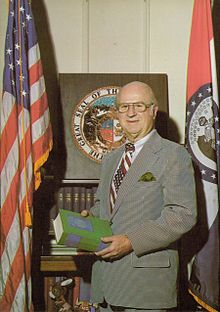
June 15, 1905 – December 26, 1997
Born in Braymer, Missouri, he graduated from Northeast High School in Kansas City and later from Central Missouri State University in Warrensburg, where he was a member of the Sigma Tau Gamma fraternity. He began his journalism career at The Daily Star-Journal in Warrensburg, eventually becoming its editor. He later served as editor of the Jefferson City News-Tribune before acquiring the Windsor Review and the Lamar Democrat, both weekly newspapers in Missouri. Governor Forrest Smith enlisted him as a speechwriter.
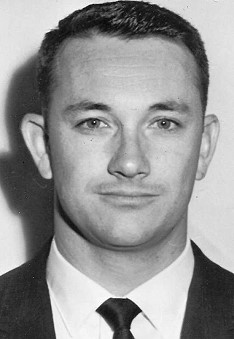
In 1960, he ran for Missouri Secretary of State but was defeated by Warren Hearnes. However, he secured the position in his successful 1964 campaign.
A member of the Democratic Party, he served as Missouri’s Secretary of State from 1965 to 1985, holding the record for the longest tenure of any elected state constitutional officer in Missouri history.
A publisher by profession, he was honored by the Northwest Missouri Press Association, which presents an annual award in his name.
Several public facilities in Missouri have been named in honor of James C. Kirkpatrick. In 1998, Senate Concurrent Resolution 36 officially renamed Missouri’s State Information Center as the James C. Kirkpatrick Information Center. The main library at the University of Central Missouri in Warrensburg also bears his name, known as the James C. Kirkpatrick Library. A replica of his Capitol office, previously housed in the former Ward Edwards Library, is now displayed on the library’s second floor, along with a collection of his public and private papers in the Special Collections archive.
Additionally, the Student Government Association at the University of Central Missouri established the “James C. Kirkpatrick Excellence in Governance Award” to recognize outstanding public service and the advancement of higher education in Missouri. This award has been presented annually for the past 23 years in the James C. Kirkpatrick Library, typically around St. Patrick’s Day, in tribute to Kirkpatrick’s heritage.
Bossie Francis Murderer or Victim?
by Joyce Simmons-Dorrell
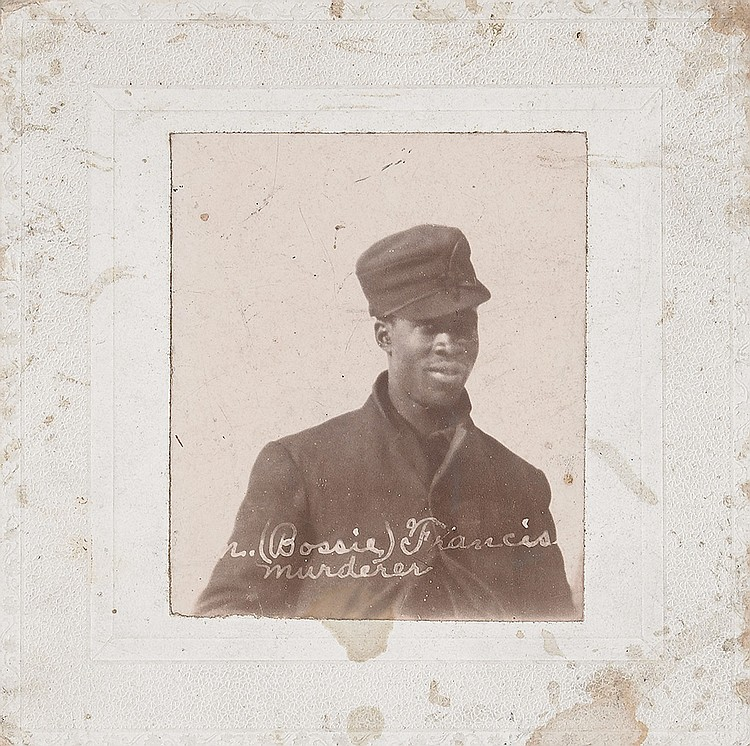
Bossie Francis was wanted for the brutal murder of a white woman in Missouri. Somehow, he managed to escape to Johnson County, Indian Territory (now Oklahoma), where he was shot and killed by a local sheriff while resisting arrest for an unrelated offense. He was buried by the county, and the incident was soon forgotten. That is, until word spread about a $2,500 reward for his capture. At that point, authorities decided to exhume the body, and the Missouri officials sent a photo to the sheriff in Indian Territory to confirm the identification. The case quickly became a media sensation in the Western press.
Mob Tortures a Few Negroes to Extort Information
Kansas City, Aug. 30, 1901
Armed men and bloodhounds this morning again took up the search 40 miles south of Kansas City for Bossie Francis, the murderer of Mary Henderson, which will be continued till the negro is run down. A counsel among the pursuers has already decided that the Negro’s punishment shall be meted out at the stake. W. C. Hyatt, Mary Henderson’s brother-in-law, approves of this method.
Kansas City. Mo. Aug. 30, 1901
“Bossie”‘ Francis, the murderer of Miss Mary Henderson at Columbus. Mo., on Tuesday evening, has thus far eluded his pursuers, and the large mob that has been searching for him has partially disbanded, discouraged over the failure of its efforts, after having been, as its members supposed at the point of capturing the negro. A pack of bloodhounds was obtained yesterday from Manhattan. Kan., and taken to the Hyatt farm, the scene of the murder. They found the trail of Francis readily, and followed it straight to the coal mine at Blackwater, owned by a negro, John Hardin, whose wife is an aunt of Francis. The mob composed of (a number of men), felt sure that Francis was hidden in the mine shaft, but as he was known to have two pistols none of the men ventured to go down.
One Man Who Wasn’t Afraid.
A. W. Rice. owner of the bloodhounds, entered the mine, taking the dogs with him but failed to find Francis after a thorough search. Yesterday afternoon Deputy Sheriff Temple, of Warrensburg, called a council, and after discussing the situation the men decided to disperse for the night, leaving a few of their number on guard.
“Bossie” Is Well Known and popular.
“Bossie” Francis is known to all the Negroes in the county, and is very popular among them. No one supposes that he has gone far from Columbus, and it is thought that no negro in the neighborhood would refuse him food and shelter. There are several negro settlements in the district, and there are negro cabins everywhere. There seems to be no doubt that Francis first tied to his uncle’s house at Blackwater, and then took refuge in the woods. At this season of the year the vines and weeds along the numerous creeks make thick cover.
Mob Tortures Supposed Witnesses.
The mob was not engaged all day in hunting the woods. It had three Negroes to torture first into telling what they knew. This was early yesterday morning, when it captured Km met Davenport. Charles Brisooe (who lived near Columbus) and Bud Francis, a brother of the murderer, between Columbus and Holden. The men acted suspiciously, but declared that they knew nothing about Francis’ whereabouts. To make them talk it was decided to string all three up. They were strung up until Davenport agreed to tell what he knew, and declared the fugitive was in a coal mine near by. But he could not be found there.
HOLDEN, Mo.. Aug. 29.—’Bossie” Francis, the murderer of Miss Mary Henderson of Columbus, Mo., on Tuesday evening, has thus far eluded his pursuers and tonight the large posse that has been searching for him has partially disbanded, discouraged over the failure of their efforts, after having been, as they supposed, at the point of capturing the negro. A pack of bloodhounds was obtained today from Manhattan. Kan., and taken to the Hyatt farm, the scent of the murder. They found the trail of Francis readily and followed It straight to the coal mine at Black Water, owned by a negro named James Hardy, whose wife is an aunt of Francis. The posse, composed of two hundred men, felt sure that Francis was hidden in the mine shaft, but as he was known to have two pistols none (of the men ventured to go down. Finally A. W. Rice, owner of the bloodhounds, entered the mine, taking the dogs with him, but he failed to find Francis after a thorough search. Late this afternoon Deputy Sheriff Temple of Warrensburg called a council of the posse and, after discussing the situation, the men decided to disperse for the night, leaving a few of their number on guard at the important points. The search will be continued tomorrow by a large number of men.
One Friend Gave a Tip (Davenport said that Bud Francis had told him he was to meet the murderer (last night at the Porter-Murray coal mine, six miles north of Holden, when he was to give “Bossie” 18.00 that Briscoe owed him. Bud Francis had, Davenport said, taken Davenport and Briscoe with him and made them go into the mine to And the murderer. He declared that they had not found Francis. Davenport, Briscoe and Bud Frances were hurried before the mob to the place indicated by Davenport. The mob worked hard at the mine but to no avail, and gave up when relieved at daybreak, by hundreds of other armed men. who took up the hunt where the night shift had left off. The three negroes were finally sent to Warrensburg and placed in Jail for safe keeping and surrounding towns were wired for bloodhounds. The place where Francis is supposed to be hiding is in a negro settlement. The surrounding are favorable for him. both because he, has many friends there and because the mine and the thick brush afford ideal hiding places. Hunt Be Captured In Time Every white man in the neighborhood is on the alert, however, and as every avenue of escape is well guarded. Francis will surely be captured In time. Francis is known to be armed, and if he is finally located in the mine It will doubtless become necessary to starve him out. As but few men could enter the pit at a time, they would be at the mercy of the murderer. The funeral of the murdered woman was held this morning A special to the Star from Odessa. Mo., says: Bloodhounds were started from here for the scene of the murder this morning. There is great excitement in Odessa and mobs are reported forming there every hour to join the chase. A Special to the Star from Warrensburg says: After it became known that the negroes who were strung up last night to make them talk had been brought here, a mob of a hundred people gathered around the jail. Excitement is running high and the crowd about the jail is growing.
KANSAS CITY, Sept. I.—”Bossie” Francis, the murderer of Miss Mary Henderson, at Columbus; Mo., last Tuesday. has not yet been apprehended, and many people believe that he is no longer near the vicinity of Johnson county. There is no conclusive evidence that the man whom the posse was after last night near Strasburg and Pleasant Hill was Francis. The only persons who saw him were some section hands and today they told Deputy Sheriff Temple of Johnson county that they saw a nan running from the railroad tracks to the woods, but they could not tell whether he was a negro or a white man. A negro was taken off a freight train at Harrisonville last last night, but he waw not the man wanted. No effort was made to find Francis in Johnson county today. He is believed to be In Cass or Henry county, and a few armed nun are searching for him in those counties. Posses left Pleasant Hill and Lee’s Summit this afternoon to prosecute hunt between those towns, as they had heard that a negro answering the description of Francis had been seen in that neighborhood today. Every rumor is being investigated, but all cluse thus far have led to false trails and new reports do not inspire much confidence. Information against Charles and Frank Brisco and Kmmett Davenport, charging them with being accessories after the fact in the murder of Miss Henderson. have been filedvat Warrensburg. Their preliminary hearing will be held there on Wednesday
San Francisco Call, Volume XC, Number 93, 1 September 1901
PURSUERS FAIL TO CAPTURE MARY HENDERSON’S MURDERER
It Is Asserted That the Negro Bossie Francis Was Paid to Commit the Crime by Whites Who Aided in His Escape.
Kansas city, Mo., Aug. 31.-The man-hunt that has been in progress in Johnson and Cass counties, Missouri, since Tuesday evening, when Miss Mary Henderson was found murdered at the home of her brother-in-law, Chapman Hyatt, and the negro hired man, Bossie Francis, the supposed murderer, missing, has not been successful. After fruitless beating of the bush, ransacking of negro cabins and search of coal mines the hundreds of volunteers yesterday were ready to give up, and even the bloodhounds refused to follow new trails. Last night, however, fresh interest was aroused by the discovery of a negro skulking in the woods near Strasburg. A party of men set out in pursuit, but the negro vanished mysteriously.
To-night all the towns along the Missouri Pacific were intensely excited by a report that Francis had been captured near Pleasant Hill; that the law officers were bent on taking him to Warrensburg jail, but that the hunters would carry him to the Hyatt farm and hang or burn him there. Pursued by a Posse. A negro answering the description of Francis was pursued to-night by a posse in the neighborhood of the Star School, between Pleasant Hill and Strasburg. So were the hunters of getting their man that one went to Pleasant Hill with the Information that the negro was in sight and would be taken in a few minutes. From this grew the rumor that Francis was actually a prisoner. Later it was learned that the fugitive escaped. Rain is falling, the night is dark and the chase is at a standstill again.
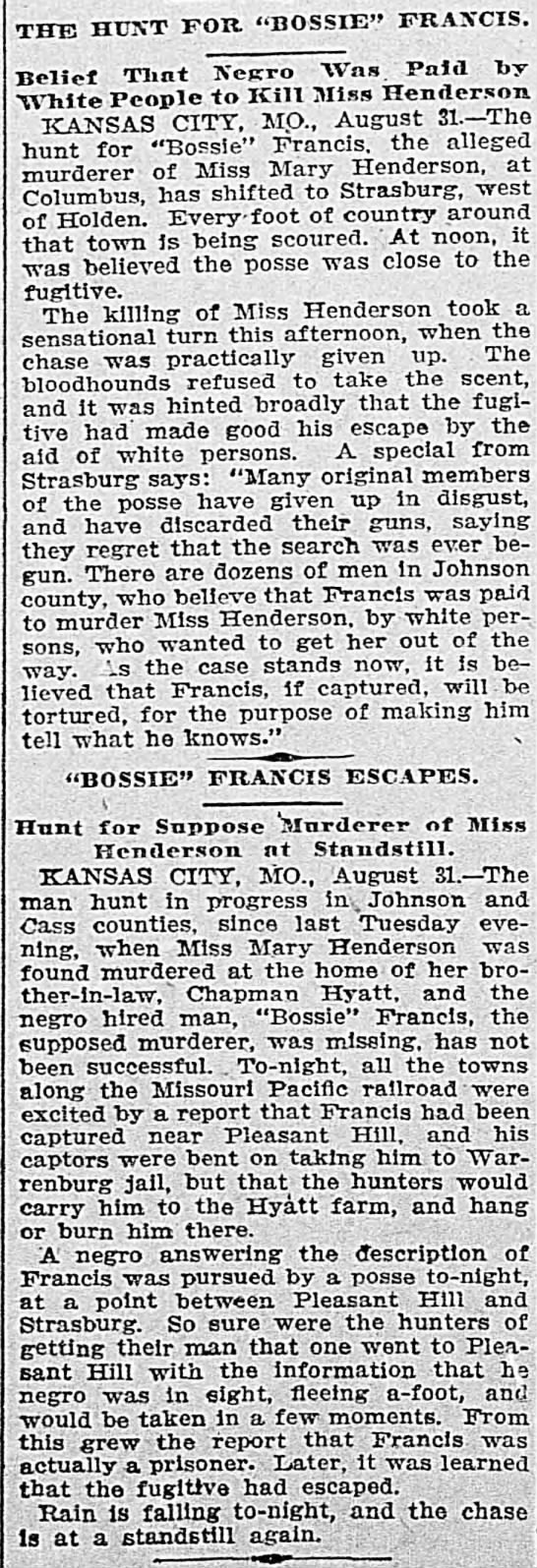
The killing of Miss Mary Henderson at Columbus,Mo., took a sensational turn to-day, and it was hinted broadly that the murderer had made good his escape by the aid of white persons. Paid to Commit Murder. A special to the Star from Strasburg says: “There are dozens of men in Johnson County who believe that Francis was paid to murder Miss Henderson by white persons who wanted to get her out of the wav. So convinced are many members of the posse that Francis has escaped by the aid of white persons that they refuse to take further part in the efforts to catch the murderer. If he is caught he will not be burned at once, but will be tortured for the purpose of making him tell what he knows about reports that white persons desired Miss Henderson to be got out of the way.”
BOSSIE FRANCIS AGAIN
Negro Killed at Ada by Marshal Thought to be the Escaped Missourian
Some three months ago the city marshal, R. C. Couch, killed a negro who resisted arrest to such an extent that the marshal was compelled to kill him in order to save his own life. The negroe was supposed to be about 52 years old, and his body was buried by the city. Nothing more was thought about the matter until a few days ago, when inquiries came from northern Missouri concerning such a man, and the body was exhumed. The description furnished by the Missouri officials fitted almost exactly and the body is awaiting the arrival of the Missouri parties. The dead negro is supposed to be a party wanted for murdering an aged and respected white lady there, and his name is thought to be Bossie Francis. The case created considerable interest at the time, and rewards of $2,500 were outstanding for the negro, dead or alive.
St Louis Republic, 6 Jun 1902, Fri, First Edition
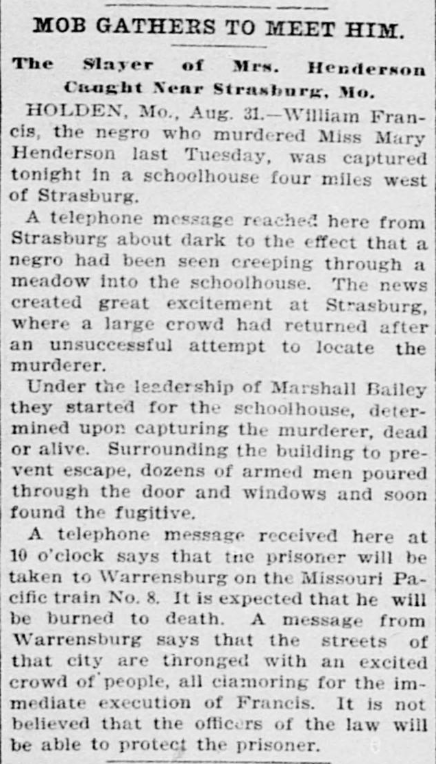
Years later, in New Orleans, a longtime acquaintance of Bossie’s thought he spotted him in a crowded street. Approaching the man, he said, “Hello, Bossie, it’s been a long time.” The man responded, “I’m not Bossie anymore.”
The murder still raises questions to this day. It was widely known that Mr. Wyatt was having an affair with his wife’s sister, and that she had just discovered she was pregnant with his child before her body was found in his front yard. Many suspect Mr. Wyatt was behind the murder, but he placed the blame on his farmhand, Bossie.
Photos from Warrensburg
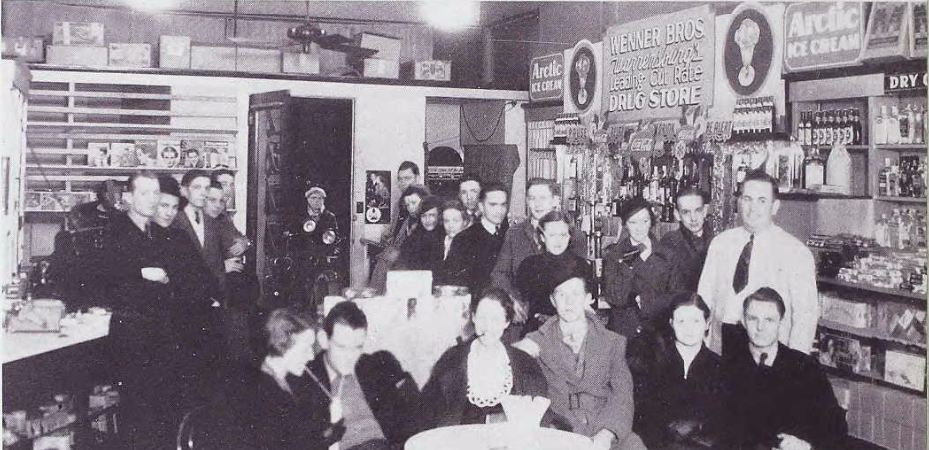
Wenner’s 1935
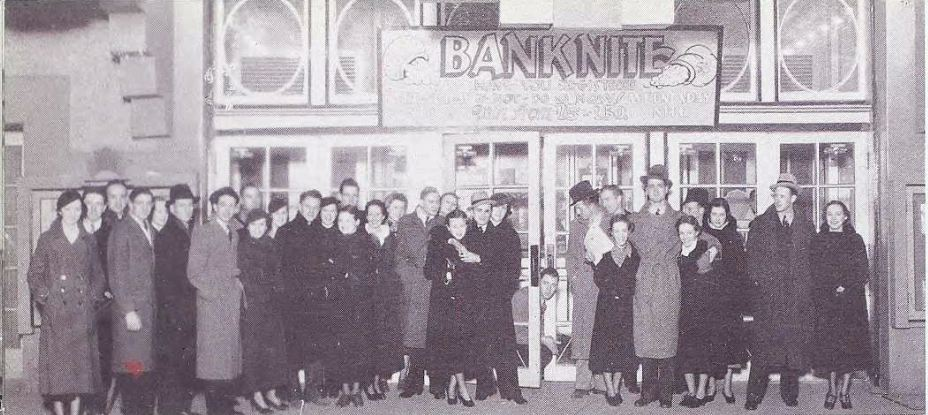
Star Theater 1938
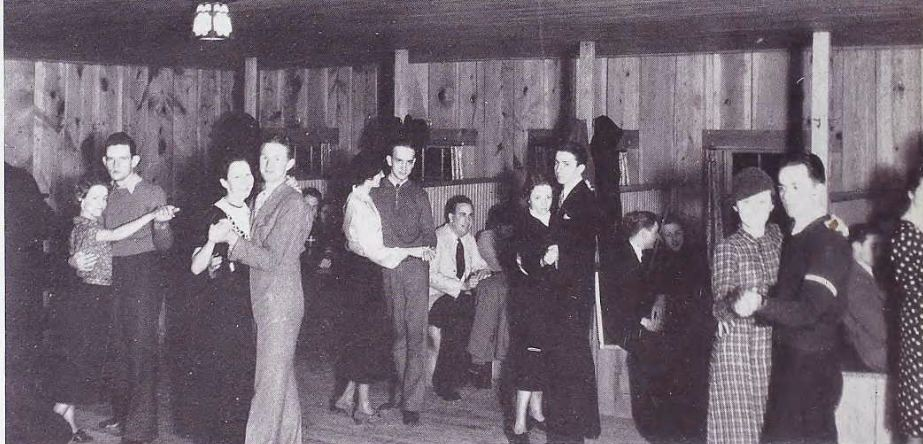
The Lantern 1938
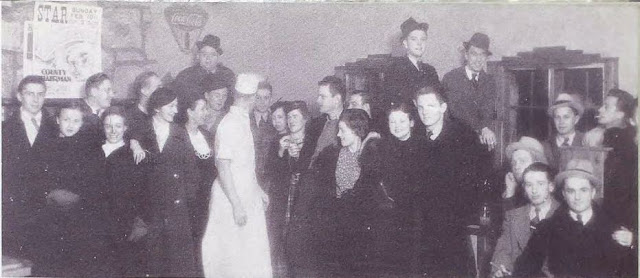
Hart’s Cafe
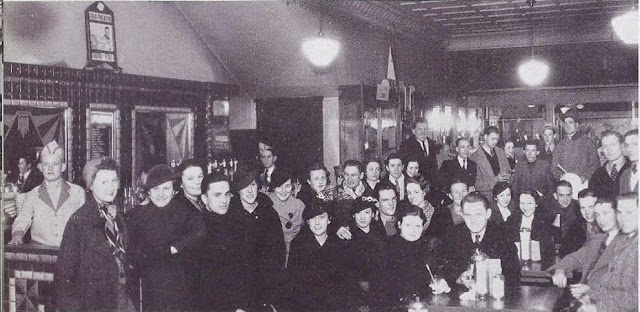
Marr’s Drug and Soda Fountian
 Johnson County (MO) Historical Society
You must be logged in to post a comment.