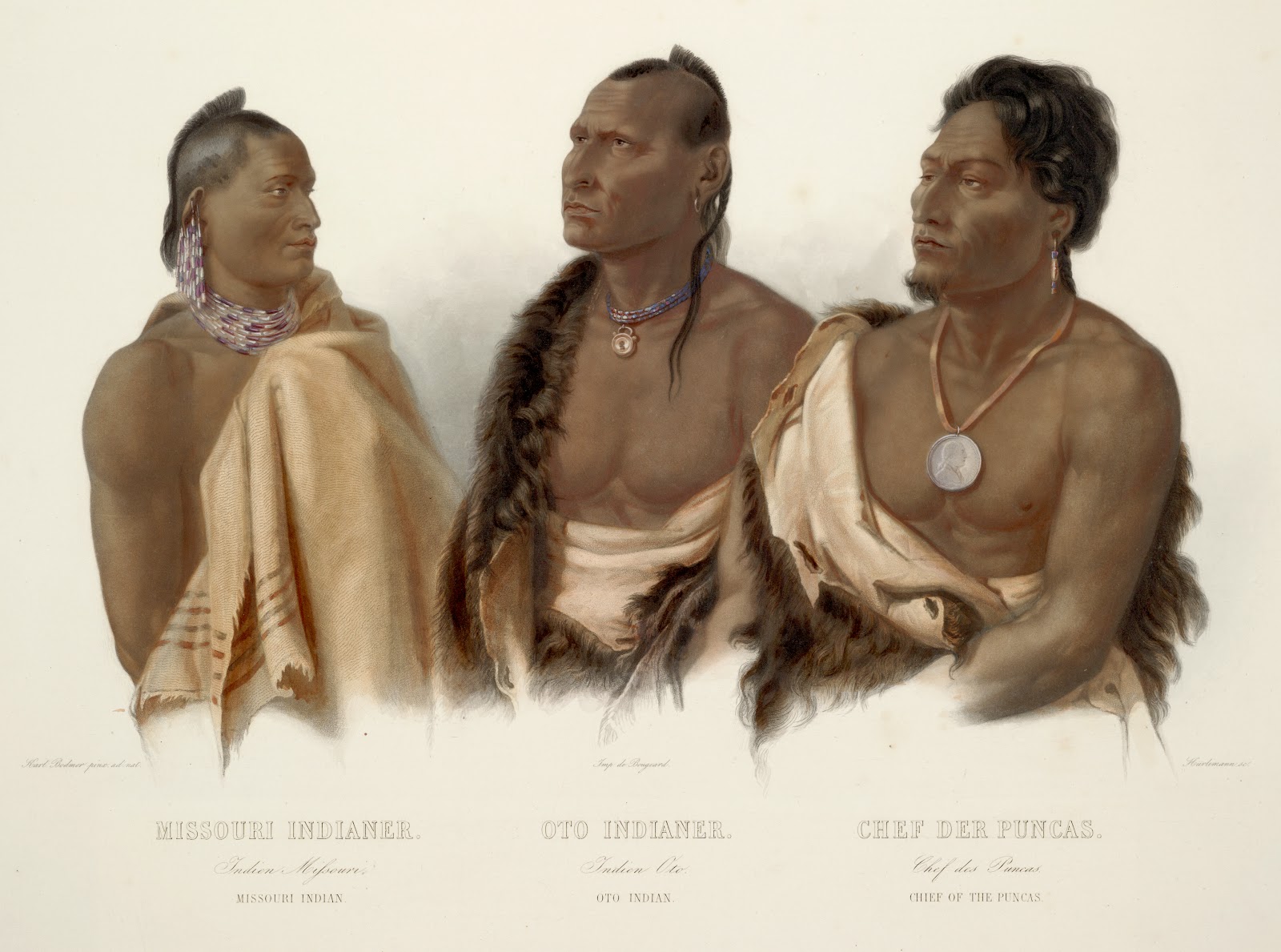
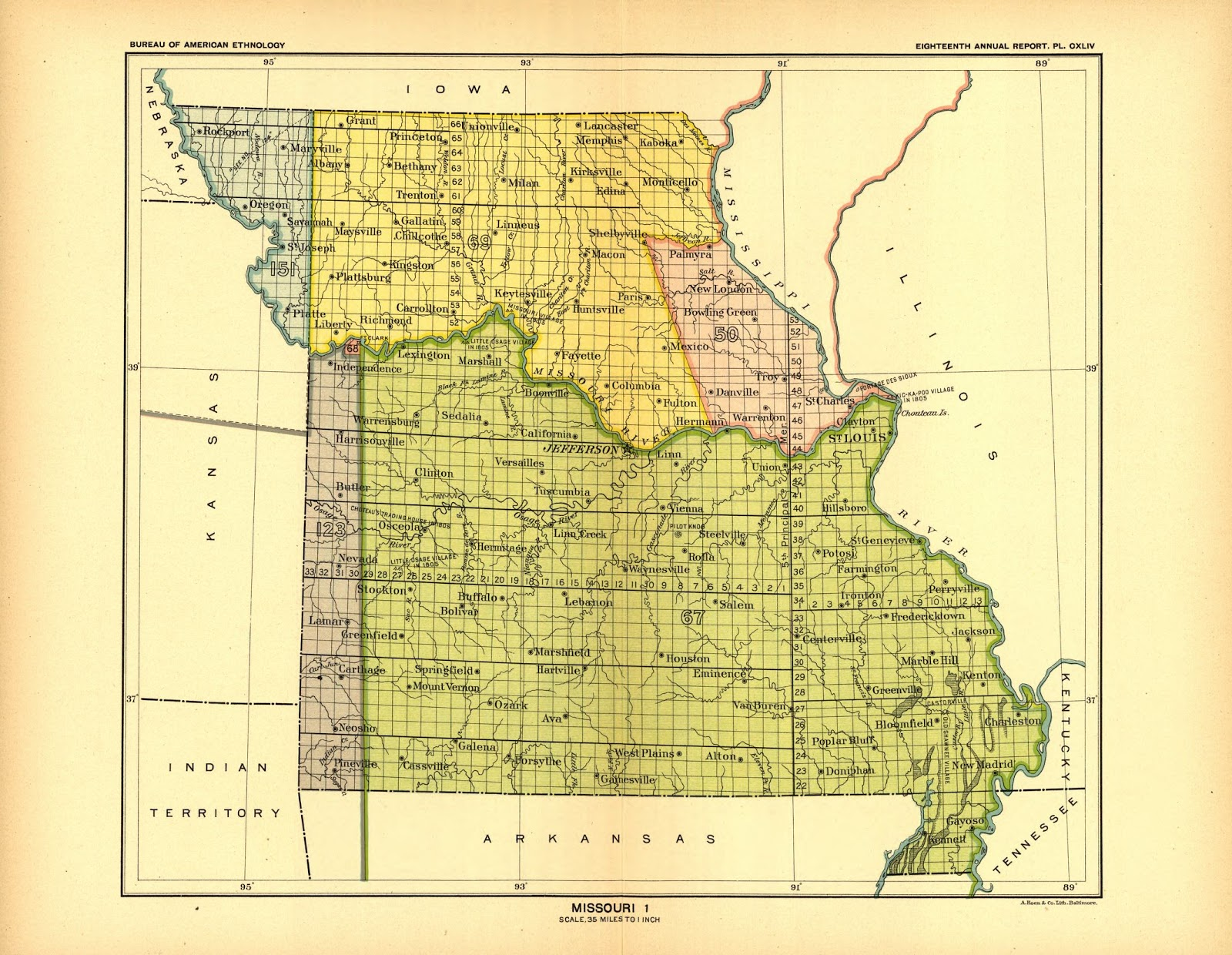
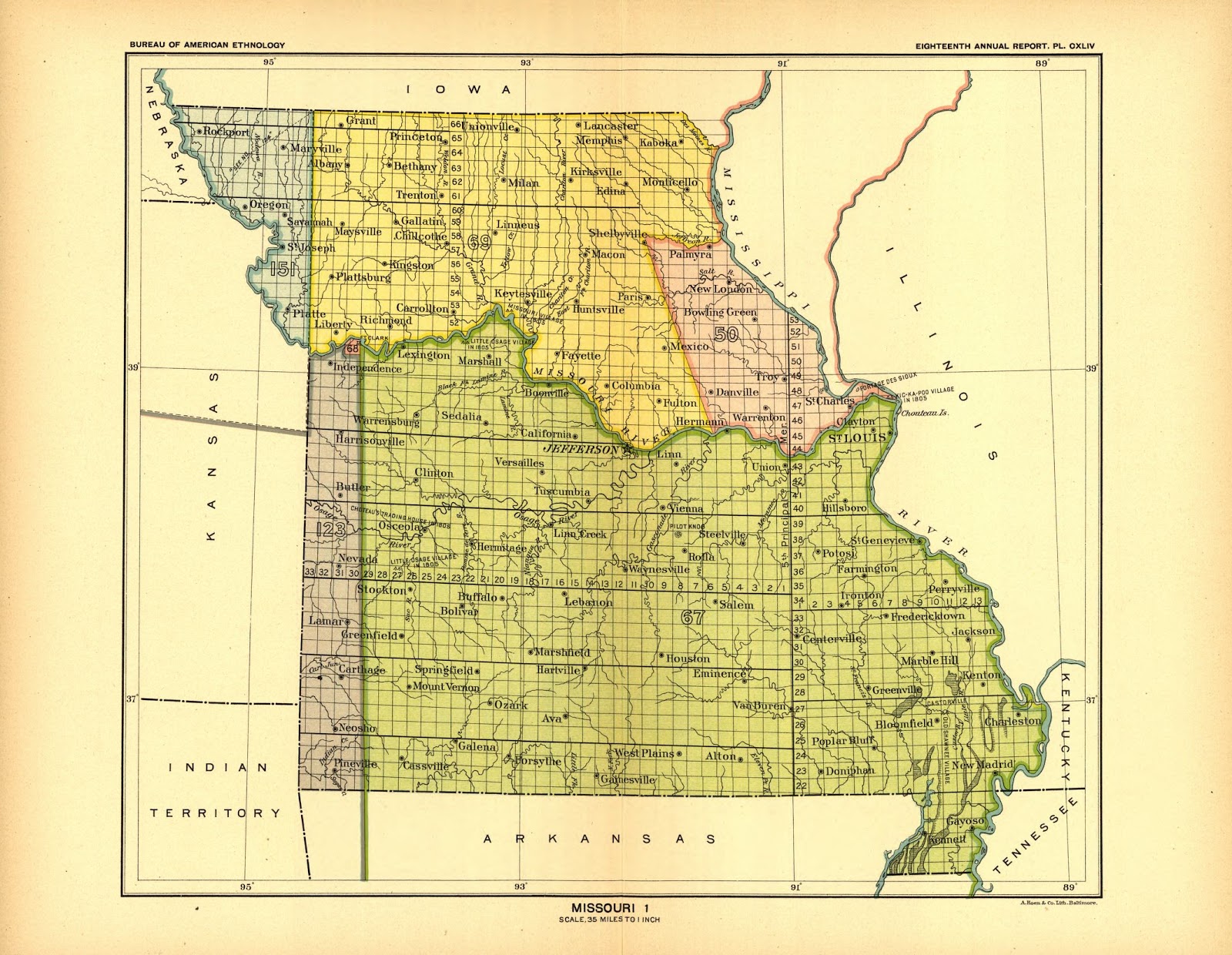
Did you know the name “Missouri” is a Siouan Indian word? It comes from the tribal name Missouria, which means “big canoe people.” The Missouri Indians were not the only native people of this region, however.
The original inhabitants of the area that is now Missouri included:
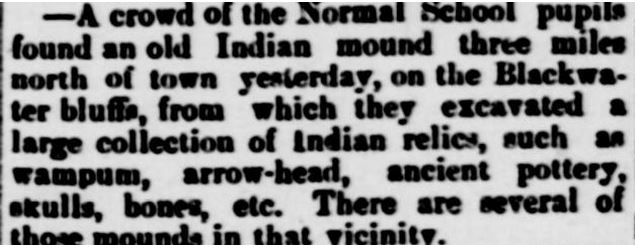
Indian Mounds North of Warrensburg 3 miles
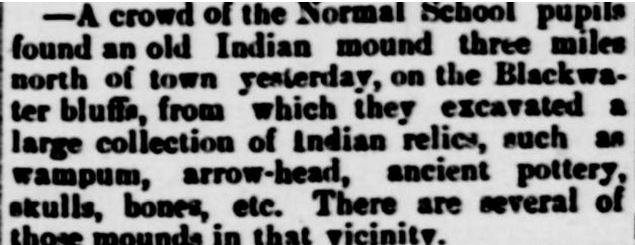
The sandstone quarries, two miles north of Warrensburg, are sketched more fully in the city history. Indian Mounds. An old Indian burial place has recently been discovered on the farm of Mr. H. Spiess. The present indications are three large mounds within a radius of a few rods. These mounds are supposed to have been the work of the ancient mound-builders, who inhabited all this portion of North America, long before the Indians of more recent day had made the conquest of the Mississippi valley. The mounds have been dug into, and various relics found, some of which are preserved in the collection of curiosities at the normal.
The writer made an examination of these mounds, and found, among other things, a large molar, rib, and piece of a cranium, all of which bore unmistakable evidence of great age, and that they were the remains of an ancient Mound Builder. The largest mound is twelve yards in diameter, and six feet high. It contains a cell or vault 10 x 12 feet, built up with flat stones, brought from the creek, one half mile distant. In this narrow house the bodies of the chiefs were interred. The other two mounds are similar to the first, but smaller. Oak trees, from one to two feet in diameter, are now growing on and about the mounds. It is supposed that, at the time these mounds were built, great numbers of that race dwelt in this locality. Warrensburg may have been the center of a great settlement of Mound Builders. White Sulphur Springs, about three miles north of Warrensburg, on the farm of Mr. McFarland, boils up from the bottom lands, one-half mile west of Post Oak. The taste and odor of sulphur is very strong, and it leaves a deposit of the same mineral upon debris over which the water flows. curb has been placed in the excavation, and it is rendered easy of access for all who desire its valuable medicinal waters.
From the History of Johnson County, MO 1881
The Sedalia Bazoo, March 26, 1878
Lewis and Clark’s expedition first encountered the Missouri settlements in summer 1804, when the Missouri were away buffalo hunting and their villages were empty. The Missouri were farmer-hunters, growing and harvesting corn, beans, and squash, but also hunting bison and other game to supplement their diet. At one point, Clark lamented that the Corps might pass through the region before the Missouri returned.
For more than a hundred years the Missouri Indians lived in earth-covered homes along the river that bears their name, at the river’s junction with a tributary called the Grand River. But six years before the arrival of Lewis and Clark, the Sauk and fox Indians swept down from the northeast to defeat them. The survivors established villages south of the Platte River in what is now part of Nebraska.
But on July 28, one of the corpsmen met a Missouri Indian, who told Lewis that his band of about 20 lodges had recently joined surviving Oto. Both populations had been recently stricken with smallpox; now only about 250 people survived. Lewis and Clark sent out a party to this village, and on August 2 the men returned with a small group of Oto and Missouri.
The next day, at modern-day Council Bluffs, Iowa, Lewis and Clark held their first meeting with western Indians, setting the pattern for future such councils. Amid great pomp and ceremony the Corps marched in their full uniform regalia, demonstrating their weaponry and distributing gifts to those chiefs they felt were of sufficient rank.
Despite the success of these first meetings, Lewis still wanted to meet with the head Missouri chief, Big Horse. A search party went out and on August 18 the Corps finally met with Big Horse and Oto Chief Little Thief.
The discussions centered on trade and peace negotiations. Lewis wanted the Oto-Missouri to support peace on the Plains and to stop raiding the neighboring tribes. The Missouri and Oto were more interested in a reliable, open-trade system.
Indian Mounds North of Warrensburg 3 miles
The sandstone quarries, two miles north of Warrensburg, are sketched more fully in the city history. Indian Mounds. An old Indian burial place has recently been discovered on the farm of Mr. H. Spiess. The present indications are three large mounds within a radius of a few rods. These mounds are supposed to have been the work of the ancient mound-builders, who inhabited all this portion of North America, long before the Indians of more recent day had made the conquest of the Mississippi valley. The mounds have been dug into, and various relics found, some of which are preserved in the collection of curiosities at the normal.
The writer made an examination of these mounds, and found, among other things, a large molar, rib, and piece of a cranium, all of which bore unmistakable evidence of great age, and that they were the remains of an ancient Mound Builder. The largest mound is twelve yards in diameter, and six feet high. It contains a cell or vault 10 x 12 feet, built up with flat stones, brought from the creek, one half mile distant. In this narrow house the bodies of the chiefs were interred. The other two mounds are similar to the first, but smaller. Oak trees, from one to two feet in diameter, are now growing on and about the mounds. It is supposed that, at the time these mounds were built, great numbers of that race dwelt in this locality. Warrensburg may have been the center of a great settlement of Mound Builders. White Sulphur Springs, about three miles north of Warrensburg, on the farm of Mr. McFarland, boils up from the bottom lands, one-half mile west of Post Oak. The taste and odor of sulphur is very strong, and it leaves a deposit of the same mineral upon debris over which the water flows. curb has been placed in the excavation, and it is rendered easy of access for all who desire its valuable medicinal waters.
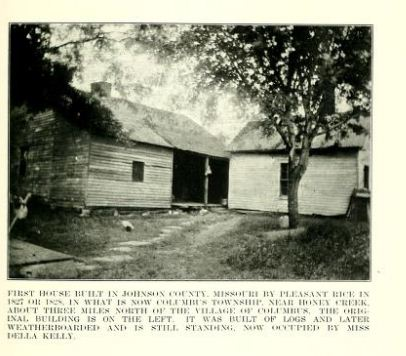
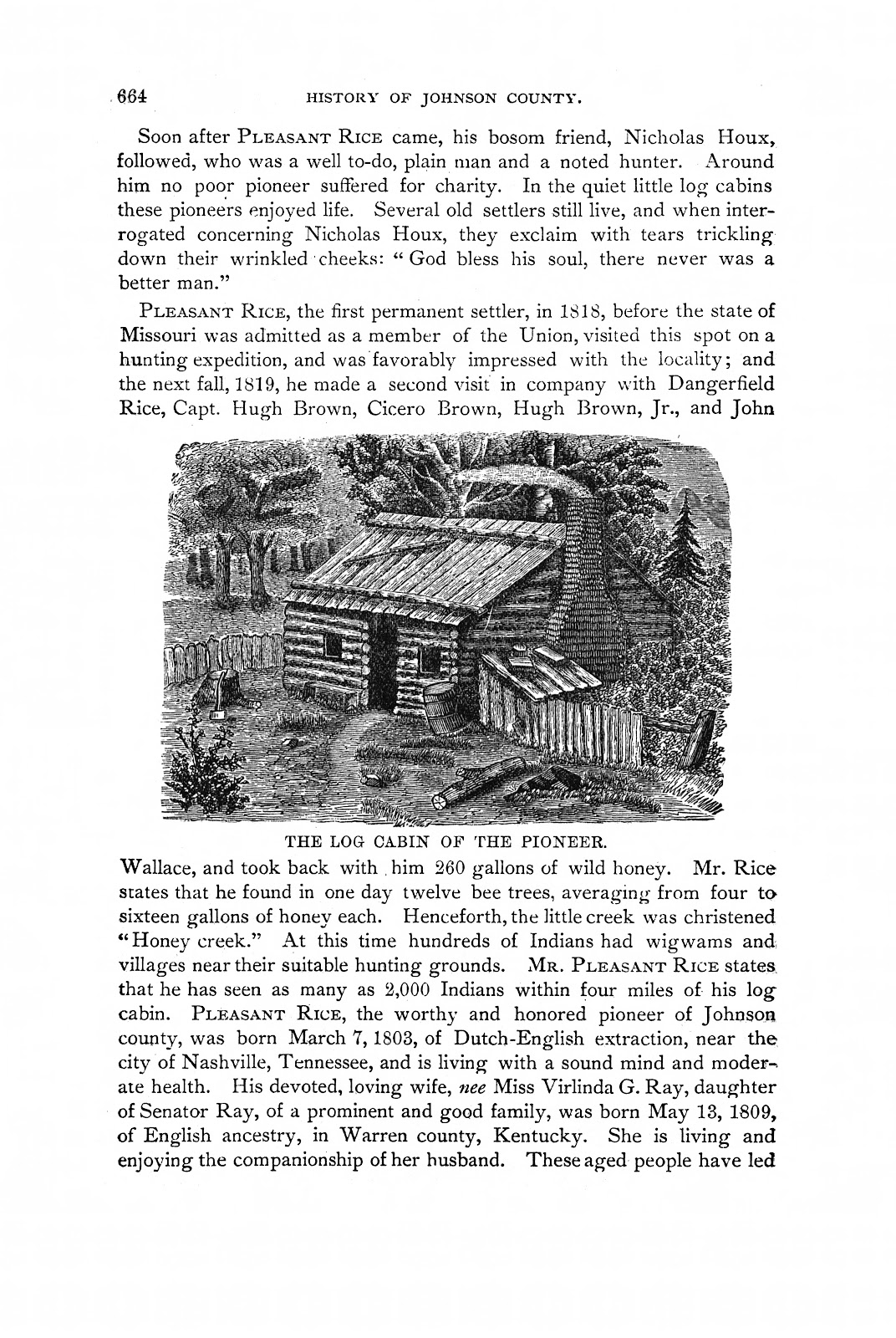
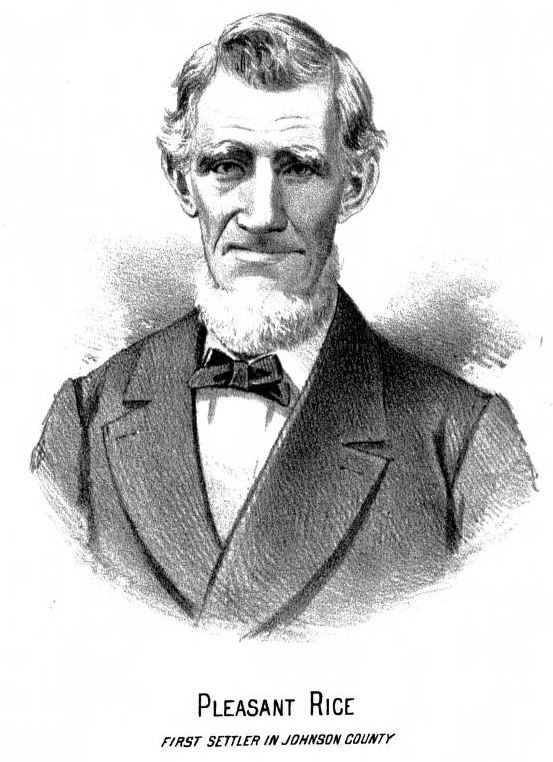
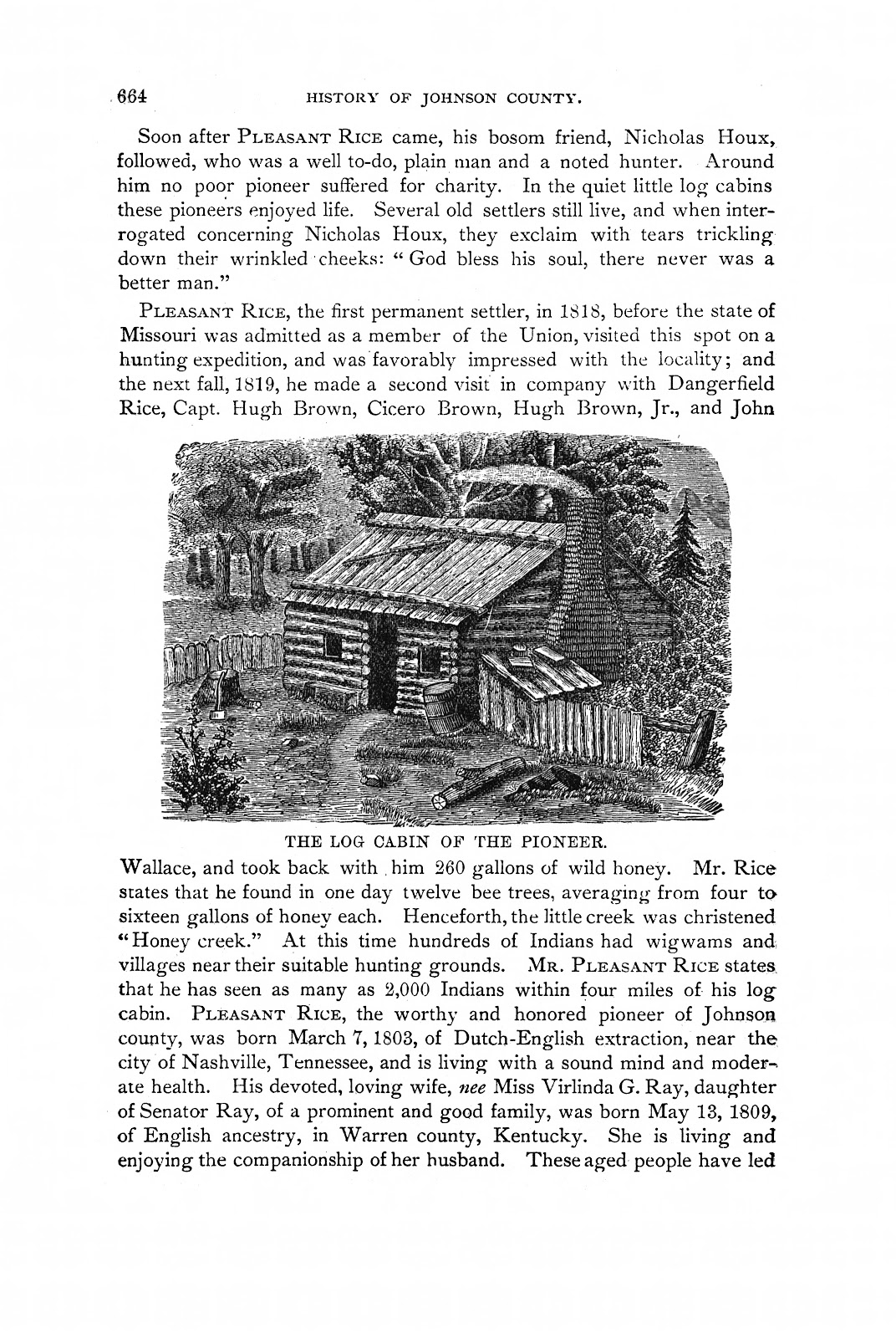
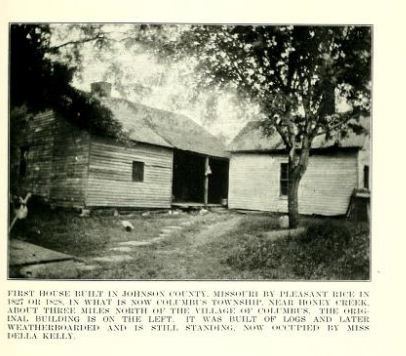
Around Columbus Missouri Pleasant Rice was the first permanent white settler in Johnson County. Nicholas Houx followed shortly after. They both settled in what is now Columbus township in 1827. Pleasant Rice first visited this locality on a hunting expedition in 1818 and in the fall of 1819, returned on a hunting expedition in company with Dangerfield Rice, Capt. Hugh Brown, Hugh Brown, Jr., Cicero Brown and John Wallace. They got on this expedition, besides various game and fur, two hundred and sixty gallons of wild honey. Mr. Rice stated that he found twelve bee trees in one day, from which he took an average of sixteen gallons of honey each. Henceforth the little creek along which he hunted bees on that occasion was given the name of Honey creek. At that time hundreds of Indians had their wigwams along the creeks near suitable hunting grounds. Mr. Rice estimated that he saw as many as two thousand Indians within a radius of four miles of his log cabin. He settled with his family on Honey creek in section 10 township 47 on a place which is now owned by Mrs. Kelly, grandmother of Charles L. Gillilan, ex-county assessor. Part of the old building which he first erected is still standing. It is fourteen feet square and was covered with clapboards and weight poles. The logs were chinked with mud and the door swung on wooden hinges and was fastened by a wood latch, the string of which was always said to hang on the outside. The chimney was built of mud and sticks. This old hut was built by Pleasant Rice with the assistance of a negro, and the logs used in its construction. Since then the old clapboards have been dispensed with. It has a new roof, and the log walls have been covered by siding, and it is now used as a kitchen.
Pleasant Rice was born near Nashville, Tennessee, March 7, 1803. He was of Dutch and English descent. His wife, to whom he was married August 26, 1826, bore the maiden name of Virlinda G. Ray. She was a daughter of Senator Ray and came from a prominent Kentucky family. She was born in Warren County, Kentucky, May 13, 1809. Mr. and Mrs. Rice were the parents of thirteen children, ten of whom grew to maturity, four sons and six daughters and many of their descendants are now living in Johnson County.
Nicholas Houx was born in Maryland of French and German ancestors. His parents moved from Maryland to Kentucky and he and five other sons moved later to Missouri. He married Miss Rachel Maxwell, just before leaving Kentucky. He and his bride came on horseback to Missouri, bringing all their possessions with them. They lived first at Booneville for a few years, then a few years at Lexington, and then moved to what is now Columbus township, in Johnson County. Pleasant Rice helped him build his first house. He was a stanch Cumberland Presbyterian, a noted hunter and a successful farmer. He died about 1834, at the age of thirty-three, and left two sons and three daughters.
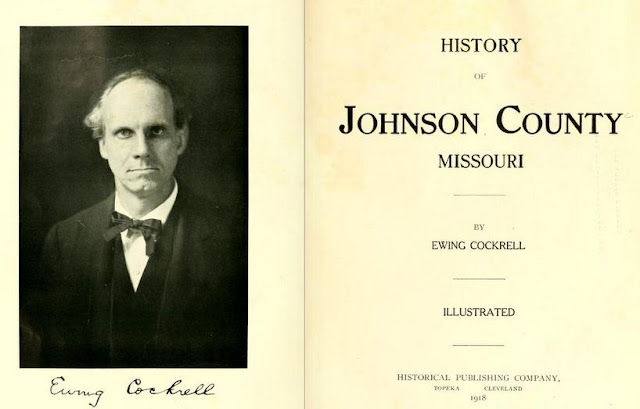
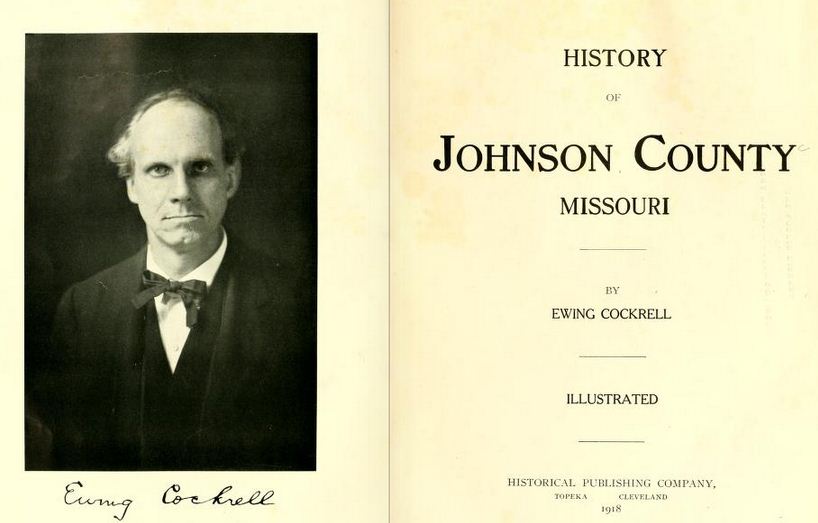
Source: “History of Johnson County, Missouri” by Ewing Cockrell, 1918Discovering Johnson County’s Historic Trails and Early Roads
Over the past year, we’ve received numerous inquiries about the origins of our county roads and the reasons for their current routes. To shed some light, here’s a brief overview based on historical records.
Few people today are aware that an ancient Indian trail once meandered through Johnson County. This historic route extended from the Osage River, near present-day Warsaw, heading in a northwesterly direction. It entered the county southeast of Warrensburg, crossing the city along Gay Street near the Grover dwelling and continuing north toward Lexington on the Missouri River. Chosen for its ease of travel, this trail navigated around hills, marshes, and treacherous fords, providing a narrow path that accommodated only one traveler at a time.
Before permanent settlement in Johnson County, travel across the region was limited. The primary travel route was north of the county, along the Missouri River, which formed part of the Santa Fe Trail extending from Old Franklin to Santa Fe, New Mexico.
When settlers arrived, they sought to create a road from Warsaw to Lexington. At that time, Lafayette County stretched from the Missouri River to the Osage River, resembling a long, narrow ribbon. Although parts of the county had been surveyed, there were no established farm lines or fence rows to contend with. Recognizing the trail’s suitability for travel, the state highway was aligned along it. Today, remnants of this old route can be seen about a mile southeast of Warrensburg. Portions of the road also traverse cultivated land. Notable segments include the public road running east from the southeast corner of Section 18, Township 46, Range 25 North, and another that ascends the hill by just north of Warrensburg. As we travel these roads today, we follow the same path that Native Americans used for centuries.
Another significant trail was the Shawnee Trail, located in the southwest part of the county. Described in the Johnson County History of 1881, this trail began at Shawnee Mound in Henry County—a favored resting place for the Shawnee. From there, it passed by Chilhowee Township, continuing northwest through Rose Hill Township to Center Knob near Kingsville. The old Clinton to Independence Road followed this trail.
By Joyce Dorrell
Source. History of Johnson County 1881 County Roads file in Resources.
COLUMBUS TOWNSHIP.
From a historic standpoint Columbus township is second to none in Johnson County. Here the first permanent settlement in Johnson County was made in 1828. Columbus township was originally a part of Jackson township but was established according to its present boundaries May 12, 1870. It was named for Christopher Columbus.
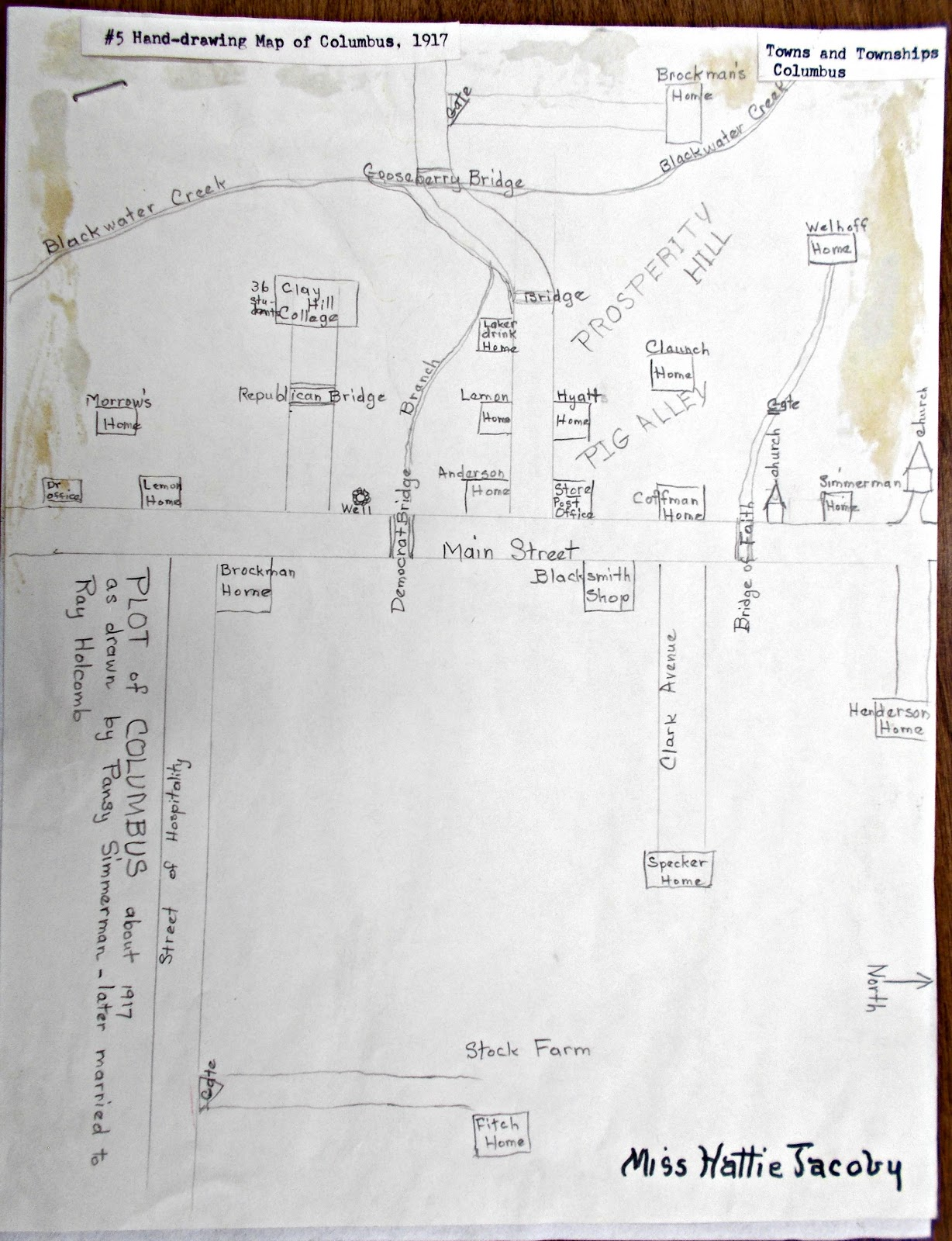
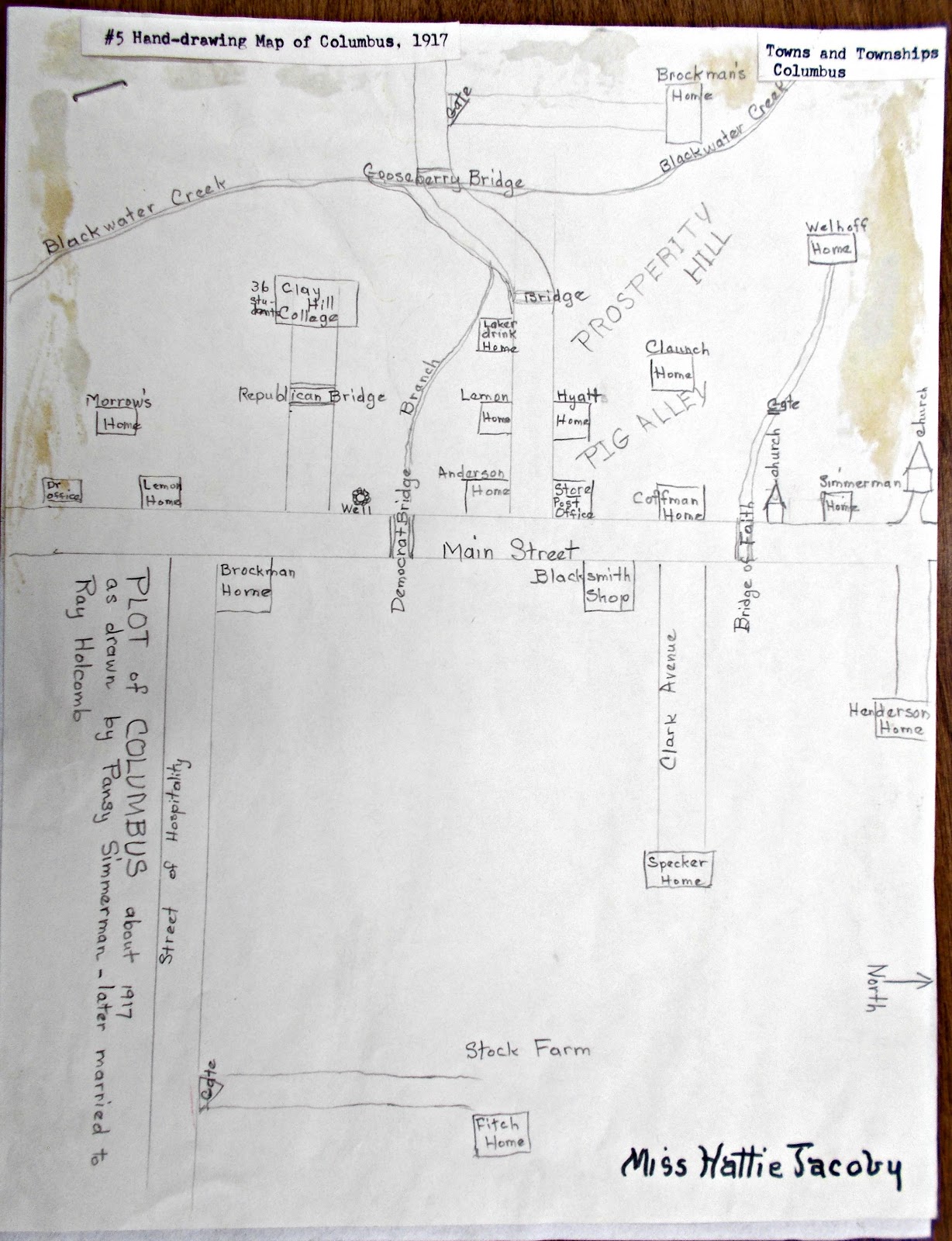
Columbus, Missouri Johnson County 1917 Hand Drawn Map provided by Miss Hattie Jacoby. Drawn by Pansy Simmerman about 1917.
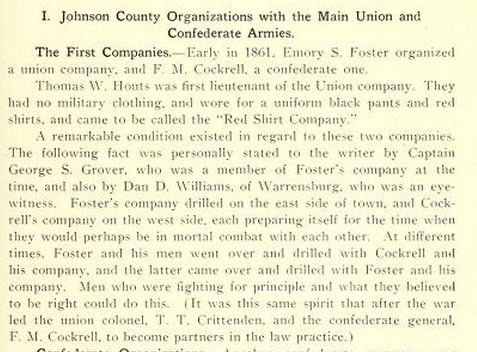
The following is a list of early settlers in what is now Columbus township: Pleasant Rice, Nicholas Houx, Robert King, Dr. Robert W. Rankin, John Whitsett, Thomas Evans, John Evans, David Norris, Samuel Ramsey, John Kelley, Uriel Jackson (who had the first horse-mill in the county), Moses Pinkston, Jesse Marr, Thomas Windsor, Richard D. Bradley, Sr., John Furguson, Elmore Douglas, Morgan Cockrell, Jonathan Fine, B. H. Fine, Prince L. Hudgins, William Logan, Isaac Garrison, James Morrow, Uriel Murray, David Morrow, William Davidson, Joseph Cockrell (the father of F. M. Cockrell, United States Senator), Josiah Beatty, William Kincaid, J. Washam, James C. Francis, Col. Ambrose, Toombs, Benjamin Runnels (who was a soldier under Gen. W. H. Harrison in his Indian campaign), Benjamin Matthews, C. D. Cobb, Love S. Cornwell, James Perdee, Robert Craig, N. W. Lowrey, James C. Strange, a gentleman by the name of Edwards (who was a tailor in the town of Blackwater, and who is the father of Senator Edwards, of Lafayette county), Peter Drace, Levi Simpson, William C. Baker, T. Simmerman, Jesse Kelley, Robert D. Morrow, William Horn, I. Reese (who was sheriff at one time), Thomas Claunch, J. H. Miller, J. W. Henderson, Dr. E. D. Schreiner, R. R. Dalton, Abel. Gilliland, Rev. William Horn, Reason Offnit, William E. Cocke, R. Sanders, J. P. Murray, R. Rudolph, P. H. Drace, John Kitchen, J. Kinder, William Ramsey, W. T. Herndon, M. Davis, J. Harner, B. W. Boisseau, J. Pickel. C. Gautt, Z. T. Davis and James M. Fulkerson, the first physician in Johnson’ county.
The first child born in what is now Columbus township, which was also the first birth in the county, was Margaret Ann Rice, daughter of Pleasant Rice. She was born April 7, 1829, was reared to maturity, married, and died October 6, 1870.
The first death was Mrs. Chitwood and the location of her lone grave has long since been forgotten.
First Mill.-The first mill was erected in 1830 by Uriel Jackson. It was a two-horse mill and the process of grinding was slow and tedious. Later the owner went to the Osage river, where mill stones could be cut from the rock and brought home a pair of burs, after which the process of grinding was speeded up in that locality. The second mill to be built was Wade’s mill on the Blackwater. This was operated by waterpower and was quite a pretentious mill for its day and age.
Early Physicians. -Dr. James Monroe Fulkerson was the first physician of the county. He was born in Lee county, Virginia. His father settled in Lafayette county in 1849, when James M. was only eighteen years old. Doctor Fulkerson received his medical education at Cincinnati, Ohio. In 1834 he came to Columbus and made his home at the residence of Nicholas Houx, and a short time afterwards married Elizabeth C. Houx, daughter of Nicholas Houx. Doctor Fulkerson became a very wealthy man and was prominent in the affairs of the county. When the Civil War broke out he owned a large number of slaves and about three thousand acres of land. He served one term in the state Legislature from Johnson county. He served as surgeon in the Osage Indian War and was also in the service during the Mormon War of 1834.
Doctor Brooks also practiced medicine here at an early day.
First Court. -The first court met at the residence of Nicholas Houx.
First Post Office. -The first post office was at the town of Columbus in 1832, and the first postmaster was William Kincaid, who served for some time. He was followed by Josiah Beatty, Jerry Washam and Charles D. Cobb. At one time the office was kept at Blackwater.
First Store. -The first store was erected in 1836 by William Beatty. Houx operated a tannery and P. L. Hudgins kept a whiskey shop. Later Hudgins left Columbus and started the town of Blackwater, which was laid out in March 1836, about one mile south of Columbus, near the creek. Hudgins was afterwards converted, gave up the whiskey business, and became a preacher and was regarded as a man of some talent.
Early Churches. -About the time of the first settlement here Rev. J. B. Morrow began preaching. For a time, there was preaching in the residence of Nicholas Houx. Regular monthly meetings began in 1829. The first church, a log structure, was built shortly afterward and camp meetings were held in the grove as early as 1831. On this occasion Rev. Finis Ewing, great-grandfather of the writer, and Rev. Samuel King, founders of the Cumberland Presbyterian church, were present. The Reverends Robert King, J. B. and R. D. Morrow were also there. The first Sunday school was organized in 1834. John Harris and James Morrow were active in Sunday school work and instrumental in the first organization. A preacher’s institute was organized here and taught by Rev. J. B. Morrow. This school was started in 1834 and abandoned two years later.
The Cumberland Presbyterian church was organized here in 1830 by Rev. R. D. Morrow, but they had no building until 1837, when a log house was erected. In 1847 they built a brick church. Among the early pastors of this church were Reverends Robert D. Morrow, James H. Houx, John A. Prather, S. Finis King, A. VanAusdol and A. A. Moore. Some of the first members of this congregation were Nicholas Houx, Rachel Houx, James B. Harris, A. Harris, Isabelle Foster.
The Methodist Episcopal Church, South, is prominent among church organizations of Columbus township. The Methodist church was organized here in 1843, and the following ministers seem to have served this congregation prior to the Civil War: Thomas T. Ashley, 1843; Daniel S. Capell, 1844-5; E. E. Degge, and Silas Williams, D. A. Leeper, J. Chase, T. C. James, W. M. Pitts, James A. Cuming, R. A. Foster, A. Williams and W. M. Pitts, up to 1858-9. Some of the ministers since 1866 were: H. W. Webster, 1866-7; M. Minshall, H. N. Watts, M. Doreen, W. J. Brown, T. P. Cobb, J. C. Daily, E. W. Woodard, John D. Wood and J. D. H. Woolridge, 1880-81.
The Church of Christ was organized by Elder D. Young. In July 1865, this church was reorganized and three years later, a frame building erected at a cost of two thousand dollars. Among the early pastors of this denomination, we find the names of Hiram Bledsoe, C. A. Hedrick, G. W. Longan, D. M. Granfield and E. M. Monsert, E. A. Cheat-ham, Samuel B. Stark, James Meyers, W. E. Frakes and Ralph Green-well were some of the original members.
Early Cemeteries. -The cemeteries in Columbus township were among the oldest in the county. The first one was at Columbus and Nicholas Houx was the first to be buried there.
Columbus cemetery contains the last resting places of many of Johnson county’s pioneer citizens and there are numerous tombstones in this burial ground bearing the epitaphs of several prominent early settlers, among them hundreds of men and women who were identified with the early history of this county. Among the countless number are the stones bearing the following inscriptions: “Nicholas Houx Died August 9, 1831 Aged Forty-two Years.” The widow of Nicholas Houx afterward married Jonathan Fine and a marker at her grave gives the date of her death as December 29, 1857. “Dr. Frederick D. Fulkerson Died August 18, 1857.” “Pleasant Rice Born March 7, 1803-Died May 9, 1892.” Virlinda G., Wife of Pleasant Rice, Born May 13, 1809-Died June 10, 1890.” “Reverend Robert D. Morrow, D. D. Born December 26, 1796-Died January 23, 1869. “Here rest the remains of the first Cumberland Presbyterian missionary to the state of Missouri. He was ordained by the Logan Presbytery, February, 1819, was an active minister of the Gospel fifty-three years, was an humble and devoted Christian, a learned and eminent divine. His death was peaceful and triumphant.” “Elizabeth M., his wife, born August 7, 1802. Died December 29, 1880.” “Baxter Ewing Morrow Born June 9, 1824-Died July 25, 1890.” “Ann S. Dinwiddie, Wife of Allen Wallace 1809-1857.” There are many more stones marking the graves of scores of residents of Columbus and Columbus township, whose names are indelibly written on the pages of township history. The memorial tablets of stone erected long, long ago impress the visitor with the flight of time and the older people with a train of reminiscences and memories of the days of seventy years ago, when other forms were familiar and frequently seen, moving amid the scenes of early pioneer life in Johnson County.
Early Schools. -The first school in the township was taught by Z. T. Davis at the farmhouse of Robert Craig, in 1833. Notable among the early teachers were Mr. Maum and his wife, Louis McCoy, Joshua Rogers, James Francis, Rev. Ben Love, Ben A. Bradley. Rev. R. D. Morrow was also a capable teacher of the early days. Among later teachers of the township were W. C. DeWitt, John Sarency, C. A. Potterf, Albert Potterf, Miss Nannie Dalton. Waldon school was established in 1868. The first director was James Middleton. Its early teachers were S. M. Corman, Henry Harmon, Mattie Gaskin, Minnie Morrow, Maggie Brown, William Cook, D. W. DeWitt, D. B. Longan, W. C. Naus, Jennie C. Woolsey, Albert Dunbar, Charles A. Potterf, S. P. Culley, Henry C. Potterf, Eula Tracy, and A. J. Sparks.
Justices.-The justices of the peace of Columbus township, as far back as the records go, with the dates of their election are: 1870, C. W. Hesser, John B. Edwards; 1878, James Mosby, W. H. Lee; 1882, James Mosby, W. H. Lee; 1886, James Mosby, W. T. DeWitt; 1888, James A. Anderson; 1890, James Mosby, James Tuttle; 1894, J. M. Tuttle, David Braden; 1898, John M. Black, James Mosby; 1900, A. J. McMahan; 1902, J. A. Black, W. S. Rankin; 1906, J. A. Black, W. D. Grinstead; 1908, W. S. Rankin; 1910, James A. Black, J. W. Henderson; 1914, James A. Black, J. W. Henderson.
County Officers. -The following are the county officers who have been elected from the township, since 1882, with the dates of their election: 1882-1886-1890-John M. Rice (Democrat), county clerk. 1908-1912-Charles L. Gillilan (Democrat), recorder. 1890-1892-1894-James A. Anderson (Democrat), county judge.
County Road County Road improvements made by the township, since this system was established in 1911, were up to January 1, 1918, twenty-three in number, and aggregated $1,319.50 furnished by citizens of the township, and $1,250 by the county. In the amount of this work Columbus ranks third among the townships of the county. Organizations. -The following is a complete list of organizations in Columbus township. Full details of each organization are in this book in separate chapters of the different organizations: Churches-Baptist, Honey Creek; Catholic; Cumberland Presbyterian ; Methodist South; Presbyterian, at Columbus; Presbyterian, Jacoby Chapel.
Fraternal Organizations-Modern Woodmen, Royal Neighbors.
Homemakers Clubs-Greendoor, McCoy. Total number of organizations is ten.
Place name:
Rice’s Branch
Description:
A tributary of Blackwater in the cental part of Columbus Township; named for Pleasant Rice (1803-1893), who settled on the banks of the stream in 1827. Mr. Rice came from Tennessee to Johnson County as early as 1818. (Jeff Coffman; HIST. JOHNSON (1881), 661; Ferguson’s “Pleasant Rice First White Man to Settle in Johnson County,” Warrensburg Star Journal, August 23, 1930)
Source:
Johnson, Bernice E. “Place Names In Six Of The West Central Counties Of Missouri.” M.A. thesis., University of Missouri-Columbia, 1933.
Pleasant Rice Cabin, First Resident and Residence in Johnson County, Missouri
First house built in Johnson County, Missouri by Pleasant Rice in 1827 or 1828 in what Columbus Township near Honey Creek about three miles is now North of the village of Columbus. The original building is on the left. It was built of logs and later weatherboarded and is still standing, now occupied by Miss Della Kelly. Carol Bodenhamer Dunham’s great great great grandfather, Pleasant Rice, first resident of Johnson County
Pleasant Rice, First Settler of Johnson County, Missouri 1827
For ages the names of heroes have been given to places and things. During the history of America, its great men have been honored in the name of numberless counties, townships, cities, towns, municipalities and post offices. Robert Macklin White, a member of the Missouri state legislature at the time when Johnson County was organized, presented the name to the general assembly, which the county now bears. His recommendation was adopted December 13, 1834, to name the county in honor of Richard Mentor Johnson. R.M. Johnson was born near Louisville, KY, October 17, 1870, and died in Frankfort, November 19, 1850. At the age of 23 he was elected to the Kentucky legislature. Subsequently he became a member of the United States Congress, being elected to both the House and Senate. In 1836 he was a candidate for vice-president on the Van Buren ticket and again in 1840. He retired to his farm in Scott County, KY.
The first county court meeting was held April 13, 1835, at the residence of Mrs. Rachel Houx, near the present site of Columbus. Amos Horn had been appointed Justice of the County Court with John Townsend being appointed clerk pro Tem and James Carmichael filling the position of assessor. On the second meeting of the County Court, held on May 4, 1835, Richard Hancock was appointed collector for the county. It was at this time that the county was divided into four townships: Jackson, Washington, Jefferson and Madison, which roughly divided the county into quarters, with Jackson being to the NW, Washington to the NE, Madison to the SW and Jefferson to the SE. As of 1881 the four original townships had been divided by the following additional townships:
     Warrensburg        October 3, 1846
     Post Oak           February 14, 1849

     Hazel Hill         June 10, 1856
     Grover             February 9, 1869

     Chilhowee          May 15, 1868
     Columbus           May 12, 1870

     Rose Hill          August 17, 1869

     Kingsville         May 12, 1870
     Simpson            January 23, 1875
     Centerview         November 17, 1870

 Johnson County (MO) Historical Society


You must be logged in to post a comment.