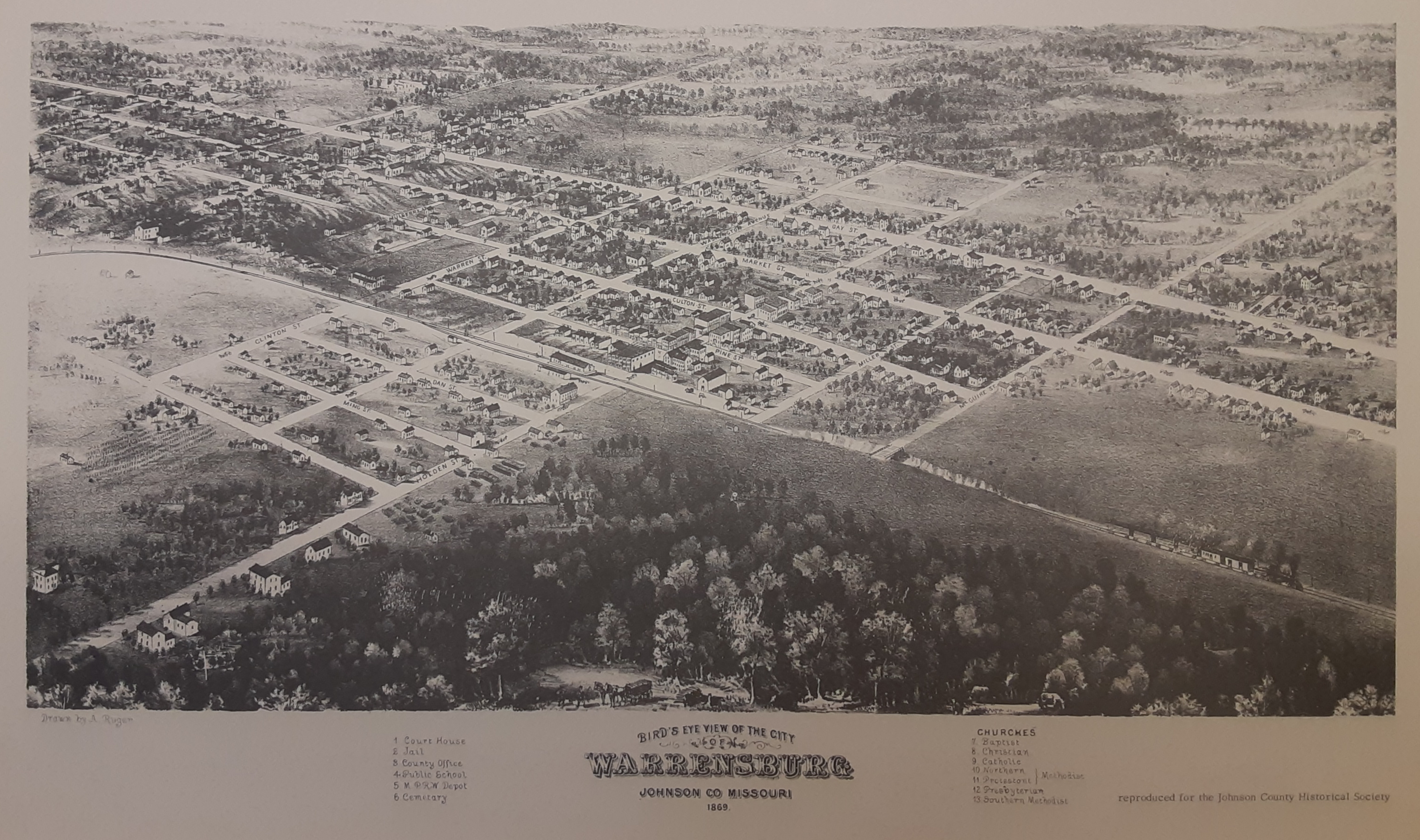
1869 Birds Eye View of Warrensburg Missouri
The County Seat and Home of the Johnson County Missouri Historical Society.
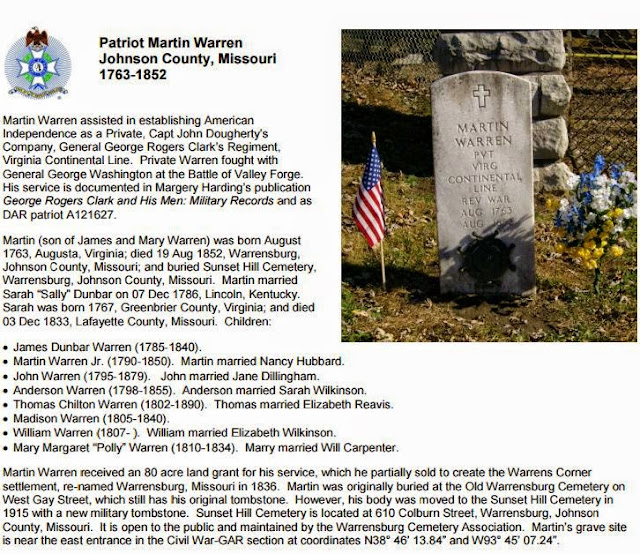
MARTIN W. WARREN (JAMES, SAMUEL, WILLIAM, JOHN) was born Aug 1763 in Augusta Co., Virginia, and died 18 Nov 1852 in Johnson Co., Missouri. He married (1) SALLY DUNBAR Bet. 1775 – 1780 in Lincoln Co., Kentucky, daughter of JOHN DUNBAR and SARAH CHILTON. She was born 1765 in Amhurst Co., Virginia, and died 1833 in Lafayette Co., Missouri. He married (2) RUTH COLE Abt. 1835. She died 06 May 1845 in Dover, Missouri.
MARTIN W. WARREN: Martin came to Missouri in 1819, first to Howard Co., then Lafayette Co., then to Johnson in 1832.
The town of Warrensburg, Missouri in Johnson County is named for him. He was a veteran of the Revolutionary War.
The son of James Warren, Martin joined the Revolutionary War under the leadership of Captain John Daugherty and General George Rogers Clark at 18 years of age. From 1781 to the end of the war in 1783, Martin served either in the militia or the regulars in the “Illinois Department” which mainly fought on the western frontier. Survival was vicious in the frontier as unpredictable guerrilla warfare often took the place of conventional warfare.
The Warrens moved from either Maryland or Virginia into Kentucky and would later move to Missouri in 1816. Years later, in 1833, Martin Warren would finally settle in Johnson County, three whole years prior to any thought of placing a town in this location. His Revolutionary War service land grant entitled him to 80 acres of land which he took within the confines of present-day Warrensburg. At the time, the acres consisted of nice quality timber and a prairie perfect for Martin’s occupation as a farmer. Martin proceeded to build one of the largest log houses in western Missouri with two main connecting rooms on the main level, each about 20 square feet apiece. Each room had large chimneys, one made of stone and the other created out of bricks while the upper level contained a hall, another room, and an attic. A separate 20 square foot building was created to the west of the main house and used as a kitchen as was customary at the time out of fear of fires.
It would appear that Martin Warren may not have been overly excited about the possibility of placing a town in this locale. When Martin was asked if he would be willing to sell some farmland in order to create a town in this vicinity, Warren is reported as saying either one or both of the following:
“I do not believe in starting any more one-horse towns; but, [I] will give you what land you want on top of the hill. I will not ruin my good farmland.”
“I wouldn’t give up good farmland for another one-horse town.”
Either way, Martin Warren eventually gave in and sold the property up on the hill and Warrensburg received its official start on May 9, 1836.
At 70 years old, Martin Warren would marry again, this time to a lady named Ruth Cole. About a decade later, Martin would sell his farm to a prominent citizen named Benjamin Grover who would later have to be sued before all payments were made for the land and log cabin he had acquired. The entire conflict would not be resolved until after Martin Warren’s death at his son Thomas’s house on the Cliff Baile Farm (located 13 miles southwest of Warrensburg) on August 19, 1852.
Published on Psychology Today (http://www.psychologytoday.com)
“A Man’s Best Friend is his Dog”: The Senator, the Dog, and the Trial
By Stanley Coren, Ph.D.
Just about everyone has heard the old saying “A man’s best friend is his dog,” or some variation of that phrase. However, I doubt that very many people know where that adage came from. It can be found in the transcript of a trial, and it was part of one of the most memorable closing arguments ever made by a lawyer. The trial was held in Missouri in September of 1870, and it concerned the killing of a dog.
The case revolved around a black and tan hound named Old Drum, who was the favorite dog of a farmer named Charles Burden. A nearby neighbor, Leonidas Hornsby, owned a considerable amount of livestock. Because Hornsby had lost some sheep, presumably due to attacks by local dogs, he swore to shoot any dog he found on his property. On October 28, 1869, Hornsby found Old Drum wandering near his yard and ordered one of his hired hands to shoot him. Burden immediately sued Hornsby for damages, and the trial quickly became one of the strangest in Missouri history. After several appeals following hearings in lower-level courts, the case eventually ended in an appeal to the Supreme Court.
Both the plaintiff and the defendant were stubborn men and set their ways. In the end they hired the best lawyers available in the state. Old Drum’s owner was represented by G. N. Elliott and John F. Phillips who both went on to distinguished careers as judges, and later by Wells H. Blodgett who became a State Senator, and George G. Vest who served in the United States Senate for 24 years. The dog’s killer was represented by Francis M. Cockrell who was elected as the other United States Senator from Missouri and as served as such for 30 years. His partner, Thomas T. Crittenden, would go on to be elected to the U.S. Congress and later became Governor of Missouri.
It was well understood that that Old Drum was a special hunting dog. He was quite famous in his local area and was much in demand for his tracking and trailing ability. A unique feature was his voice, which could be easily picked out of any pack. It had a deep regular sound, like that from the booming of a drum, which is why Burden gave him his odd name. The dog was fearless, strong, and persistent, and seldom failed to get his quarry. Even Crittenden (one Hornsby’s own counsels), would admit some years after the case had been decided that Old Drum was an exceptional hound and that “the dog was known far and near as one of the fastest, best nosed and least uncertain, and as having the most singular bark.”
At the courthouse in Warrensburg, Missouri the trial began with Judge Wright presiding. By this time the case had attracted considerable interest because of the emotional impact of a fine dog unnecessarily killed in its prime of life, the passion and hostility of the feelings between the individuals involved, and “dream team” of esteemed legal counsels representing the parties involved. The courtroom was crowded with lawyers, witnesses, the supporters of both sides, the press, and the merely curious. The judge was clearly annoyed about the degree of public interest, and the expressions of heat and rage, which seemed to go far beyond what should have been attracted by what he thought should have been a simple civil case. He demonstrated his impatience when he said that he “wanted this dog case fully tried and ended; it has already taken too much time.” This is perhaps why, after the witnesses were heard, despite the esteemed array of lawyers representing both parties, Judge Wright allowed only two closing speeches for each side.
The very last argument in the trial was to be made by George Vest on behalf of Old Drum’s master. Vest had taken a deep personal interest in this case and had stated during the trial that he would “win the case or apologize to every dog in Missouri.” Vest’s closing argument to the jury made no reference to any of the testimony offered during the trial, and instead offered a eulogy of sorts. Only a partial transcript has survived, but it is one of the most enduring and passionate bits of prose to come out of a court proceeding.
When Vest stood those in the courtroom saw a slight forty-year-old man, only five feet six inches tall, weighing about 110 pounds. He had a large head on a short neck, broad shoulders, red hair, a freckled face, blue eyes with a tinge of grey. However, his voice was clear and friendly, and with his charm and ability to tell stories and paint pictures with words became clear when he began to speak.
“Gentlemen of the Jury: The best friend a man has in this world may turn against him and become his enemy. His son or daughter that he has reared with loving care may prove ungrateful. Those who are nearest and dearest to us, those whom we trust with our happiness and our good name, may become traitors to their faith. The money that a man has he may lose. It flies away from him perhaps when he needs it most. A man’s reputation may be sacrificed in a moment of ill-considered action. The people who are prone to fall on their knees to do us honor when success is with us, may be the first to throw the stones of malice when failure settles its cloud upon our heads. The one absolutely unselfish friend that a man can have in this selfish world, the one that never deserts him, the one that never proves ungrateful or treacherous, is his dog.
“Gentlemen of the jury, a man’s dog stands by him in prosperity and in poverty, in health and in sickness. He will sleep on the cold ground where the wintry winds blow and the snow drives fierce, if only he may be near his master’s side. He will kiss the hand that has no food to offer; he will lick the wounds and sores that come from encounter with the roughness of the world. He guards the sleep of his pauper master as if he were a prince. When all other friends desert, he remains. When riches take wing and reputation falls to pieces, he is as constant in his love as the sun in its journey through the heavens.
“If fortune drives the master forth an outcast in the world, friendless and homeless, the faithful dog asks no higher privilege than that of his company to guard against danger, to fight against his enemies. And when the last scene of all comes, and death takes the master in his embrace and his body is laid away in the cold ground, no matter if all other friends pursue their way, there by his graveside will the noble dog be found, his head between his paws, his eyes sad but open in alert watchfulness, faithful and true even in death.”
The defendant’s lawyers Crittenden and Cockrell fully expected to emerge victorious, but after Vest started speaking they realized that they had failed. People present at the trial reported that when Vest finished, there were few present in the courtroom, the jury included, whose eyes were dry. Some said that the jury’s foreman appeared to lead the rest in weeping. Recognizing that their cause was lost, Crittenden is said to have whispered facetiously to his partner, “We had better get out of the courtroom with our client, else all might be hanged.”
In the end Burden won and received a token award of fifty dollars. However much more than this was accomplished by the chord struck by Vest’s words. If you ever go Warrensburg, Missouri, on the southeast corner of the current Johnson County Courthouse lawn, you will find a bronze statue of the much beloved black and tan hound, Old Drum. It was erected in 1958 with the help of contributions from dog lovers throughout the United States. The sculpture is of a hunting dog standing on all fours, with his tail relaxed and low and his head up. On the front of the concrete base is a bronze plaque on which you will find the words of George Vest’s final argument which not only moved the jury to find in Burden’s favor but also is the origin of the familiar and much believed summary of our relationship to canines, “A man’s best friend is his dog.”
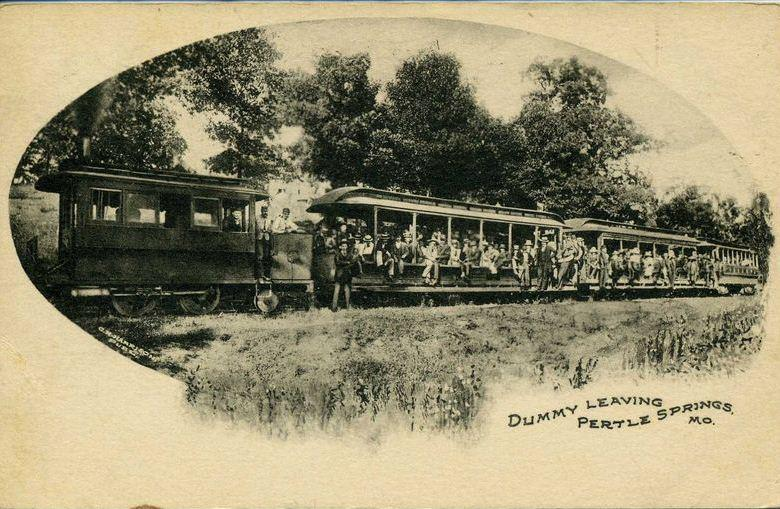
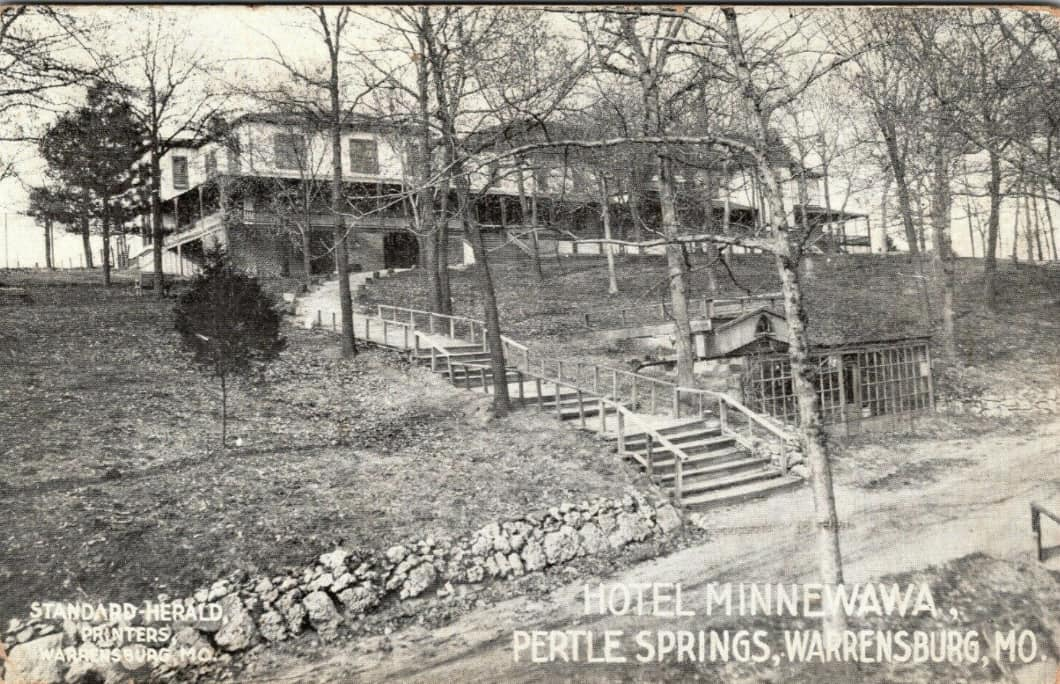
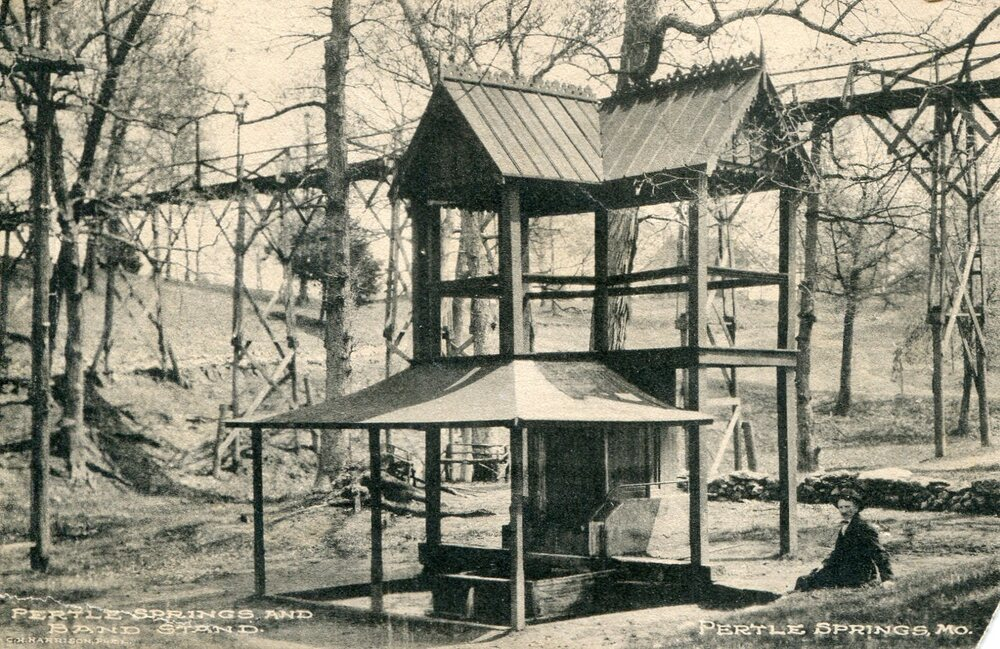
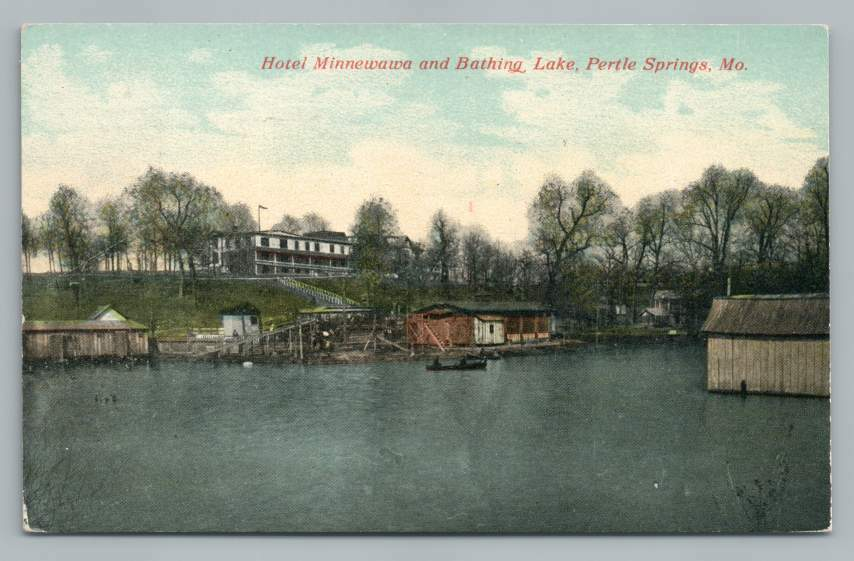
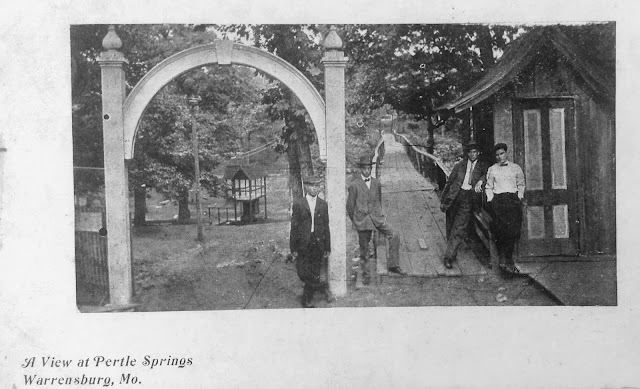
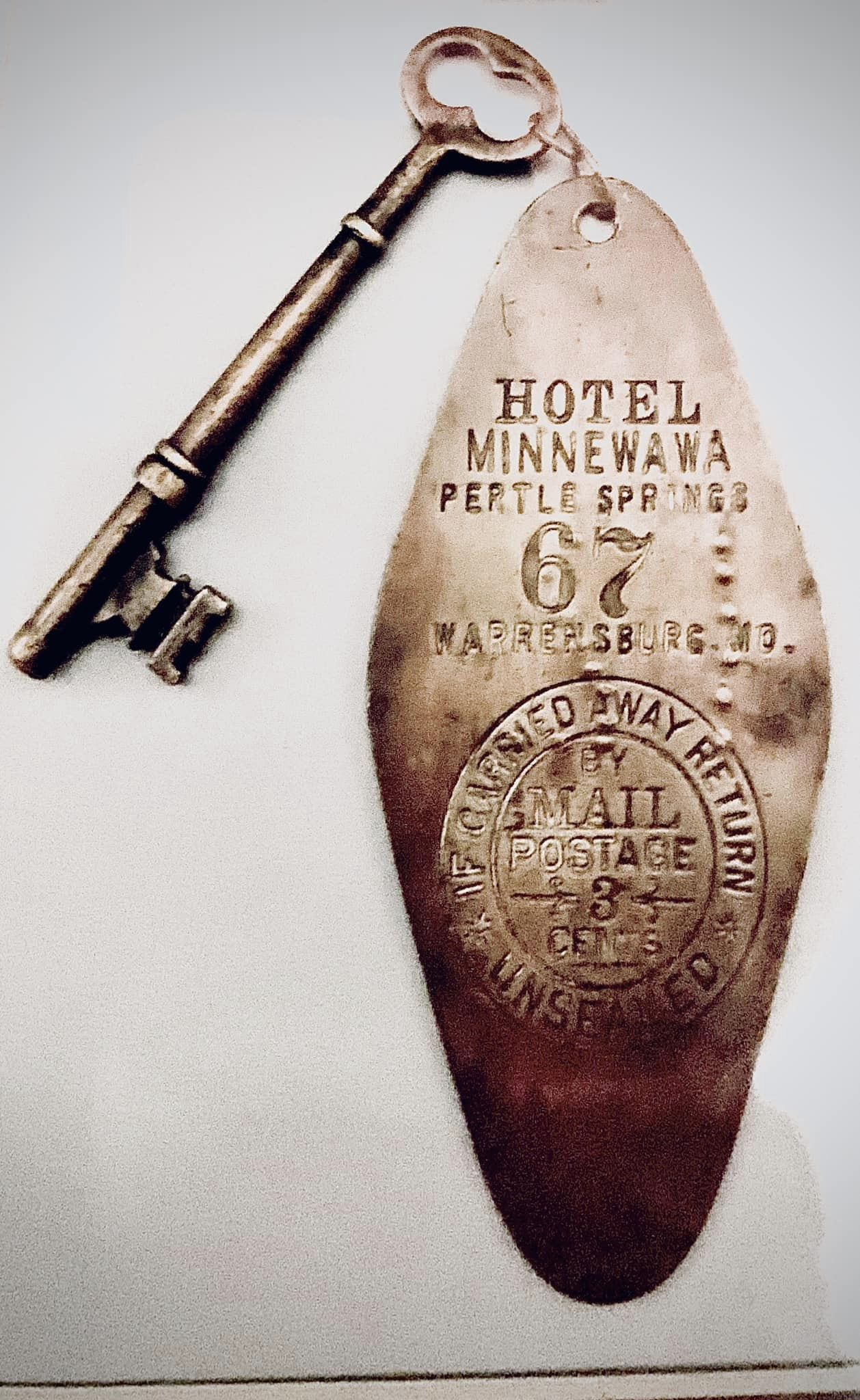
PERTLE SPRINGS
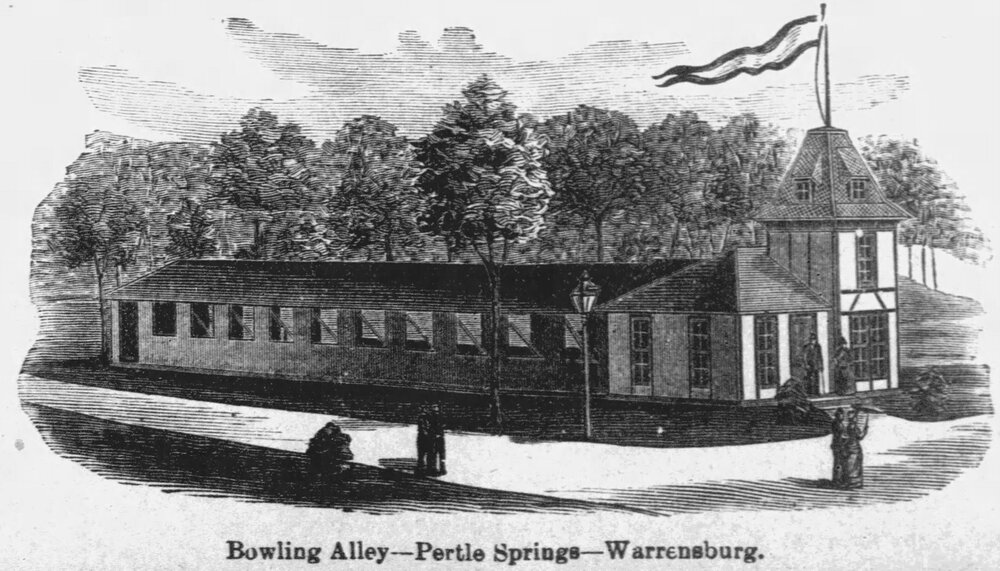
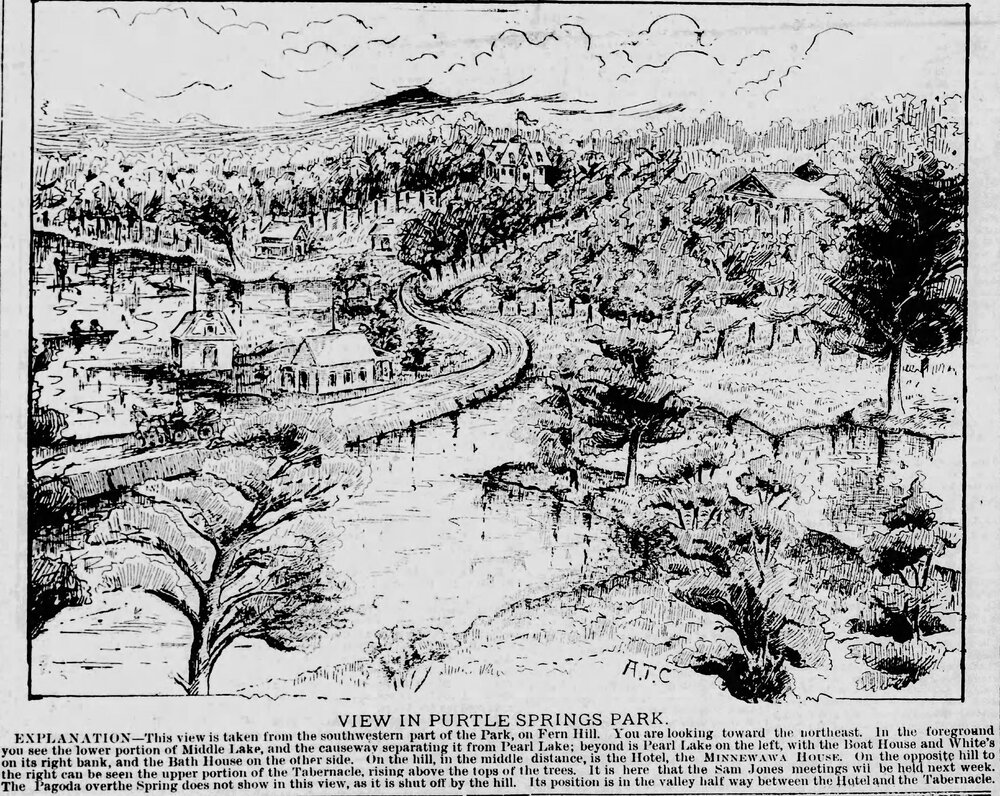
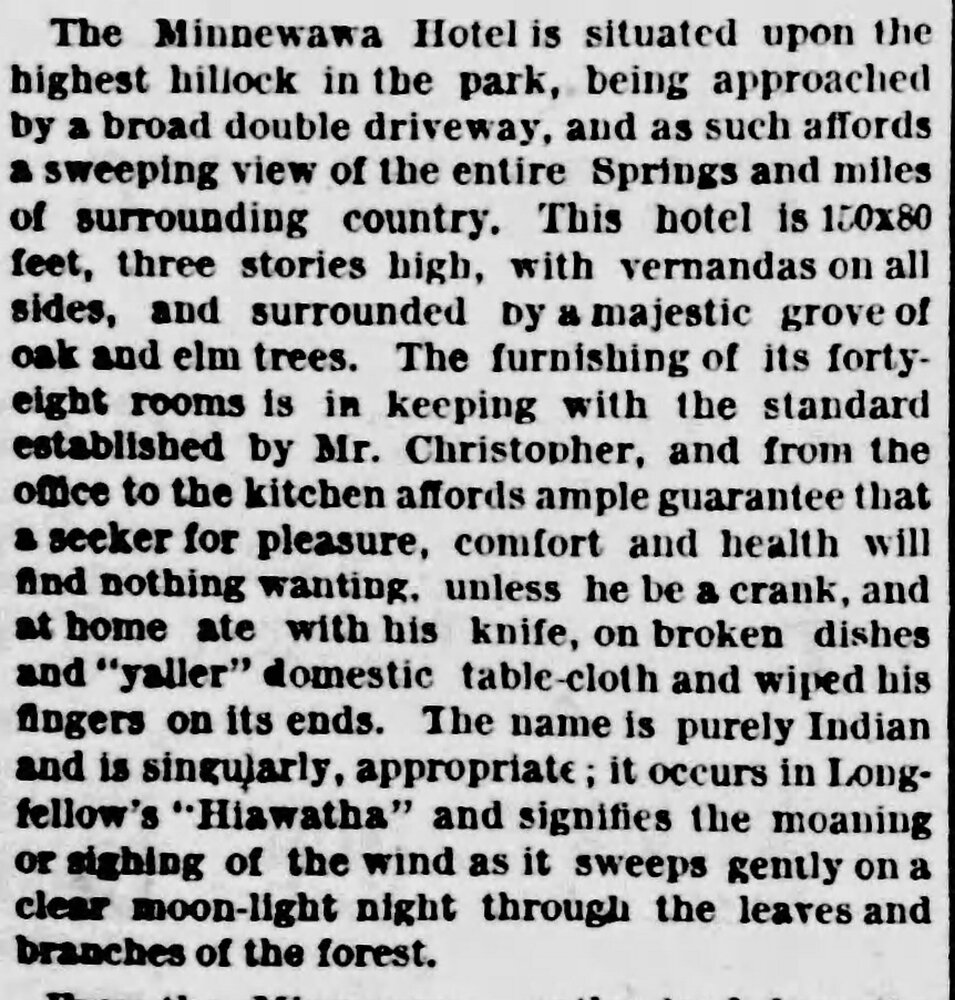
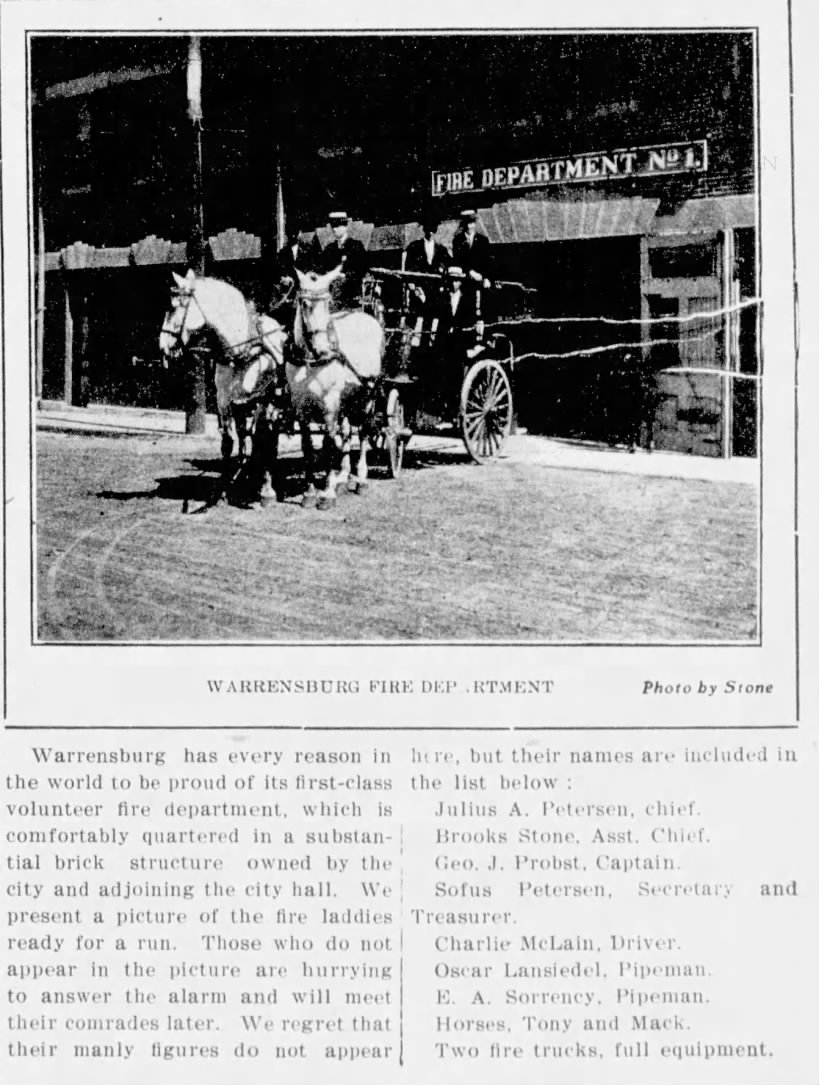
1911 Wbg. Fire Department


Sherriff Burke, Murray Q Williams (One of the first owners of the drug store after the Vernaz brothers both passed) and Sam Barton in front of Vernaz Drug Store 116 W. Pine St. Warrensburg Mo. 1925.
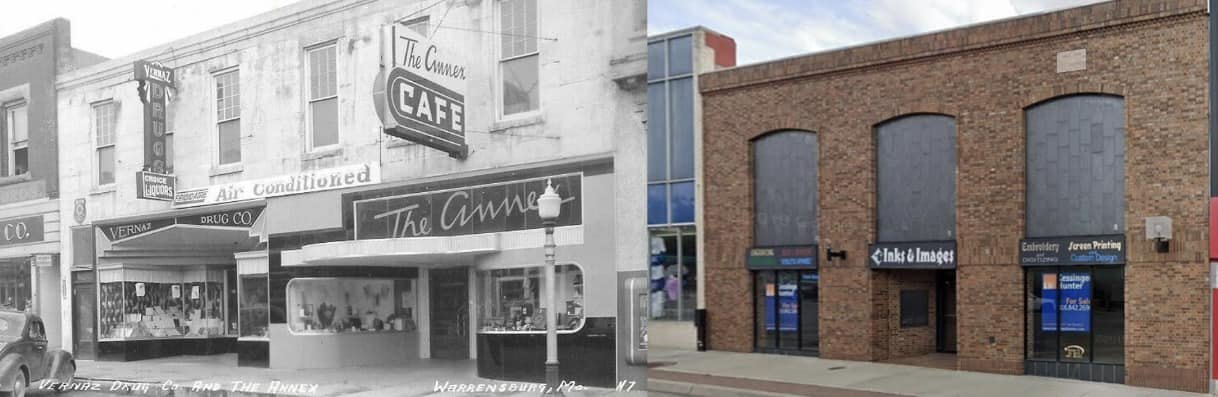
Vernaz Drug then and now.
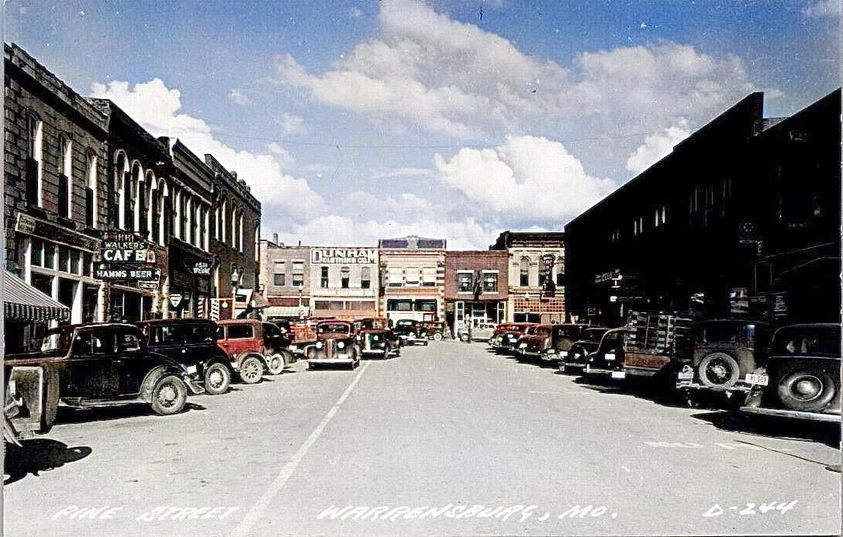
1942 View of W. Pine St. Looking East
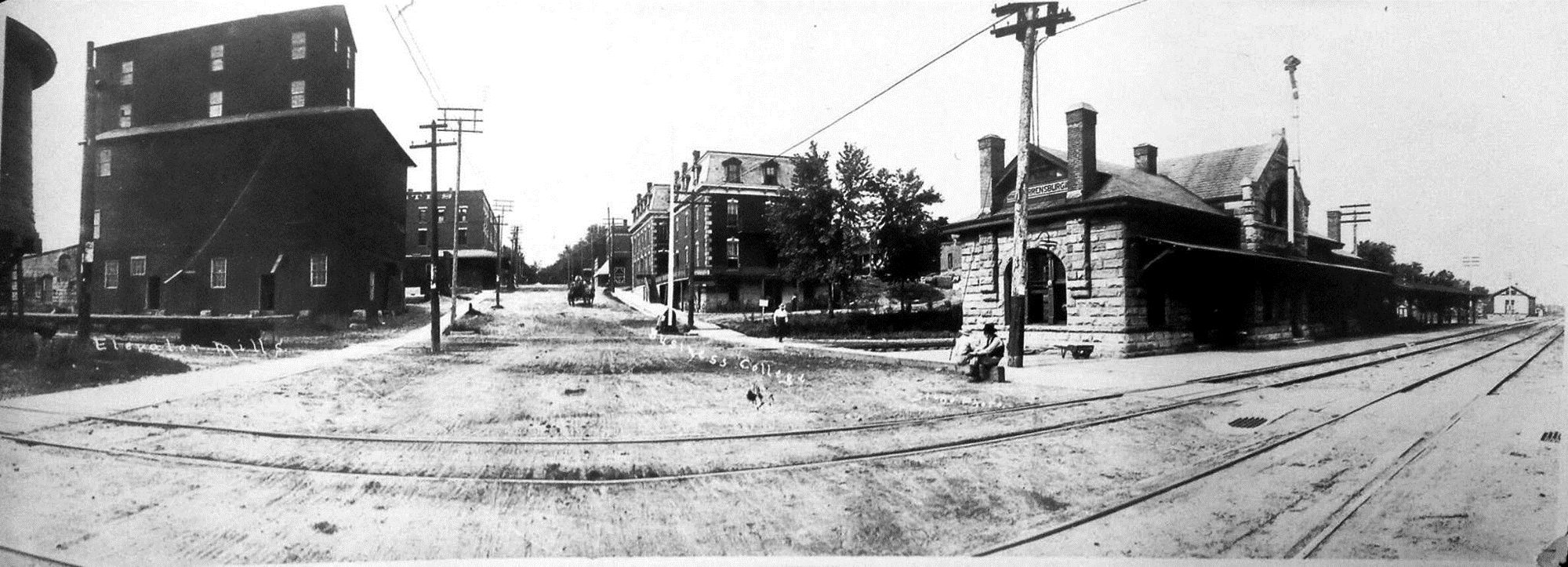
1900 looking South on Holden St in Warrensburg, MO
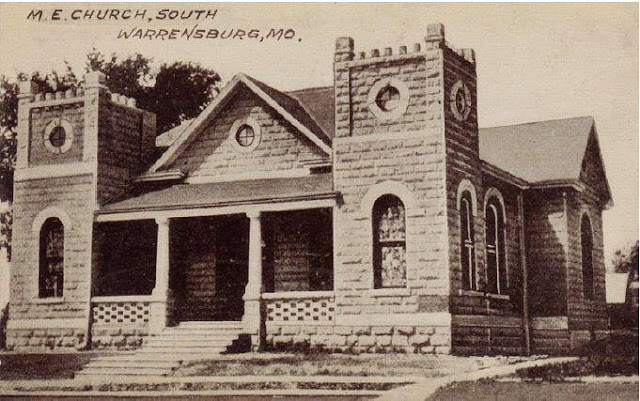
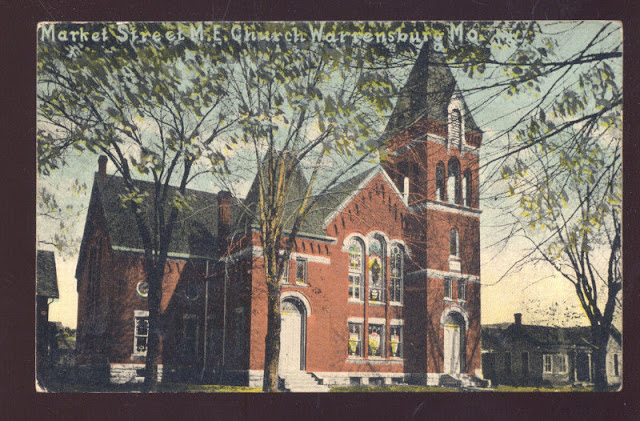
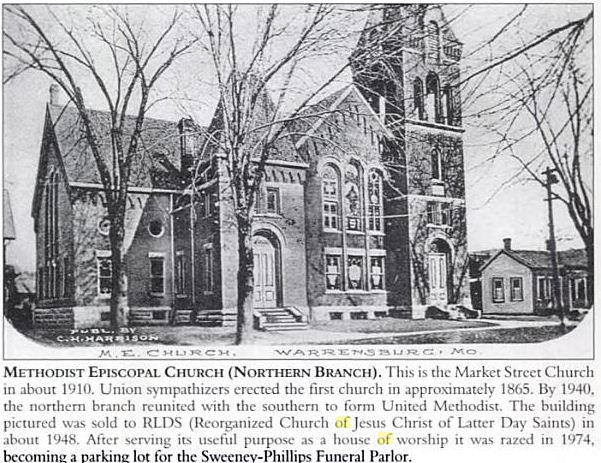
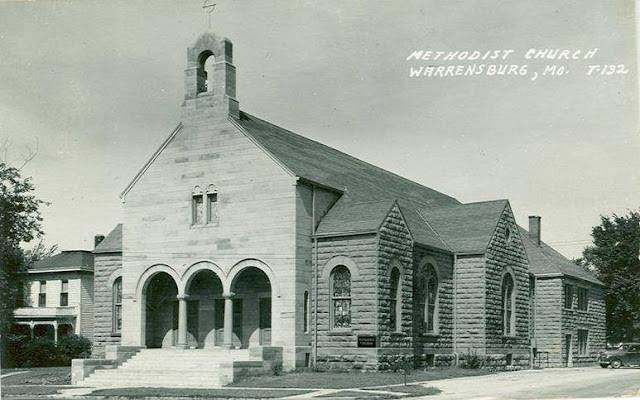
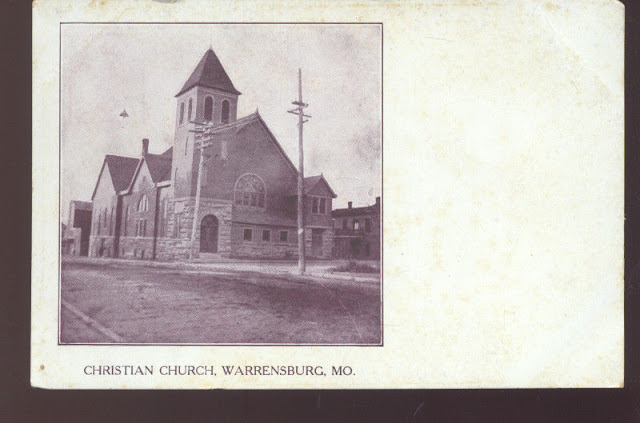
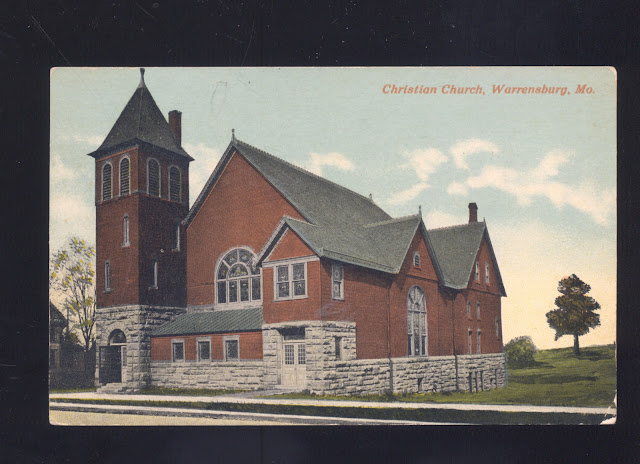
Churches
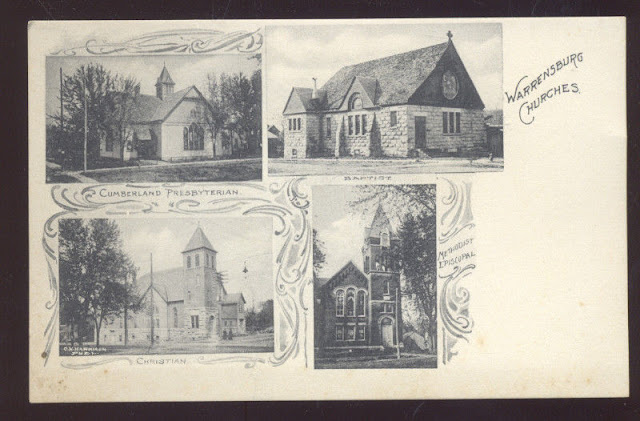
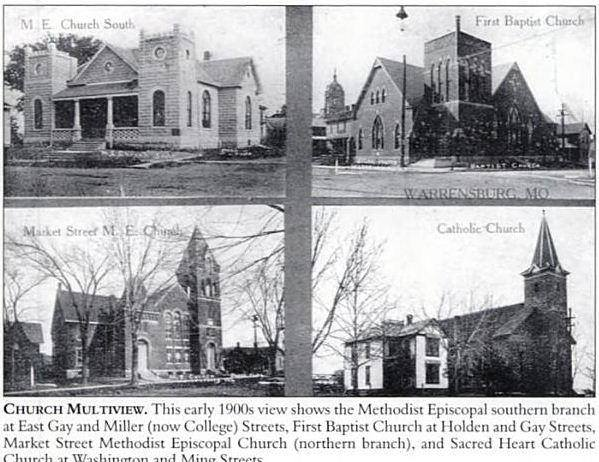
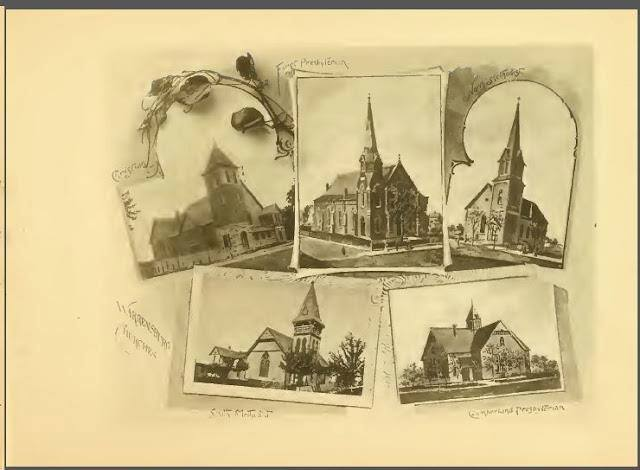
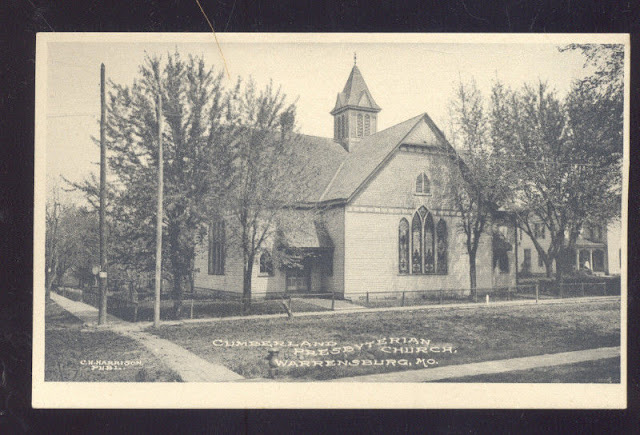
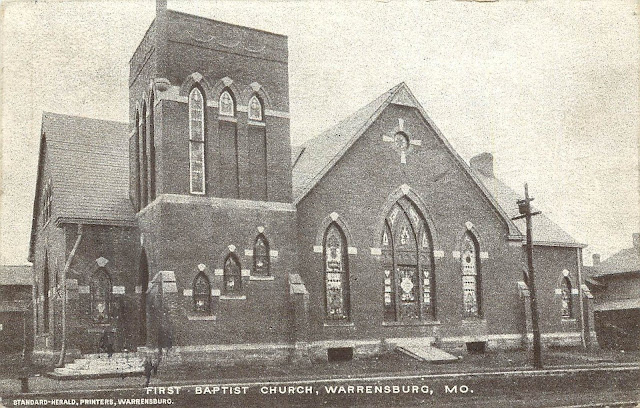
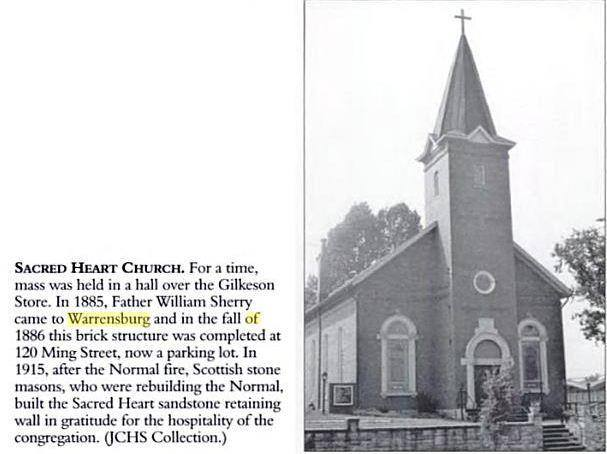
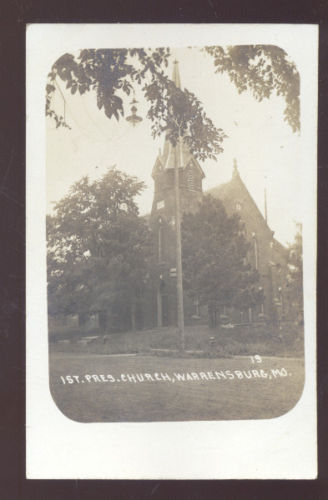
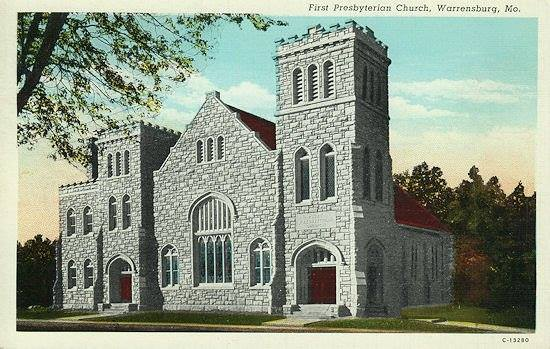
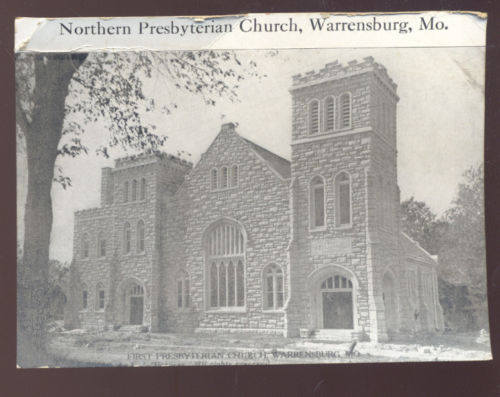
Notable Structures
Heroes Restaurant & Pub, 107 W Pine
Built in 1875, altered by 1940
History
107 W. Pine St. has served as a storefront for local businesses since 1875, originally starting out as a grocer’s store. Through its life it has been a book and stationery store in 1895, a recreation store in 1958-1967, and Tom’s Auto Parts in 1972. Today, the building is home to a local staple—Heroes Restaurant & Pub—that has been a part of the downtown scene since 1981.
Fun Facts
- Hungry? Grab a basket of onion rings and a burger for dinner at this local pub!
- In 1945, Andrew Smitzer was granted a license to sell 5% alcohol beer at his cafe here.
Architecture
The two-story two-part commercial block has brick cladding and a flat roof. A ventilated parapet caps the building. The storefront configuration divides the primary (south) elevation into two bays. A vinyl door with a glazed transom fills the east bay, accessing the second story. A glazed aluminum door with a sidelight fills the recessed entrance in the west bay; display windows flank the door. A transom with plywood infill spans the length of the storefront. Double-hung windows with fixed arched upper sashes and cast stone window hoods and sills fill the four second-story bays. Metal framing for a cloth awning hangs above the first story storefront.
IMAGE [Historical photo] can use the same Pine Street Photo that Alex has in their Area 1.
Parlour Seven 105 E Pine
Built in the 1800s, altered by 1900
History
105 E. Pine St. has served as a storefront for local businesses since 1900, and has changed shape and use many times. It began as a doctor’s office in the 1880s, and was used as a dwelling before eventually becoming the Postal Telegraph Office by 1907. It stayed this way for almost 20 years, before becoming Johnson County Building and Loan in 1923, Wray Loan and Investment Company in 1930, and Baston Insurance in 1958-1972. Salon Vogue, moved away after 10-years of service. It currently houses Parlour Seven, the most recent business to use the storefront.
Fun Facts
- In 1921, subscriptions to Kansas City and St. Louis newspapers were run through 105 E. Pine St. by Ivan Hayden.
Architecture
This one-story one-part commercial block has red brick cladding and a flat roof. A flat parapet with soldier course brick bands and terra cotta tile coping caps the building. The primary (south) elevation has two bays. A two-part aluminum display window fills the west bay; a glazed aluminum door fills the east bay.
IMAGE (this picture below is of West Pine St) We will have to see if there is an East Pine Picture

Java Junction, 112 N Holden
Built 1885
History
112 N. Holden St. has served as a storefront for local businesses since 1885, the most notable of which has been the Wilcoxon Brothers Clothing in 1932, Cut Price Store in 1940, and Stewart’s Shoes 1955- The building has been home to Java Junction, an espresso bar and roastery, since 1995, and has served as a staple of the downtown landscape since then.
Fun Facts
- You could buy tickets for the “grandest, richest and most gorgeous street parade ever seen” in Warrensburg here in 1911.
Architecture
The two-story two-part commercial block has red brick cladding and a flat roof. A flat parapet with terra cotta tile coping caps the building. Corbelled brick courses above the storefront and the second story windows ornament the building. The primary (east) elevation has three bays. On the first story, display windows fill the outer bays; paired glazed aluminum doors fill the recessed entrance in the center bay. A leaded glass transom spans the length of the storefront. Brick window hoods and stone sills frame the window opening in each bay; double-hung vinyl windows with simulated muntin grids fill the openings.

IMAGE 

Black Compass Tattoo Company, 126 N Holden
Built 1883, 2nd floor removed, façade altered in 1963
History
126 N. Holden St. has served as a storefront for local businesses and restaurants since 1883. The most notable of which were a drugstore in 1895, nickel and dime store in 1913, Palace Confectionary in 1931, and Duncan’s Ready to Wear in 1958-1972. Today, the building serves as the home of Black Compass Tattoo Company, a Warrensburg shop since 2016.
Fun Facts
- In 1931 the Ideal Cafe opened, where you could get a regular meal for $0.25.
- In 1899, John McHugh received a license to open a Dram Shop at this location.
Architecture
The one-story one-part commercial block has wood panel cladding and a flat roof. A wood-clad pier frames the north side of the primary (east) elevation. The primary elevation has three bays. A glazed aluminum door with fixed transom and two-part display window fill the angled, recessed entrance in the center and north bays; a display window fills the south bay.
IMAGE [Historical photo]

Rudy’s Frame Shop & Gallery, 122 W Pine
Built 1895, storefront alt. before 1953
History
122 W. Pine St. has served as a storefront for local businesses since 1895. Businesses housed in this building included Commercial Bank in 1898-1907, Johnson County Mutual Fire and Lightning Insurance in 1913, Midwest Auto Store in 1953-1967, and Carter Appliance Store in 1972. The building today is home to Rudy’s Frame Shop & Gallery.
Fun Facts
- The old Commercial Bank began in 1881, it had a unique circular entrance.
- If you had deposited $10 from today it would be $278.15 when the bank first opened.
Architecture
The two-story two-part commercial block has stone cladding and a flat roof. A projecting stone cornice with stone corbels capped with simple capitals ornaments the building. The primary (north) elevation has three bays; the second story fenestration defines the bays. A glazed aluminum door with a fixed transom on the east side of the first story accesses the second story. A glazed aluminum door with fixed transom and a four-part display window resting on a brick bulkhead fills the first story storefront. A fabric awning shades the first story. On the second story, paired double-hung vinyl windows with simulated muntin grids and fixed transoms fill the center bay; single double-hung vinyl windows with simulated muntin grids and fixed transoms fill the outer bays.
IMAGE picture available
INfinite Smiles Photography, 120 W Pine
Built 1895
History
120 W. Pine St. has served as a storefront for local businesses since 1895. Businesses housed in this building included a dry goods and grocery store in 1895-1914. From 1932 to 1972, 118-120 W. Pine housed the Hursh Furniture Company. The building today is home to INfinite Smiles Photography.
Fun Facts
- In 1899, Chas R. Markward claimed to have the “cleanest, handsomest and best lighted” store in the city.
Architecture
The two-story two-part commercial block has brick cladding and a flat roof. A corbelled parapet with metal coping caps the building. The building’s primary (north) elevation has three bays. Wood board and batten siding clads the first story. Vinyl doors fill the recessed entrances in the outer bays. Non-historic aluminum display windows fill the center bay. A fabric awning shades the storefront. Double-hung vinyl windows with cast stone sills and arched brick lintels fill the second story bays.
IMAGE [Historical photo]
118 Cakery, 118 W Pine
Built 1900
History
118 W. Pine St. has served as a storefront for local businesses since 1900. Businesses housed in this building included a music shop in 1907 and furniture store in 1914-1972. From 1932 to 1972, 118-120 W. Pine housed the Hursh Furniture Company. The building is currently home to 118 Cakery.
Fun Facts
- In 1921, you could buy a pair of men’s socks for $0.14 a pair at Kansas City Army Salvage Goods.
Architecture
The two-story two-part commercial block has brick cladding and a flat roof. A corbelled parapet with recessed brick panels and terra cotta tile coping caps the building. The building’s primary (north) elevation has three bays. A glazed aluminum door with a fixed transom fills the recessed entrance in the center first-story bay. Non-historic aluminum display windows fill the outer bays. A fabric awning shades the storefront. Double-hung vinyl windows with cast stone lintels and sills fill the second story bays.
IMAGE [Historical photo]
116 W Pine
Built 1890, alt. in 1930
[No current business.]
History
116 W. Pine St. has served as a storefront for local businesses since 1890. Businesses housed in this building included a grocery store in 1895, Evan’s Apple Orchard in 1931, Dixie Cleaners in 1955-1967, and Family Discount in 1972. The building remained empty after the store moved away or was deemed unnecessary.
Fun Facts
- In 1912, Vernanz Drug Co. was one of the five druggists in town.
- Vernanz Drug Co. gave a free lead pencil to every girl and boy who called their store on Wednesday, September 5, 1900.
Architecture
The one-story one-part commercial block has brick cladding and a flat roof. A flat parapet with terra cotta tile coping caps the building. The building’s primary (north) elevation has one storefront with a recessed, angled main entrance. A glazed aluminum door with fixed transom fills the entrance; display windows flank the door. A structural glass transom spans the length of the storefront.
IMAGE

112 W Pine St
Built 1885, alt. 1920 and 1949
[No current business.]
History
112 W. Pine St. has served as a storefront for local businesses and restaurants since 1885. The most well known of these has been the old Star Theatre. The building was originally a two story dry goods store from its construction in 1885 until the 1920s when Thomas and Charles Goodnight converted it into the Star Theater. Today, the building sits empty after the historical establishment moved away or was deemed unnecessary.
Fun Facts
- In 1912, the Yale Theatre had the newest and most popular moving pictures.
- At the Star Theatre in 1928, you could see shows like “Gentlemen Prefer Blondes” and “That’s my Daddy” for $0.10 and $0.25.
Architecture
The three-story two-part commercial block has textured metal cladding and a flat roof. The primary (north) elevation has three bays. On the first story, two sets of paired glazed aluminum doors with fixed transoms fill the recessed entrance in the center bay. Curved walls flank the entrance; a window in the west wall accesses a ticket booth. Display cases for posters flank the entrances. The angled marquis above the first story retains its historic shape but has non-historic textured metal cladding. The textured slipcover on the second and third stories and the first-story configuration date to a 1949 façade renovation; however, the sign on the slipcover and the textured metal cladding on the first story are non-historic.
IMAGE
Inks & Images 2.0, 106 W Pine
Built 1963
History
106 W. Pine St. has served as a storefront for local businesses since 1963. Businesses housed in this building included Mattingly’s Store from 1958-1972. The current business housed in the building has been there since 1987, and is Inks & Images, now known as Inks and Images 2.0.
Fun Facts
- In 1897, Hines & Co. claimed to be the “Leaders in Ladies and Gent’s Fine Footware”.
- You could buy 20 pounds of sugar for $1.00 at Wright & McNair in 1898.
Architecture
The two-story two-part commercial block has buff brick and structural glass cladding and a flat roof. The primary (north) elevation has three irregularly spaced bays; an engaged brick pilaster divides the west bay from the center and east bays. A glazed aluminum door and aluminum display window fills the east bay. Paired glazed aluminum doors with a fixed transom flanked by aluminum display windows fill the recessed entrance in the center bay; a six-part aluminum display window fills the west bay. Structural glass with aluminum framing clads the second story.
IMAGE [Historical photo]
Wrestling Central, 100-102 W Pine
Built 1915, alt. in 1955
History
Since 1915, 100 and 102 W. Pine St. has served as a storefront for local businesses. Some of the most notable of these include Marr’s Drugstore, Buente Brother’s Drugstore from 1945-1967 at 100 W. Pine and Foster’s Clothing Store at 102 W. Pine from 1932-1972. Today, Wrestling Central uses the building for their storefront.
Fun Facts
- In 1894, you could bring your chickens to Redford & Shockey to sell to business.
Architecture
The two-story two-part commercial block has red brick cladding and a flat roof. A flat parapet ornamented with projecting rowlock and soldier brick courses and cast stone coping caps the building. 102 W. Pine Street comprises the west half of the building; 100 N Holden Street comprises the east half of the building. The building’s primary (north) elevation has four bays. The west half of the building (102 W. Pine St.) has two bays. On the west half, structural glass clads the first story of the primary elevation. The east half of the building (100 W. Pine) has two bays. On the east half, stone veneer clads the first story of the primary elevation. Paired, glazed aluminum doors fill the canted corner entrance in the east bay, a three-part display window fills the west bay. A stone veneer column in front of the entrance supports the building. A fabric awning shades the storefront. Paired one-over-one double-hung vinyl windows with cast stone sills fill the second-story bays.
IMAGE [Historical photo]
Warrensburg Station, 100 S Holden
Built 1890; alt. in 1940 and 1985
History
Since 1890, the Warrensburg Train Station has served as one of the main transportation hubs of Warrensburg, Missouri. It was originally opened by the Missouri Pacific Railroad, and was later renovated in the 1940s. As the town and businesses grew, everything centered around the station, and it still serves as the heart of downtown Warrensburg.
Fun Facts
- In the early 1900s, a small train was connected from downtown Warrensburg to Pertle Springs, which people could use for day trips and fun travel.
- Nearby the train station sits a statue of Old Drum, which was constructed in 1958, it depicts a story that is significant to Warrensburg, and shows the story of “Man’s Best Friend”.
- In 1904, a World’s Fair Passenger Train, crowded with people on the way to St. Louis, crashed with a freight train headed the opposite direction. Twenty-eight people were killed and sixty were injured in the wreck. The accident happened just three miles outside of Warrensburg.
Architecture
The one-story railroad depot has been in continuous use since its construction in 1890. The building has a stone foundation, and features Richardsonian Romanesque stylistic elements such as the gable parapets and arched window openings. A stone water table wraps the building. Tall, narrow window openings with rough-cut stone lintels filled by recessed wood windows pierce the primary and south elevations. A wood-frame shed roof awning spans the primary elevation; arched wood braces spring from projecting stone blocks and support the awning. The arched opening on the east elevation has stucco infill with a glazed aluminum door and flanking windows. A one-story modern addition attaches to the building’s west elevation. The addition has stone veneer cladding and a gabled asphalt shingle roof. A wood-framed gabled awning extends from the historic depot’s awning on the north elevation and spans the length of the addition.
IMAGE

Magnolia Opera House, Loft Apartments, 145 W Pine
Built 1889
History
This extraordinary building has been a historic fixture in Warrensburg since 1889. It has served as a storefront for local businesses, originally starting off as a small copper shop. In 1889 W.H. Hartman and Isaac Markward built the current building at the cost of $18,000 (approx $540,000 today). The building was then leased to the Quarry City Orchestra and they subleased it. The opera area has a seating capacity of 800. In 1893 the opera house started having shows. The first floor was vacant except for a cabinet shop in the rear. In 1907 buggies and implements were being stored and sold on the first floor; the cabinet shop remained in the rear. Businesses also housed in this building included Vitt-Mayes-Garrison Manufacturing Company in 1932-1945 which became the Brookfield-Garrison Manufacturing Company in 1945-1963, and Unitog Company Office and Plant in 1967.
Fun Facts
- The Magnolia Mills building was the temporary morgue (minconception that it was the opera house), next to the railroad tracks after the 1904 World’s fair train wreck. Twenty-seven of the dead were taken out of the wreck and brought to Warrensburg on a flat car. It is said to have been the “bloodiest disaster in the history of the Missouri Pacific railroad” at the time. Thirty people were killed, including many children and 54 people were injured in the high speed collision at Bear Creek on October 10, 1904.
- Santa Claus often made his headquarters here, as early as 1895.
- The Magnolia Opera House hosted several musical groups back in its heyday, such as the Schubert Quartette and the Avelin Joslyn Company. It is difficult to discern if famous pianist “Blind Boone” ever actually performed at the Opera House as this location was typically a “whites only” establishment. Blind Boone played here at least two times.Johnson County Star (Warrensburg, Missouri) 06 May 1893, Sat
- Political speakers such as D.A. DeArmound, a congressional candidate, would also come to the Opera House to promote their candidacies.
- The building was converted to apartments and now houses many UCM students.
Architecture
Two buildings comprise 145 W. Pine St. The east third of the building, constructed circa 1890, is a three-story two-part commercial block. Paired one-over-one double-hung vinyl windows with cast stone sills fill the second and third story bays. Projecting brick panels ornament the façade between the second and third stories. The west two-thirds of the building, constructed in 1889, was historically the Magnolia Opera House. A projecting cornice divides the first and second stories. On the first story; engaged stone pilasters divide the façade into two storefronts.
Image

Magnolia Mills was located diagonally across from the Magnolia Opera House, later, with new owners, it became Innes Mills


All-Starz Barber Shop, 139 W Pine
Built 1925
History
This building has served as a storefront for local businesses since 1888. At this time it served as a 2-story cabinet shop. From 1893-1924 it was a vacant lot and the current establishment was built in 1925. Later businesses housed in this building included Builder’s Wood Products Company in 1972.
Fun Facts
- A furniture manufacturer store, owned by J.G. Houts occupied a space on Pine street, and is suspected to have occupied this location.
Architecture
The two-story two-part commercial block has brick cladding and a flat roof. A corbelled cornice caps the building. Engaged brick pilasters divide the primary (south) elevation into three bays. On the first story, a paneled, glazed garage door fills the vehicular opening in the east bay; a glazed metal door fills the center bay; a vinyl door and aluminum display window fill the west bay. Despite alterations to the storefront, this building retains integrity and clearly communicates its historic commercial function and the era in which it was constructed, rendering it contributing to the District.
Image

Warrensburg Wholesale Carpet, 135 W Pine
Built 1925
History
This building, also called the Gene Stanley building, has served as a storefront for local businesses since 1883, originally starting out as a grocery store. It served as a confectionery in 1888, G.A. Whitman’s tin shop in 1900. In 1925 the building was remodeled. Businesses housed in this building included Dunlop Tire and Rubber Company in 1930, an auto sales and service shop in 1945, Carder Body Shopin 1958-1963, and Warrensburg Wholesale Outlet in 1972.
- Chevrolet garage 20s-30s- and most of 40s
Fun Facts
- Operated by Mr. M.R. Scott and owned by Floyd Jenkins of Warrensburg, the Dunlop Tire and Rubber Co. store opened its doors on West Pine in 1929. This shop was the second shop in the Kansas City area to become a merchandising chain store.
- Mr. and Mrs. Floyd Jenkins were quite the socialites in Warrensburg, often being visited by friends and family from the surrounding area.
Architecture
The one-story, one-part commercial block has buff brick cladding and a flat roof. A corbelled parapet with terra cotta tile coping caps the building. Engaged brick pilasters divide the primary (south) elevation into three bays. A three-part display window and glazed aluminum door fill the east bay; a two-part display window and a garage door fill the center bay; and a four-part display window fills the west bay. A transom infilled with vertical metal siding spans the length of the façade
Image

Green Truck Bakery, 127 W Pine
Built 1880
History
Originally a wagon shop, this building has served as a storefront for local businesses since 1880. Through its life it has been a blacksmith’s shop in 1888, a second hand store in 1907, Maxwell’s Cash Grocery in 1930, and Callison Radio and TV Service 1958-1967. It now houses Green Truck Bakery, a welcome recent local addition to the community.
Fun Facts
- At Maxwell’s Grocery in 1930 customers could buy 48 lbs. of Peacock brand flour for $1.65 which is approximately $20 today.
Architecture
The one-story one-part commercial block has brick cladding and a flat roof. A flat parapet with a projecting stretcher brick course and terra cotta tile coping caps the building. An engaged sandstone pier ornaments the west side of the primary (south) elevation. The building’s primary elevation has two bays. Paneled wood garage doors fill the vehicular openings in both bays. A plywood infilled transom spans the length of the storefront.
Image
Cigawatt, 125 W Pine
Built 1880
History
Originally a local grocer, this storefront has served the community since 1880. Businesses in this building went through various name changes, but remained a grocery until the Callison Radio and TV Service in 1958-1967 and Midwest Auto Store took over in 1972.
Fun Facts
- Mr. Ross, of Ross Brothers Grocery, was a key witness to a gang related robbery in Warrensburg in 1912. He testified that his diamond ring was taken from the store safe which was “blown” in the robbery. His ring was never found or recovered, but the culprit was charged and served three years for robberies that stretched as far as Indiana. *very interesting, just a comment we have a picture when it was grocery store, in a picture I will attach.
Architecture
The one-story one-part commercial block has brick cladding and a flat roof. A flat parapet with terra cotta tile coping caps the building. The building’s primary (south) elevation has one storefront. A glazed aluminum door fills the recessed entrance on the west side of the elevation; display windows fill the rest of the elevation. A fabric awning shades the storefront
Image
The District, 121 W Pine [123-111 W Pine]
Built 1870
History
This location t has served as a storefront for local businesses since 1870. The current establishment consists of what once were five different smaller buildings.
What once was 123 West Pine Street served as a dry goods store in 1883, a cabinet maker and marble shop in 1893, Farley Brothers marble shop in 1900-1907, Mcray ran a dry cleaner upstairs and a tailor downstairs (1914), serving as J.B. Allen Meat Market in 1920, and J.L. DesCombes was a machinist (1930).
What once was 119 West Pine Street served as a saloon with a painting establishment upstairs in 1883, a meat market with a band room upstairs in 1888, a meat market with a photography upstairs in 1893, Heberling and Mayes Meat Market in 1912 and in later years became a shoe store, record shop and then furniture storage.
What once was 115 West Pine Street served as C.H. Harrison’s Book & Stationery Store, became a grocery in 1930, and Williams Furniture took over in 1955.
What once was 117 West Pine Street served as a saloon with a lodge in 1883, Wright Brothers General Store in 1895, and Frank Rutherford Ceylon Tea and Coffee House in 1908.
What once was 111 West Pine Street served as a boot and shoe store in 1883, was used as an office in 1888, McFadden’s Saloon in 1895, John Moriarty’s Saloon in 1902, Thomas Dillards Restaurant in 1912, Walkers Cafe, a dry goods store and in the 1960s served as a photo studio. 111 ½ Pine street was the only building that remained as a single establishment during its time as a barbershop.
What once was 113 West Pine Street served as a dry goods store in 1883-1890s, was vacant for a few years and became the Eagle Cafe in 1920.
Fun Facts
- Mr. Harrison of C.H. Harrison’s Book & Stationery Store, bought out the book and stationery stock of Brooks & Williams, and in 1885 he started selling them at his own store.
- In December 1902 John McFadden, of the McFadden’s Saloon located at 111 W. Pine, passed away and his wife sold the saloon to John Moriarty.
Architecture
The two-story two-part commercial block has brick cladding and a flat roof. A small corbelled cornice caps the building. The primary (south) elevation has four bays. A very tall cast-iron storefront fills the west three bays on the first story. A glazed aluminum door fills the recessed entrance in the storefront’s center bay; display windows flank the entrance. Multi-light transoms pierce the storefront above the display windows and entrance. A vinyl door with multi-light transom fills the east first story bay. Double-hung vinyl windows with arched brick lintels fill the three second story bays.
Image

Johnson County Courthouse, 300 N. Holden St.
Built 1896-98
History
The Johnson County Courthouse hosted its first meeting in 1898. The budget for this building was $50,585 (or over $1 million today), and it was designed by architect George E. McDonald. Since construction, the statue of Minerva that sits atop the courthouse has undergone renovations. Otherwise, this building remains accurate to its original late 19th century construction. This was the County’s third Courthouse.
Fun Facts
- While the building was still under construction in 1897, members of the community secretly paid and demanded that the golden ball on the end of the Goddess statue’s staff be changed to silver. The golden color was described in the newspaper as an “unhallowed badge of the money power.”
- The statue is that of Minerva, Roman goddess of wisdom.
- The courthouse clock was added to the building a year after construction was completed. The original clock had glass, then later wooden hands, and mechanisms run by weights, rather than springs. These weights include a “time weight” of 500 pounds and a “striking weight” of 700 pounds. The striking weight had to be wound every six days.
- In 1996, the courthouse opened a time capsule that had been buried during the 1896 construction. This time capsule contained nine newspapers from the week of August 20, 1896. It also contained a Gray Reunion poster and ribbon, a list of city officials, a roll of the 1896 Johnson County Bar, and three coins from that period. There was also an unopened envelope from the Masonic Lodge, which was given to the family.
- The courthouse has been struck by lightning at least four times: twice before 1928, once in 1940, and once in 1945.
- In 1902, a storm tore the extended arm from the Goddess statue. When employees repaired her, they discovered a deposit of honey left by a swarm of bees.
Architecture
This three and one-half story courthouse was built with Romanesque Revival style architecture. It features a stone foundation and cladding and a complex asphalt shingled roof. This roof includes a central hipped section, lower cross gables on each slope, multi-sloped turrets at each corner, and a central bell tower. Symmetrical rectangular and round-arched windows and doors surround the building, featuring non historic sashes. The building has several other Romanesque features such as stepped parapets, stone belt courses, and grouped columns. The Goddess of Liberty proudly holds her staff atop the bell tower.
IMAGE [Historical photo]
200 N. Holden St.
Built 1895
[No current business.]
History
Though this storefront is currently unoccupied, it has long served as a location for a variety of businesses. It first served as a bookstore and a toy store in 1895, and has since served as Thrift Shop Ready to Wear in 1930 and Walker’s Café in 1958-1972. The café was previously located on Pine street.
Fun Facts
- In 1900, the lower section of this storefront served as Beazell’s Bookshop, and the upper section served as an office for a money lender.
- In 1919, one pound of Folger’s coffee was 55 cents.
- In 1934, a pint of rubbing alcohol cost 14 cents here!
Architecture
This three-story two-part commercial block has brick cladding and an asphalt shingled mansard roof with gabled dormers. A glazed aluminum door with sidelights and fixed transom pierces the south end of the storefront; a two-part display window fills the north end. A flat canopy shades the storefront and wraps around the building to the south elevation.
IMAGE [Historical photo]
Meyer’s Market, 202 N Holden
Built 1895
History
This building has served as a grocery store in 1883, Thurber and Christopher Hardware in 1902, office space, Crescent Groceries in 1914-1916, “M” System Story in 1929-1931, Wenner’s in 1938, American Sales Co. in 1958, Mark Richard Dress Shop in 1963-1967, and Mode O’Day Dress Shop in 1972. Meyer’s Market moved into this location in
Fun Facts
- In 1897, this store was known as Cheatham Bros Grocers, and sold packaged coffee for 15 cents
- In 1902, this store sold clothing such as cloaks, corsets, blankets, skirts, and hosiery.
- Life insurance policies in 1904 could range from $1,000 to $1,000,000. This is equivalent to $31,000 to $31 million.
- In 1916, a pound of Christmas candy was 15 cents!
Architecture
This Victorian Functional two-story commercial block has brick cladding, a flat roof and glazed aluminum doors flanked by multi-light aluminum display windows. A vinyl door with stained glass transom pierces the north side of the primary elevation, accessing the second story.
IMAGE [Historical photo]
208 N. Holden St.
Built 1893
[No current business]
History
Though this building is currently dormant, it has served as a storefront for a variety of businesses since 1893. It began as a drug store, then became a grocery store in 1895. It has served as several shoe stores (Heberling Shoes in 1913-1931 and Brown’s Shoes in 1955-1972), a real estate office, and other department stores. Most recently, the store has served as a bike shop in 2009 and a Girl Scouts Cookies location.
Fun Facts
- In November 1898, the McBride & Bros. clothing store printed an ad for their “Slaughter Sale,” boasting that “everyone is taking advantage of” this sale!
- Heberling’s Shoe House moved to this location in 1908.
Architecture
The front of this building was repainted in the fall of 2021, but the rest of this building remains original to the Heberling shoe store front. The green and white tiled Heberling entrance leads to the front door, with a stone veneer front across the second story.
IMAGE [Historical photo]
Awesome Blossoms , 212 N Holden
Built 1895
History
This storefront originally existed as two separate locations. 210 N. Holden St. functioned as a harness shop in 1895, a hat shop in 1913, Russell Bros. Clothing Co 1915-1927, Hout Gift Shop in 1931, and DeBacker and Son Flower Shop in 1958-1972. The next location, 212 N. Holden St., served as a grocery store in 1888 and several general stores. Awesome Blossoms opened for business in 212 N. Holden in 2014, and in 2018 the owners were offered the 210 N. Holden storefront.
Fun Facts
- The owners of Awesome Blossoms, Gina Carlyle, and Jennifer DeBacker, also serve on the Warrensburg Main Street committee!
- Awesome Blossoms is the only florist in town aside from Hy-Vee’s floral section.
- In 1898, this storefront was a clothing store that also bought grocery stock like poultry, butter, and eggs. Their newspaper ad read, “If you want to save money, trade with us.”
Architecture
This storefront features a two-story stone-cladded face and a flat roof. The purple stained glass and tin ceilings inside are true to the original 1895 store.
IMAGE [Historical photo]
109 W. Culton St.
Built 1897
[No current business.]
History
This storefront began as the office for Warrensburg’s original newspaper, The Journal Democrat, in 1897. In 1932, it served as the Estes Tire Company in 1932, then served as Jack’s Shoe Shop from 1958-1963. It was an entrance to Russell Bros. Clothing Co. and later was Suzanne’s Dress Store 1963-1982
Fun Facts
- In 1903, The Journal Democrat cost $1, paid in a yearly subscription. This is the equivalent of about $32 today.
Architecture
This two-story two-part commercial building has brick cladding, a flat roof, and terra cotta tile capping the building. Metal framing for a cloth awning hangs above the second story windows and the first story storefront.
IMAGE
111 W. Culton St.
Built 1919
[No current business.]
History
Though this building is currently vacant, it has served as businesses such as a car repair garage in 1919, a tin shop in 1920, Isaac Brothers Plumbing, Heating, and Tinning in 1932, an auto painting shop in 1945, a physician’s office, Dr. Cy Smith, in 1967, and an insurance agency in 1972.
Fun Facts
- In 1946, this location posted an ad in the newspaper stating that they are purchasing “hatching eggs,” with listed prices such as 8 cents for white leghorns.
Architecture
This two-story two-part commercial building features brick cladding, a flat roof, and large display windows on the outer bays. Metal framing for a cloth awning hangs above the second story windows and first story storefront.
IMAGE [Historical photo]
102 Hout St.
Built 1890s
[No current business.]
History
Little history has been documented on this building, but it is identical to 104 Hout St., and likely built in the 1890s.
Fun Facts
??
Architecture
This one-story one-part commercial building is adorned with brick cladding, a flat roof, and an aluminum door. This building is identical to 104 Hout St.
IMAGE [Historical photo]
104 Hout St.
Built 1890s
History
This building is estimated to be constructed sometime in the 1890s, and most recently served as the location for H&R Block, which has since moved next door (108 Hout St.). In 2019, Karen Vick and Rachel Mifflin opened MKT Clothing Co. to provide “effortless, trendy clothing” for women. MKT Clothing Co. recently moved to 219 North Holden Street
Fun Facts
- Rachel Mifflin is also the owner of Ivory and Lace, a bridal shop at 124 N. Holden St.
- Karen Vick was the owner of The Market on Holden St., which has since been replaced by Meyer’s Market
Architecture
Portions of the rear of this building remain original, but much of this building has undergone remodeling. The large front windows serve as one example of the modern architecture that updates this location for current customers.
IMAGE [Historical photo]
H&R Block, 108 Hout St.
Built 1883
History
This storefront opened in 1883 as a jewelry store, and has since served as a grocery store in 1888, a print shop in 1907, R.N. Warnick Motors in 1958, Western Auto Store in 1963-1967, and Lohkamp’s Paint and Wallpaper in 1972.
Fun Facts
- [Who did what in this building; famous people]
- [Scary things: Ghost stories!]
- [Fires]
- [Ask owner questions, if needed]
Architecture
This one-story one-part commercial block has brick cladding, a flat roof, and large display windows.

SC Fuel, 109 N Holden
Built 1890
History
109 N Holden St. has served as a storefront for local businesses and restaurants since 1890. Previous businesses located here included Thrailkill Clothing from 1901-1931 (together with 111 N Holden St.), a doctor’s office in 1931, and Shively’s Menswear in 1958. RISE Crafts and Curiosities, a local non-profit that specializes in custom works created by people with disabilities, was also located here.
Fun Facts
- John Thrailkill of Thrailkill Clothing was also president of the directorate of the Warrensburg fairs
- J. C. Sutton, assistant to John Thrailkill of Thrailkill Clothing, was also a captain in the air corps.
- In 1931, J. C. Sutton of Thrailkill Clothing once had to report to the Sheriff and prosecuting attorney about three boys who were shooting at him and another man with a rifle. No one was hurt, but the three boys were arrested and admitted to everything.
Architecture
This two-story building is a two-part commercial block with brick cladding, terra cotta coping tiles, and a flat roof. There are three bays in the west elevation. The building also includes three one-over-one double-hung vinyl windows with stone sills in the second story.
IMAGE [Historical photo]
Blackwater Barber Co LLC, 111 N Holden
Built 1890
History
111 N Holden has served as a storefront for local businesses and restaurants since 1890. Previous businesses include Thrailkill Clothing in 1901 (also combined with 109 N. Holden St.), M. J. Johnston’s Millinery around the same time, Crescent Millinery in 1904, and a barber shop in 1958. Dunham’s Menswear and then later Shivley’s Menswear were located here.
Fun Facts
- John Thrailkilll of Thrailkill Clothing was a part of the Warrensburg Merchant’s Parade in 1903
- During a Journal-Democrat contest in 1904, there were 15 prizes and 16 contestants, so Crescent Millinery Co. decided to give away a $5 hat as the 16th prize so that the last competitor wasn’t left out
- M. J. Johnston’s Millinery was one of the most popular clothing stores for its time among the ladies in Warrensburg.
Architecture
This two-story building is part of a two-part commercial block. The building includes brick cladding and cast stone coping caps. There is a large display window in the north bay, and a wooden glazed door in the recessed southern entrance. Two one-over-one double-hung vinyl windows with stone still are on the second floor.
IMAGE [Historical photo]
Muddy Creek BBQ, 115 N Holden
Built 1880
History
115 N Holden St. has served as a storefront for local businesses and restaurants since 1880. Businesses housed in this building included The Racket in the early 1900’s, O’Bannon’s in the 1940s, and Liwin’s Clothing Store in 1958. It was also a COPAT Department Store in 1963, and Williams Watch Repair in 1967.
Fun Facts
- The Racket used to allow their customers to buy eggs at the highest market price from another store and then trade those expensive eggs for anything the customer wanted in the department store.
- The Racket used to help receive letters directed to Santa Claus from the children of Warrensburg. Being so big into Christmas, the department store opened another location two doors down strictly for toys, being the only exclusive toy store in Warrensburg for its time
- A warrant was issued for Mr. Hershberger of the Racket Department in 1910 for violating the laws of the road while riding his motorcycle.
Architecture
This two-story building was altered in 1930. It was made with red brick cladding, wood siding, and a flat roof. There is also a metal-roofed carport in the rear of the building to provide a patio for the restaurant inside the building.
IMAGE [Historical photo]
Courtesy Loans, 117 N Holden
Built 1880
History
117 N Holden St has served as a storefront for local businesses and restaurants since 1880. It started off serving as a drug store owned by E. N. Johnson, but then in the early 1900’s was turned into the Peoples National Bank upon Johnson changing career aspirations. It was also Johnson County Mutual Insurance Company from 1958 to 1972.
Fun Facts
- Skeletal remains were found here when the street was being dug out.
- The Peoples National Bank started as a private institution with a capital of $5,000. In two years, the founding stock increased to $15,500. After 18 years, this very successful bank had a stock of around $75,000.
- The Peoples National Bank was damaged in a fire in 1909 that caused over ten thousands in losses for the town. Thankfully, the bank was fully insured. However, it was claimed to be the worst fire in 30 years.
- The E. N. Johnson drugstore used to sell a medication called “Electric Bitter.” It was claimed to cure all diseases of the liver and kidney as well as remove pimples, boils, salt rheum and other blood infections. It was also claimed to cure Malaria fevers and drive it from the system, as well as get rid of headaches, constipation, and indigestion.
- The E. N. Johnson drugstore also used to sell a product called “William’s Australian Herb Pills,” which were made to help women appear more attractive. This product is claimed to brighten the eyes, make you less tired, and help the skin not appear dull. It is claimed that upon taking it, “you are another woman.”
Architecture
This two-story building is made of red brick cladding, terra cotta tile coping caps, and a flat roof. The second story windows are made of multi-light steel casement with header brick sills and cast stone lintels with keystones. There is also a fabric awning over the front display window.
IMAGE
Salon Vogue, 119 N Holden
Built 1885
History
119 N Holden St. has served as a storefront for local businesses and restaurants since 1885. Previous businesses in this building included a harness shop in 1895, J. C. Thiele Shoe Store in the early 1900’s, the Great Atlantic and Pacific Tea Company in 1929, and Hunt Jewelry Store in 1958.
Fun Facts
- In 1909, a fire started in the morning that destroyed Warrensburg buildings and stocks valued at over ten thousand dollars. J. C. Thiele of the shoe store received $1000 in insurance money due to the burning of his business. It was claimed to be the worst fire in 30 years.
- In 1912, Warrensburg had its third annual meeting of the Johnson County Poultry Show. J. C. Thiele donated shoes as a prize to exhibit winners.
- The Great Atlantic and Pacific Tea Company was awarded a gold medal from the jury of awards of the Sesquicentennial Exposition on their “Eight o’ Clock” brand coffee
Architecture
This two-story building is part of a two-part commercial block. It has brick cladding, a flat roof, and terra cotta tile coping caps. The second story arrangement defines the three bays in the primary elevation. This building also includes one-over-one double-hung wood windows with cast stone sills and arched brick lintels in the second story.
IMAGE
Cafe Blackadder II, 121 N Holden
Built 1883
History
121 N Holden St. has served as a storefront for local businesses and restaurants since 1883. Businesses included in this location are A. F. Zimmerman Jewelry in 1895, which was passed down to J. A. Zimmerman in the early 1900’s, an appliance store in 1958, and Teehaus in 1972.
Fun Facts
- A. F. Zimmerman Jewelry used to perform eye tests free of charge
- A. F. Zimmerman of A. F. Zimmerman Jewelry once hosted a “high five” party in 1896, in which prizes were awarded.
- The Warrensburg fire of 1909 scorched J. A. Zimmerman’s shoe store, but luckily didn’t do too much damage.
- Cafe Blackadder was awarded “Best Kept Secret” by voters in the Daily Star-Journal in 2018.
Architecture
This two-story building was altered in 1940. It has buff brick cladding, a flat roof, and brick string course.The building also includes terra cotta tile coping caps. The arrangement of the second story defines the bays of the primary elevation. The second story also includes one-over-one double-hung windows with cast stone lintels and arched brick sills.
IMAGE
Salvation Army Family Store, 125 N Holden
Built 1883
History
125 N Holden St. has served as a storefront for local businesses and restaurants since 1883, where it started off as the St. Cloud Hotel until 1898. It was then the D. D. Williams Harness and Saddle Store on the first floor and Collins Millinery on the second floor in the early 1900’s, the Cohn Wonder Store in 1908, and Wollworth’s from 1928 to 1972.
Fun Facts
- D. D. Harness and Saddle and Collins Millinery both suffered incredible losses from a fire in 1909. The Millinery lost $1200 in goods with only $300 in insurance
- In 1909, the Cohn Wonder Store had a very attractive Fourth of July window display. This popular display would cause several young children to stop and look at it.
- Before Woolworth’s grand opening in 1928, they offered an inspection day the day before, where the community was able to tour the new store and see the building, yet not buy anything.
Architecture
This two-story building was altered in 1940. It has brick cladding, terra cotta tile coping caps, and recessed brick panels. Display windows flank the main entrance, with a fabric awning shading the first story. There are also fabric awnings on the lower half of the windows on the wrought iron balconettes.

105 E Pine
Built 1890s
[No current business.]
History
105 E Pine St has served as a storefront for local businesses and restaurants since the 1890’s. Previous businesses include Pemberton and Larrimore Loan Office in 1899, Johnson County Building and Loan in 1913, Baston Insurance in the 1920’s, Wray Loan and Investment Company in 1930, and Postal Telegraph and Cable Company in 1932.
Fun Facts
- In 1925, Hardy Wray of Wray Loan and Investment was charged with liquor law violations. These charges were dismissed.
- Hardy Wray of Wray Loan and Investment was also the secretary-treasurer of the Goodall Manufacturing Company, a member of the Chamber of Commerce, and a member of the rotary club.
- Sam Baston of Baston Insurance also owned ½ interest in the College shop.
- Sam Basfon of Baston Insurance won the flag golf tourney in 1931.
Architecture
This building is one-story and a one-part commercial block with red brick cladding, a flat roof, and terra cotta tile coping caps. The building also includes a flat parapet with soldier-course brick bands. The doors and display windows are made with aluminum.
IMAGE
113 E Pine
Built 1900
[No current business.]
History
113 E. Pine St has served as a storefront for local businesses and restaurants since 1900. Businesses housed in this building include Premier Hatchery in 1928 with Motor Sales Co. sharing the building in the 1920’s. It was also J&M Trading Co. in the 1940s and a lumber warehouse in 1972.
Fun Facts
- Joe H. Chambers of Premier Hatchery was also appointed Poultry Specialist of Missouri University
- Mrs. Joe H. Chambers of Premier Hatchery would host Girl Scout meetings in her home
- Former manager of Motor Sales Co. Bert E. Dixon left in 1928, as he was appointed agent for the Pierce Petroleum Corporation in Warrensburg
Architecture
This building’s storefront has been altered recently. It is a two-story two-part commercial block with red brick and stucco cladding. The building also has a flat roof, terra cotta tile coping caps, and aluminum display windows and doors. There are non-historic one-over-one double-hung windows with stone sills on the second story.
IMAGE [Historical photo]
Taqueria Habana, 121 E Pine
Built 1920
History
This location has served as a storefront for local businesses and restaurants since 1920. Previous businesses in this building include Callaway Truck and Tractor Company in 1958, the Gas Service Company Warehouse in 1963, and Jerry’s BBQ in 1972. Other previous businesses include Fitt Kickers in 2018.
Fun Facts
- In 1946, the Callaway Truck and Tractor Company created a new emblem made up of the letters “I” and “H” for the Harvester Company, as a way to link the company to Cyras McCormick’s invention of the Reaper in 1831.
- According to the Warrensburg Standard-Herald, Callaway Truck and Tractor repair cost as little as $2.12 in 1946.
Architecture
This building is a one-part and one-story block with a concrete foundation, red brick cladding, and a flat roof. There are courses of stretcher brick and flat soldier bricks projecting from the building. There is also a two-part display window filling bays 1, 3, and 5.
Masonic Temple, 301-303 N Holden
Built 1893
History
This combined building has served as a storefront for local businesses and restaurants since 1893. Previous businesses include a bank in 1913, Shepard’s Dry Goods in 1932, and Sears-Roebuck in 1958. Dr. Sam Bradley, an optometrist and Dr. Quibell, a chiropractor, also had offices here.
Fun Facts
- In March of 1914, wires dropping from the ceiling set fire to the goods at the Shepard’s store. Luckily, Mr. Atkinson, the manager, happened to see the fire and he and several firemen “attacked the blaze with their bare hands.” Eventually the fire was put out with an extinguisher.
- Charles A. Shepard of Shepard’s Dry Goods store was one of the most prominent businessmen in Warrensburg, with his pioneering businesses lasting more than 60 years in multiple locations under the same ownership
- Charles A. Shepard, being a prominent businessman in Warrensburg, also loved to travel and share his findings of interest with the town
- Previous president of Sears-Roebuck, Julius Rosenwald, was placed under arrest for tax dodging a total of $2.5 million
- The Rainbow Girls and DeMolay Boys met here for many years.
Architecture
This building is a three-story two-part commercial block with brick and stone cladding. The first story includes a recessed entrance with display windows to the side of it. There is a cornice that separates the first and second floors, with three one-over-one double-hung windows with fixed transoms in the second and third bays. The windows are arched on the third floor and have stone sills and window hooks.
IMAGE

Legal Aid of Western Missouri, 305 N. Holden
(North-half of the building)
Troy Losh-North Attorney at Law, 307 N Holden (South-half of the building)
Built 1895
History
This building, built in 1895 has two parts: 305 N. Holden Street comprises the south half and 307 N. Holden Street comprises the north half of the building. Businesses housed in this building included a dry goods store in 1895, Shepard’s Dry Goods in 1932-1972, and Warrensburg Auto Supply in 1958. Businesses housed in the south half of the building included the Shryack and Co General Store in 1895, McMeekin Furniture 1958-1967, and Farmers Insurance in 1972.
Fun Facts
- In 1898 100 lbs. of flour could be purchased for only $1.40 at Shryack’s General Store.
- Mr. Shryack stopped a swindler in 1899 who was making his way across Missouri to Kansas City. The man asked Mr. Shryack for 82 Cents, and when he gave the man a dollar, Mr. Shryack noticed a huge bulge of money in his pocket. Mr. Shryack asked for his money back and the man ran away. After reporting it, the man was later captured traveling in Holden, MO at a local hotel trying to swindle others out of their money.
Architecture
The two-story two-part commercial block has brick cladding and a flat roof. A corbelled brick parapet with stone coping caps the building; stone piers frame the primary (east) elevation. Fluted wood columns frame the first story of the primary elevation. Three display windows and a glazed vinyl door fill the wood-paneled storefront; a glazed vinyl door in a recessed opening south of the storefront accesses the second story (305 N. Holden). The south half of the building (307 N. Holden) has three bays. A vinyl door with glazed side light fills the south bay; one-over-one double-hung vinyl windows with simulated muntin grids and stone lintels and sills fill the center and north bay.
IMAGE [Historical photo]
Superior Mortgage Services, 317 N Holden
Built 1897
History
The Cord Building, businesses housed in this building included Bi-Rite in 1931, an annex for the Baptist Church in 1958, and Sears-Roebuck in 1963-1972.
Fun Facts
- At Bi-Rite Grocers you could purchase coffee for 21 Cents a pound in 1931. Hamburger would run you 19 Cents for two pounds.
- In 1899, Sears Roebuck sold a pattern high-grade Reservoir Coal and Wood Cook Stove for only $13, on sale from $25!
- Howard Chappell ran Sears for many years and served as a Mayor of Warrensburg. Howard was a proud and dedicated supporter of the United States Marine Corp throughout his lifetime. He enlisted in the Marines at the age of 17 and fought courageously with the Fifth Marine Division on Iwo Jima during World War II where he was wounded in battle and received the Purple Heart.
- The Cord Building was built by the parents of E. L. Cord. Born July 20, 1894 in Warrensburg, Missouri, Errett Lobban (E.L.) Cord was destined to be a deal maker. His dad C. W. was a grocer and his mom Ida Lobban a teacher. When E. L. was ten, his father’s general store failed and C.W. moved the family to Joliet, Illinois where his wealthy brother-in-law offered to set him up in a jewelry store. In 1904, when the brother-in-law picked up stakes to move to Los Angeles, C.W. and his family went along, too.Cord founded the Cord Corporation in 1929 as a holding company for over 150 companies he controlled, mostly in the field of transportation. The corporation controlled the Auburn Automobile Company, which built the Auburn and Cord automobiles; Lycoming Engines; Duesenberg Inc.; New York Shipbuilding; Checker Cab; Stinson Aircraft Company; and American Airways (later American Airlines), amongst other holdings.
Architecture
This two-story two-part commercial block has stone cladding and a flat roof. A bracketed, pressed-metal cornice with a raised center panel caps the building. Stone piers with bracket
capitals on the first story frame the primary (east) elevation and continue to the top of the building. Stucco clads the first story of the primary elevation; decorative details on the first story reference the decorative stonework on the second story. Wood doors in recessed entrances fill the outer bays; paired one-over-one double hung vinyl windows with simulated muntin grids fill the center bay. A dentilled cornice with center balcony platform divides the first and second stories. Alternating courses of dressed and cut stone clad the second story; a stone relief colonnade flanks the window openings.
IMAGE [Historical photo]

319 N Holden
Built 1897
[No current business.]
History
Businesses housed in this building included Connor Brothers in 1913, Teen Town in 1958, and Krazy Korner Raceway in 1967. Most recently, this building housed Euphoria Salon & Day Spa.
Fun Facts
- Joseph Connor, father to the Connor Brothers, was killed in a tragic buggy-train accident. He was driving his buggy when it was struck at a railway crossing. Mr. Connor had misfortune following him as just the week before, his “fine horse” fell in a ditch and broke its leg.
Architecture
The two-story two-part commercial block has stone cladding and a flat roof. A bracketed,
pressed-metal cornice with a raised center panel caps the building. Stone piers with bracket capitals on the first story frame the primary (east) elevation and continue to the top of the building. The primary elevation has three bays; the second story fenestration defines the bays. On the first story, a glazed wood door with sidelight and fixed transom fills the recessed entrance in the center of the wood paneled storefront. Narrow display windows flank the entrance. A vinyl door north of the storefront accesses the second story. A fabric awning shades the first story. A dentilled cornice with center balcony platform and wrought iron balcony railing divides the first and second stories. Alternating courses of dressed and cut
stone clad the second story; a stone relief colonnade flanks the window openings. A bas-relief scroll design ornaments the window sills; the lintels are cut stone.
 Johnson County (MO) Historical Society
You must be logged in to post a comment.